


 The sheer number of photos involved makes this post both daunting and necessary.
Daunting, because 25 is a lot of images (and captions) to look over and post. Necessary, because this is the only way to demonstrate how far over the top Reuters photographers went in covering Tuesday's clash along the Israeli-Lebanese border. The images also raise some very troubling questions.
The Issues
1. Five photographers, (in addition to an unknown number of stringers) from one news service covering what was supposed to be routine IDF border maintenance work is astounding.
The Reuters photographers identified with photo credits are Ali Hashisho, Hamad Almakt, Kamel Jaber, Baz Ratner, and Karamallah Daher (not to be confused with AP photographer Ronith Daher who also covered the border skirmish). Ratner and Almakt worked on the Israeli side of the border. The rest of the images are from the Lebanese side.
2. Reuters' coverage and access to so many positions along the border makes us wonder if some or all of these photographers expected to "only" cover IDF gardening or the start of the next Lebanon war.
Reuters' photos simply blew away the other news agencies. Had the skirmish escalated, the wire service would have been well-poised to produce lots of gory images of dead and injured Lebanese soldiers and civilians.
3. It's reasonable to assume Reuters' picture desk staff and editors knew what was going on. There's no way the picture desk could have been flooded with these kinds of images without higher ups wondering how so many photographers were able to share the same scoop.
4. Some images of Israeli soldiers taken from the Lebanese side of the border are so close, it's a miracle that more journalists weren't killed or injured by IDF fire. In the heat of battle, it's very easy to confuse large camera equipment, like a zoom lens, with a weapon.
As it was, Assaf Abu Rahhal of the pro-Syrian paper, al-Akhbar was killed, while Ali Chouaib of Hezbollah's Al-Manar was injured.
5. Seven of the 25 pictures (28 percent) have an unidentified "stringer" photo credit; this is very suspicious and leaves a lot of unanswered questions as to who the photographers are.
Common practice is for stringers — local free-lance photographers not employed by the news service — to be credited by name, followed by the word "Stringer" or "STR" to indicate the photographer's status. None of the seven stringer photo credits identified anyone by name.
6. One photographer deserving closer scrutiny is Ali Hashisho. Judging from his especially close access and captions, it's worth asking if Hashisho also serves in the Lebanese Army, UNIFIL, or some other position that might be a conflict of interest with his work for Reuters.
7. We linked to the images on DayLife for further documentation.
8. HonestReporting obtained six unpublished graphic photos which we are including in this post. Despite their graphic nature, we are including those images because they further demonstrate the unrestricted access the Reuters photographers enjoyed. All are branded with Reuters watermarks.
9. It should be noted that Reuters wasn't the only agency with photographers on scene. AP, for example, had its own photographic issues which we blogged Tuesday night. However, for the reasons listed above, we're singling out Reuters for special attention.
The Photographs
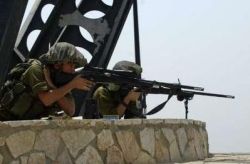
Israeli soldiers hold weapons at a look out point in Kibbutz Misgav Am near the border with Lebanon August 3, 2010. Israeli and Lebanese troops fought a rare cross-border skirmish on Tuesday that killed four Lebanese and an Israeli officer in the most serious violence along the frontier since a 2006 war. REUTERS/Hamad Almakt
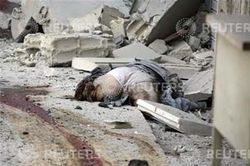
The body of Assaf Abu Rahhal, a reporter and photographer, and correspondent for al-Akhbar newspaper, is seen after he was killed during clashes between Lebanese and Israeli soldiers at Adaisseh village, southern Lebanon August 3, 2010. Israeli and Lebanese troops fought a rare cross-border skirmish on Tuesday that killed four Lebanese and an Israeli officer in the most serious violence along the frontier since a 2006 war. Reuters/Ali Hashisho
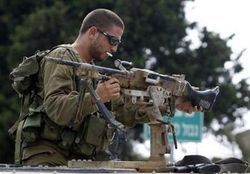
An Israeli soldier holds a machine gun atop an armoured jeep near the border with Lebanon August 3, 2010. Israeli and Lebanese troops fought a rare cross-border skirmish on Tuesday that killed four Lebanese and an Israeli officer in the most serious violence along the frontier since a 2006 war. Reuters/Baz Ratner
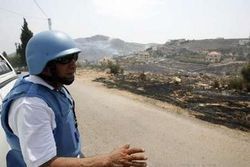
An United Nations Interim Force in Lebanon (UNIFIL) employee walks past a burnt field after clashes between Lebanese and Israeli soldiers at Adaisseh village, southern Lebanon August 3, 2010. Israeli and Lebanese troops fought a rare cross-border skirmish on Tuesday that killed four Lebanese and an Israeli officer in the most serious violence along the frontier since a 2006 war. REUTERS/Ali Hashisho
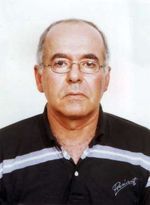
Assaf Abu Rahhal, a reporter and photographer, and correspondent for al-Akhbar newspaper, who died during clashes between Lebanese and Israeli soldiers at Adaisseh village, southern Lebanon is seen in this undated handout obtained August 3, 2010. Rahhal was one of four Lebanese killed in a rare cross-border skirmish on Tuesday between Israeli and Lebanese troops. An Israeli officer was also killed in the most serious violence along the frontier since a 2006 war. REUTERS/ Handout
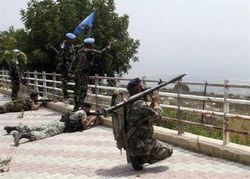
Lebanese soldiers take up position as U.N peacekeepers (in blue berets) gesture towards Israeli soldiers at the Lebanese-Israeli border in Adaisseh village, southern Lebanon August 3, 2010. REUTERS/ STR
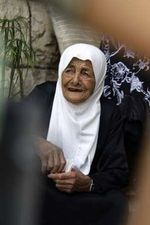
Zahiya Hamoushi, a villager, reacts during clashes between Lebanese and Israeli soldiers at Adaisseh village, southern Lebanon August 3, 2010. Israeli and Lebanese troops fought a rare cross-border skirmish on Tuesday that killed four Lebanese and an Israeli officer in the most serious violence along the frontier since a 2006 war. REUTERS/Ali Hashisho
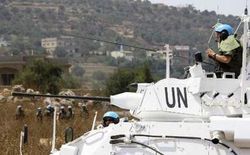
U.N peacekeepers in armoured vehicles inspect the area where clashes between Lebanese and Israeli soldiers took place at Adaisseh village, southern Lebanon August 3, 2010. Israeli and Lebanese troops fought a rare cross-border skirmish on Tuesday that killed four Lebanese and an Israeli officer in the most serious violence along the frontier since a 2006 war. Reuters/Ali Hashisho
Remains of a dead Lebanese soldier are seen scattered on a street at a checkpoint for the Lebanese army at Adaisseh village, southern Lebanon August 3, 2010. Israeli and Lebanese troops fought a rare cross-border skirmish on Tuesday that killed four Lebanese and an Israeli officer in the most serious violence along the frontier since a 2006 war. REUTERS/Ali Hashisho
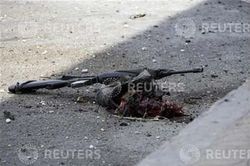
A rifle lies on the boot and part of a dead Lebanese soldier's leg at Adaisseh village, southern Lebanon August 3, 2010. An Israeli helicopter on Tuesday fired two missiles at a Lebanese army post near the southern border village of Adaisseh, destroying an armoured personnel carrier, a security source said. A Lebanese journalist and three Lebanese soldiers died after the Israeli and Lebanese armies exchanged fire in the border area, a security source said. REUTERS/Ali Hashisho
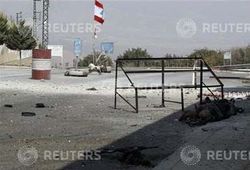
A dead Lebanese soldier lies on a street at Adaisseh village, southern Lebanon August 3, 2010. An Israeli helicopter on Tuesday fired two missiles at a Lebanese army post near the southern border village of Adaisseh, destroying an armoured personnel carrier, a security source said. A Lebanese journalist and three Lebanese soldiers died after the Israeli and Lebanese armies exchanged fire in the border area, a security source said.REUTERS/Ali Hashisho
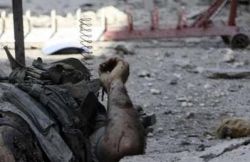
A dead Lebanese soldier lies on a street at Adaisseh village, southern Lebanon August 3, 2010. An Israeli helicopter on Tuesday fired two missiles at a Lebanese army post near the southern border village of Adaisseh, destroying an armoured personnel carrier, a security source said. A Lebanese journalist and three Lebanese soldiers died after the Israeli and Lebanese armies exchanged fire in the border area, a security source said. REUTERS/ Ali Hashisho
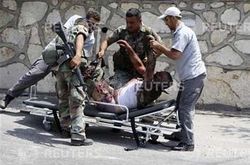
Lebanese medics and soldiers lift a Lebanese soldier wounded by an Israeli tank, onto a stretcher at Adaisseh village, village southern Lebanon August 3, 2010. An Israeli helicopter on Tuesday fired two missiles at a Lebanese army post near the southern border village of Adaisseh, destroying an armoured personnel carrier, a security source said. A Lebanese journalist and three Lebanese soldiers died after the Israeli and Lebanese armies exchanged fire in the border area, a security source said. REUTERS/Ali Hashisho
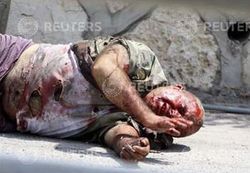
A Lebanese soldier wounded by an Israeli tank, lies on a street at Adaisseh village, southern Lebanon August 3, 2010. An Israeli helicopter on Tuesday fired two missiles at a Lebanese army post near the southern border village of Adaisseh, destroying an armoured personnel carrier, a security source said. A Lebanese journalist and three Lebanese soldiers died after the Israeli and Lebanese armies exchanged fire in the border area, a security source said. Reuters/Ali Hashisho
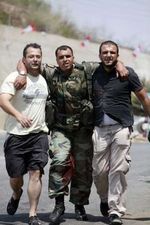
Civilians help a wounded Lebanese soldier at Adaisseh village, southern Lebanon August 3, 2010. An Israeli helicopter on Tuesday fired two missiles at a Lebanese army post near the southern border village of Adaisseh, destroying an armoured personnel carrier, a security source said. A Lebanese journalist and three Lebanese soldiers died after the Israeli and Lebanese armies exchanged fire in the border area, a security source said. Reuters/Kamel Jaber
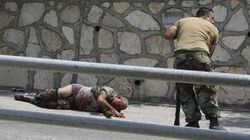
A Lebanese soldier helps a wounded soldier at Adaisseh village, southern Lebanon August 3, 2010. An Israeli helicopter on Tuesday fired two missiles ata Lebanese army post near the southern border village of Adaisseh, destroying an armoured personnel carrier, a security source said. A Lebanese journalist and three Lebanese soldiers died after the Israeli and Lebanese armies exchanged fire in the border area, a security source said. REUTERS/Ali Hashisho
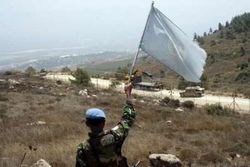
An U.N. peacekeeper waves a United Nations Interim Force in Lebanon (UNIFIL) flag at Israeli soldiers on the Lebanese-Israeli border at Adaisseh village,southern Lebanon August 3, 2010. An Israeli helicopter on Tuesday fired two missiles at a Lebanese army post near the southern border village of Adaisseh, destroying an armoured personnel carrier, a security source said. A Lebanese journalist and three Lebanese soldiers died after the Israeli and Lebanese armies exchanged fire in the border area, a security source said. REUTERS/STR
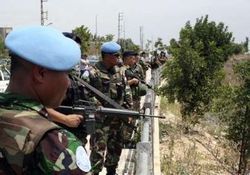
Lebanese soldiers and U.N. peacekeepers (L and 3rd L) stand at the Lebanese-Israeli border in Adaisseh village, southern Lebanon August 3, 2010. An Israelihelicopter on Tuesday fired two missiles at a Lebanese army post near the southern border village of Adaisseh, destroying an armoured personnel carrier, a security source said. A Lebanese journalist and three Lebanese soldiers died after the Israeli and Lebanese armies exchanged fire in the border area, a security source said. REUTERS/STR
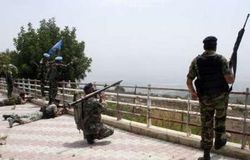
Lebanese soldiers take up position as U.N peacekeepers (in blue berets) gesture towards Israeli soldiers at the Lebanese-Israeli border in Adaisseh village,southern Lebanon August 3, 2010. An Israeli helicopter on Tuesday fired two missiles at a Lebanese army post near the southern border village of Adaisseh, destroying an armoured personnel carrier, a security source said. A Lebanese journalist and three Lebanese soldiers died after the Israeli and Lebanese armies exchanged fire in the border area, a security source said. REUTERS/STR
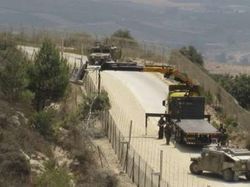
An Israeli soldier is seen on a crane on the Lebanese side of the Lebanese-Israeli border near Adaisseh village, southern Lebanon August 3, 2010. Israeliartillery shelled the Lebanese village on Tuesday, wounding two people, after Lebanese Army troops fired warning shots at Israeli soldiers along the usually quiet but tense frontier, witnesses said. REUTERS/STR
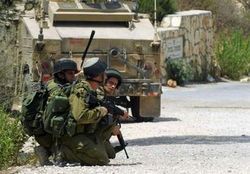
Israeli soldiers take up position near the border with Lebanon August 3, 2010. Israeli artillery shelled a Lebanese village on Tuesday, wounding two people,after Lebanese Army troops fired warning shots at Israeli soldiers along the usually quiet but tense frontier, witnesses said. REUTERS/Hamad Almakt
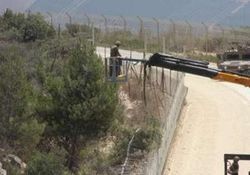
An Israeli soldier is seen on a crane on the Lebanese side on the Lebanese-Israeli borders near Adaisseh village, southern Lebanon, August 3, 2010. Israeli artillery shelled a Lebanese village Tuesday, wounding two people, after Lebanese Army troops fired warning shots at Israeli soldiers along the usually quiet but tense frontier, witnesses said. REUTERS/Stringer
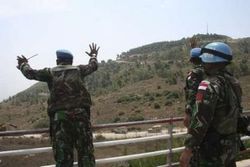
U.N. peacekeepers gesture and shout at Israeli soldiers on the Lebanese-Israeli borders near Adaisseh village, southern Lebanon, August 3, 2010. Israeli artillery shelled a Lebanese village Tuesday, wounding two people, after Lebanese Army troops fired warning shots at Israeli soldiers along the usually quiet but tense frontier, witnesses said. REUTERS/STR
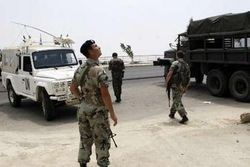
Lebanese soldiers and U.N peacekeepers patrol the area near Adaisseh village, southern Lebanon August 3, 2010. Israeli artillery shelled the Lebanese village Tuesday, wounding two people, after Lebanese Army troops fired warning shots at Israeli soldiers along the usually quiet but tense frontier, witnesses said. REUTERS/ Karmallah Daher
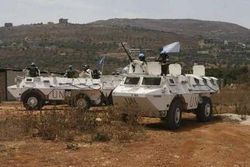
U.N peacekeepers on their armoured vehicles patrol Adaisseh village, southern Lebanon August 3, 2010. Israeli artillery shelled the Lebanese village onTuesday, wounding two people, after Lebanese Army troops fired warning shots at Israeli soldiers along the usually quiet but tense frontier, witnesses said. REUTERS/ Karamallah Daher
Troubling Questions
The pattern we see in these 25 images raises serious questions about Reuters.
1. How were five photographers encouraged to cover routine IDF maintenance work — which is simply non-news? Who tipped them off, and why?
2. How did Reuters photographers get such wide, unrestricted access to the combat zone?
3. Who are the unidentified stringers? Do they, or any of the five identified photographers, have any conflicts of interest requiring disclosure, in the interests of ethical journalism? Why did Reuters break with journalistic norms and not credit seven images with the photographer's name?
4. Is it fair to say that the Lebanese source who tipped off journalists to be in the Adaisseh area of the border bears responibility for the death of Assaf Abu Rahhal?
5. Did any higher ups in the Reuters chain of command raise any questions?