Key Takeaways:
- The Houthis can now more directly threaten shipping through Bab al-Mandeb.
- Their gains further isolate Eilat and raise Israel’s security and trade costs.
- Red Sea disruption threatens Saudi oil exports, Egyptian revenue, and regional stability.
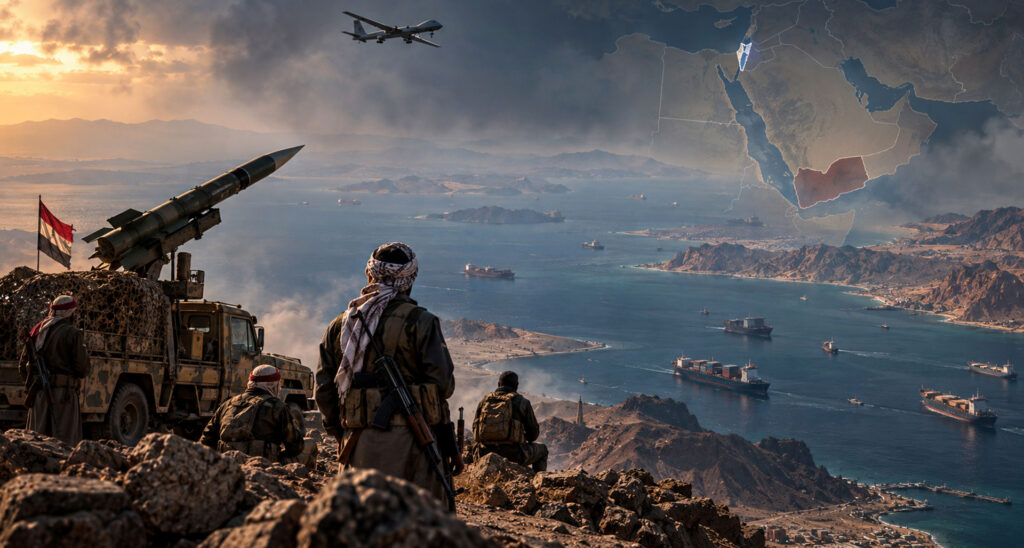
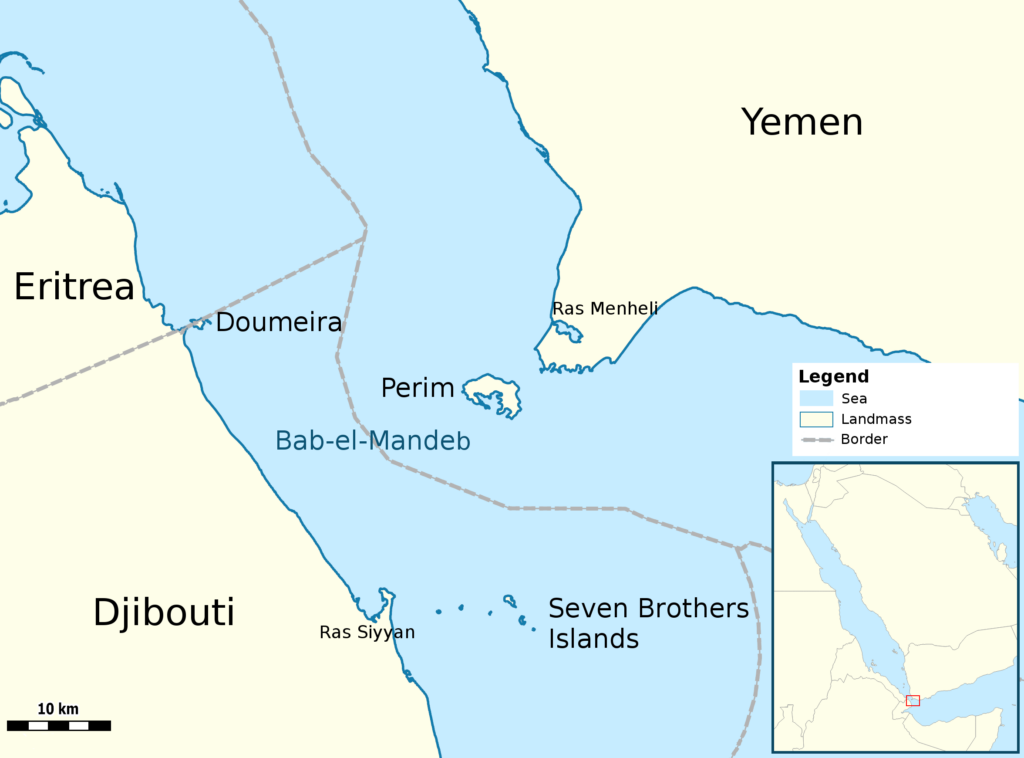
On September 10, the Iran-backed Houthis seized Mocha, a Yemeni port city on the country’s southwestern Red Sea coast. They later captured Dhubab, a coastal town farther south, and Perim, also known as Mayyun Island, which lies in the Bab al-Mandeb Strait. The Houthis then occupied Yemen’s Greater and Lesser Hanish Islands farther north in the Red Sea.
These locations sit along Yemen’s southwestern coast and the southern Red Sea, where the waterway narrows into the Bab al-Mandeb Strait before opening into the Gulf of Aden and the Indian Ocean. Perim lies inside the strait, while Dhubab faces it from the Yemeni mainland. From these positions, the Houthis can monitor passing ships more closely and threaten them at shorter range with artillery, missiles, drones, or fast boats.
Yemen’s Civil War and the Renewed Offensive
The fighting marks a new phase of Yemen’s civil war, which began in 2014 after the Houthis took the capital, Sanaa, and forced the internationally recognized government into exile. A Saudi-led coalition intervened in March 2015 to support that government. A United Nations panel later reported that Iran, Iraqi armed groups, and Hezbollah had provided the Houthis with technical assistance, training, weapons, and financial support.
A United Nations-brokered truce reduced large-scale fighting after April 2022, but it expired six months later without producing a permanent peace agreement. In early September 2026, the Houthis launched a major offensive through western Taiz and southern Hodeidah toward Mocha and Bab al-Mandeb.
The offensive pits the Houthis against troops loyal to Yemen’s recognized government and a fragmented collection of local armed groups. The anti-Houthi camp includes factions with different political goals that previously received support from Saudi Arabia or the United Arab Emirates. Saudi Arabia backs the recognized government and has conducted airstrikes against Houthi targets. Israel and the United States are not leading the ground battle, but both have struck Houthi targets in response to missile, drone, and shipping attacks.
Battlefield Footage and Uncorroborated Claims
Both sides have released footage that they say depicts the fighting. Yemen’s armed forces media center published footage on September 15 that it said showed airstrikes on Houthi supply lines and positions in Mocha and Dhubab.
On the same day, Houthi military media published footage that it said showed strikes on forces it described as Saudi and the destruction of vehicles in eastern al-Jawf Governorate. Neither video independently establishes the full circumstances surrounding the attacks.
Claims that Syrian fighters joined the battle against the Houthis also circulated online. Syrian fact-checkers found that the main photograph used to support one allegation was AI-generated and did not show an actual deployment to Yemen. However, this only proves the photo was fake, not that Syrian fighters are absent from the conflict.
Separately, Al-Akhbar, a Lebanese news outlet with ties to Hezbollah, reported that Saudi Arabia has been training Syrian fighters and sending them to fight in Yemen. Neither Saudi Arabia nor Syria has confirmed this. Since the claim originates from a single outlet with an axe to grind against the Saudis, the report should be treated with skepticism.
What the Houthi Advance Means for Israel
The Houthis’ territorial gains make Israel’s southern sea route more difficult to use. Houthi attacks had already reduced activity at Eilat, Israel’s only Red Sea port, by approximately 90 percent. With the Houthis positioned closer to the strait, Israel-linked ships face a more immediate threat as they approach the Red Sea.
Cargo from Asia can still travel around southern Africa and enter Israel through the Mediterranean ports of Haifa or Ashdod. However, the diversion increased the shipping distance between China and Israel by about 114 percent. Longer voyages also require more fuel and ship capacity and can raise freight and insurance costs.
The Bank of Israel nevertheless found that the earlier disruption did not significantly reduce Israeli imports from Asia or raise import prices during the first half of 2024. That experience shows that Israel can adjust its supply routes. However, a prolonged disruption could cause greater economic damage, particularly if fighting around the Strait of Hormuz continues and energy prices remain elevated.
The Wider Regional and Economic Impact
Saudi Arabia’s East-West Pipeline normally carries crude oil from the kingdom’s eastern fields to the Red Sea port of Yanbu, allowing exports to avoid the Strait of Hormuz. However, Saudi Arabia shut the pipeline after multiple attacks on September 10, and officials expect it to remain mostly out of service for weeks while repairs continue.
Even after operations resume, tankers carrying oil from Yanbu to Asian markets must cross Bab al-Mandeb. The pipeline shutdown and the Houthi threat to Red Sea shipping therefore place pressure on two parts of Saudi Arabia’s alternative export route, increasing the risk of supply disruptions and higher oil prices.
Egypt also suffers when shipping companies avoid the Red Sea because fewer vessels continue north through the Suez Canal. Red Sea disruption reduced Egypt’s Suez Canal receipts by approximately $6 billion in 2024 compared with 2023.
The disruption has also reduced cargo traffic through Jordan’s Port of Aqaba. The International Monetary Fund estimated that approximately 30 percent of Jordan’s imports and 20 percent of its exports may require direct passage through Bab al-Mandeb. Other countries bordering the Red Sea face similar pressure on ports, trade, and imported goods.
Longer voyages around Africa increase shipping costs, delivery times, fuel consumption, and emissions. The renewed fighting has also displaced more than 85,000 people in Yemen. Damage to roads and the port of Mocha has obstructed humanitarian operations and left emergency supplies stuck in Aden.
Control Through Threat and Disruption
The Houthis do not control Bab al-Mandeb uncontested. They hold key positions on the Yemeni side and on islands inside or near the strait, but they do not control the African coast. Commercial vessels also continue to cross, although traffic has fallen sharply.
The Houthis do not need to close the strait completely to gain leverage. They only need to make the route dangerous enough that shipping companies avoid it or demand higher insurance premiums. Their advance therefore increases pressure on Israel, Saudi Arabia, Egypt, and international trade while raising the risk of a broader regional war. As long as shipping companies consider the passage dangerous, Bab al-Mandeb will remain both a military front and a source of worldwide economic pressure.
Liked this article? Follow HonestReporting on Twitter, Facebook, Instagram and TikTok to see even more posts and videos debunking news bias and smears, as well as other content explaining what’s really going on in Israel and the region. Get updates direct to your phone. Join our WhatsApp and Telegram channels!
© Divuach Ne’eman R”A, 2025