


Key Takeaways:
-
Tone Shapes Memory: The Washington Post highlighted Khamenei’s “bushy white beard and easy smile,” softening the reality of his record.
-
Euphemism Masks Brutality: The New York Times described him as a “hardline cleric,” language that obscures decades of repression and bloodshed.
-
Headlines Matter: From Sky News to Reuters and the BBC, framing choices shape public memory. When brutality is downplayed, history is distorted.
Ayatollah Ali Khamenei was only the second Supreme Leader of the Islamic Republic of Iran. He assumed power in 1989 following the death of Ayatollah Ruhollah Khomeini and ruled for decades as the ultimate authority over a regime defined by repression, regional destabilization, and violent ideological extremism.
His tenure was marked by:
- The systematic crushing of political dissent
- The imprisonment, torture, and execution of dissidents
- The violent suppression of nationwide protest movements
- The arming and financing of proxy militias across the Middle East
- The institutionalization of chants of “Death to America” and repeated threats to destroy Israel
While Israel is under missile attack, Tehran is deciding who commands the war.
Khamenei is gone.
Iran has activated Article 111.
What happens next will determine how this war unfolds – and how far it spreads.
Article 111 of the Iranian constitution is the emergency succession… pic.twitter.com/v050rHZFsE
— HonestReporting (@HonestReporting) March 1, 2026
Under his leadership, Iran’s security forces opened fire on protesters during successive waves of unrest in 2009, 2019, and during the nationwide demonstrations that followed the death of Mahsa Amini in 2022. In January of this year, fresh nationwide protests were again met with force. Independent analysts estimate that at least 30,000 people were killed in the crackdown, a figure the regime has never credibly refuted. Across these cycles of repression, human rights organizations have documented thousands more deaths and tens of thousands detained.
Yet when Iranian state media confirmed Khamenei’s death nearly 24 hours after U.S. and Israeli airstrikes struck his compound in Tehran, segments of Western media coverage adopted a tone that bordered on reverential.
If this doesn’t make you angry, it should.
LEFT: The New York Times calls a man who led a regime responsible for mass murder, repression and “Death to America” chants a “hard-line cleric.”
RIGHT: The Washington Post gushes over his “bushy white beard and easy smile.” pic.twitter.com/ZMsldPImou
— HonestReporting (@HonestReporting) March 1, 2026
The most notable example appeared in The Washington Post, which described Khamenei as known for his “bushy white beard and easy smile,” noting that he cut a “more avuncular figure in public” than his predecessor. The obituary highlighted his fondness for Persian poetry and classic Western novels, including Victor Hugo’s Les Misérables.
The New York Times summarized him as a “hardline cleric” who had made “Iran a regional power” while maintaining hostility toward the United States and Israel.
Emotive coverage of fake tears in Tehran for the Ayatollah.
Clinical damage reporting when Iranian missiles hit the region.
Same @BBCWorld. Different framing. https://t.co/5PRLyAcwJu pic.twitter.com/hMdTHurnw7
— HonestReporting (@HonestReporting) March 1, 2026
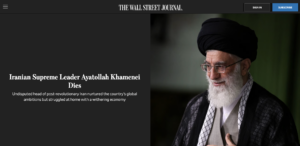
Sky News labeled him the “arch foe” of President Donald Trump, framing the moment as a personal rivalry. The Wall Street Journal observed that he “nurtured the country’s global ambitions but struggled at home with a withering economy.” Reuters referred to his “fiery ambitions” toward Israel and the United States. The BBC aired images of mourners drawn from regime-controlled broadcasts with little scrutiny of their staging.
“Fiery hostility.”
That’s what you call turning his country into the world’s biggest exporter of terror and working towards the destruction of the Jewish state, @Reuters?
Oh, and Khamenei didn’t simply die. Credit where credit’s due. pic.twitter.com/uTYYcLHOJ6
— HonestReporting (@HonestReporting) March 1, 2026
Across outlets, the pattern was consistent.
The man who presided over decades of repression was reframed through aesthetic detail and political positioning. His beard. His smile. His literary tastes. His “ambitions.”
His victims were secondary.
This is not about demanding polemics from obituary writers. It is about proportion.
When authoritarian rulers die, the moral weight of their record should not be softened by lifestyle detail or neutralized by euphemism. Calling a regime ideologue a “hardliner” obscures the reality that he headed a theocratic state apparatus that jailed journalists, executed political prisoners, funded Hezbollah and Hamas, and ordered violent crackdowns against his own people.
Headlines shape historical memory. The first paragraph matters more than the twelfth. In death, reputations are distilled and authoritarian rulers should not be granted the luxury of dilution.
So while newspapers fawned over what they chose to highlight, from his wry smile to his love of literature and carefully cultivated image, the rest of us should remember him for what he was: a brutal dictator who deserved the fiery end he met.
Liked this article? Follow HonestReporting on Twitter, Facebook, Instagram and TikTok to see even more posts and videos debunking news bias and smears, as well as other content explaining what’s really going on in Israel and the region. Get updates direct to your phone. Join our WhatsApp and Telegram channels!