UPDATE
Since this post was published, HonestReporting has been accused on social media of making this issue solely about Nada Homsi’s Palestinian ethnicity or heritage and making the claim that our critique is the equivalent of assuming that Jewish journalists should not be allowed to report on Israel, Americans on America, etc.
We wish to clarify that HonestReporting has never critiqued any journalists on the basis of their ethnic or religious background. In this particular case, we wish to restate that this issue is about Homsi’s inability to report fairly and with context on the so-called Palestinian right of return due to her direct family ties to the issue.
Homsi has since proved our point in her Twitter feed:
Thx 4 engaging in the real issue, which is yr inability 2 write without letting personal politics interfere. Res194 doesn’t enshrine right of return. That was Arab reinterpretation of resolution they originally rejected. Also, GA isn’t authorized 2 adopt binding resolutions.
— HonestReporting (@HonestReporting) December 19, 2017
To clarify: we expect all journalists, irrespective of their religion, ethnicity or background, to report professionally. We stand by our assertion that Nada Homsi is free to report on anything she likes, including Palestinian affairs in the same way that Jewish / Israeli journalists should be free to report on Israel. Homsi’s story and Twitter feed, however, demonstrate political bias that the New York Times should have taken into account.
(You can read more here about the legal issues surrounding the Palestinian “right of return.”)
A sympathetic New York Times feature story on Palestinian refugees in Lebanon treats the so-called Palestinian “right of return” as a fact that should naturally be implemented.
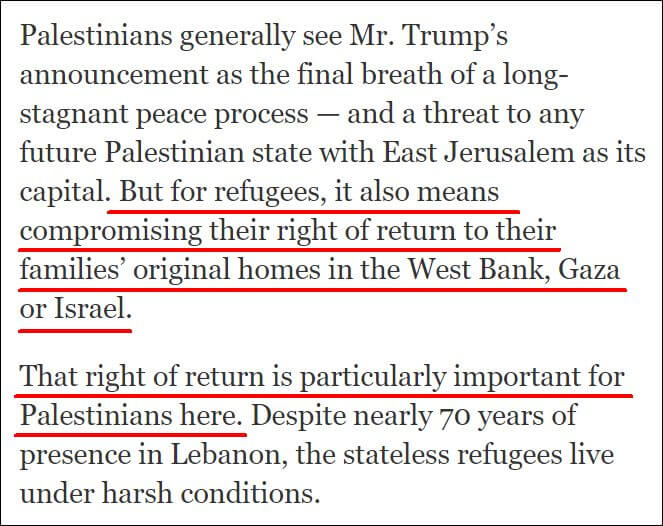
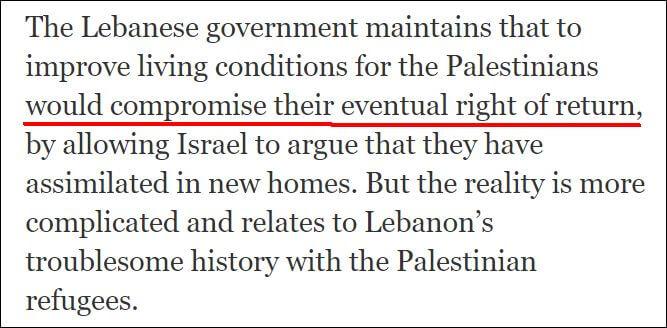
The right of return is an issue where a relative consensus exists. Even the Palestinian leadership, while paying lip-service to the concept, understands that flooding Israel with millions of Palestinian refugees from 1948, 1967 and all of their descendants simply isn’t going to happen.
Put simply, Israel isn’t going to nor does the international community expect it to commit demographic suicide.
But none of the background information pertaining to the right of return appears in the story.
[elementor-template id="323780"]Just another biased anti-Israel story in the New York Times or is there something else?
Why would a New York Times article treat the right of return as an inherent right rather than a Palestinian negotiating position? It might have something to do with the journalist responsible for the story, Beirut-based Nada Homsi.
This tweet from her Twitter account published May 15, the Gregorian date of Israeli independence in 1948 and the day Palestinians describe as Nakba Day, reveals a huge amount:
Sixty-nine years ago, my grandparents left behind everything they knew in Saffourieh, Palestine, thinking they would return in a few days.
— Nada Homsi (@no_homsi) May 15, 2017
What the New York Times hasn’t disclosed, in a shocking lack of transparency, is that Homsi, even if she may not hold UN-defined Palestinian refugee status, is at the very least, the direct descendant of Palestinian refugees from 1948.
Homsi can hardly be blamed for being biased towards the political positions of her Palestinian interviewees in Lebanon and her background may very well be an asset for the New York Times when covering the Arab world.
The New York Times, however, should be held responsible for allowing a journalist with a clear conflict of interest to report on a sensitive topic without offering full disclosure.
HR Managing Editor Simon Plosker adds:
How can the New York Times commission the granddaughter of Palestinian refugees to write a story on Palestinian refugees? This is an appalling failure to disclose a clear conflict of interest and further demonstrates the New York Times’s inability or lack of interest in addressing its inherent anti-Israel bias.
Transparency is a vital component of professional journalism. On this point, the New York Times has completely failed.
You can send your complaints to the New York Times – [email protected] . We wish to stress that your complaints should address the journalistic failure of the New York Times and not the background of Nada Homsi.
© Divuach Ne’eman R”A, 2025