Key Takeaways:
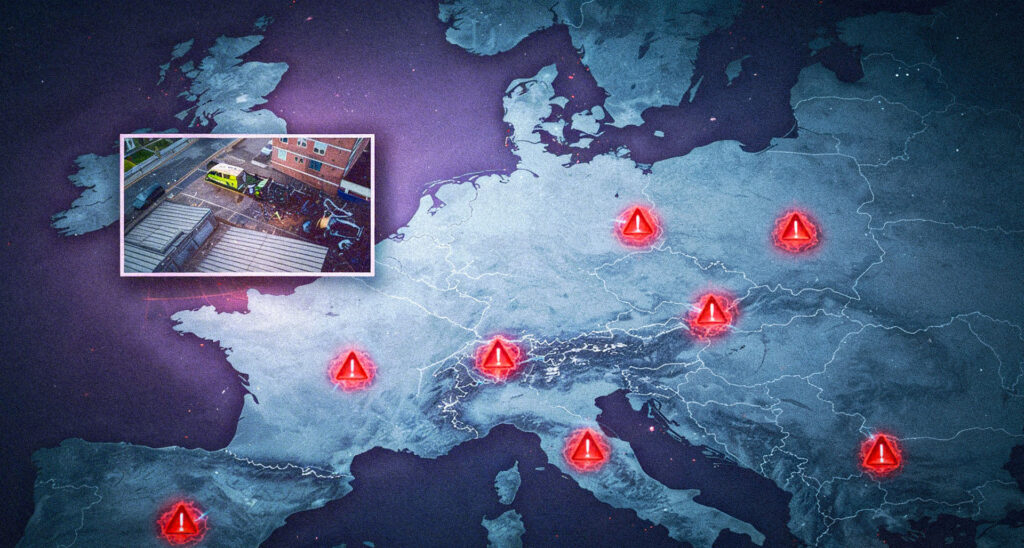
- A coordinated global network – not isolated attacks: The London ambulance bombing fits a broader pattern of Iranian regime-linked cells operating across Europe, showing these incidents are part of an organized network rather than lone acts.
- Terror as intimidation, not just mass casualty: These operations are designed to instill fear in Jewish communities and signal reach and capability, even when not immediately aimed at large-scale casualties.
- Failure to connect the dots: Authorities and media often treat attacks as standalone antisemitic incidents, downplaying or hesitating to attribute them to the Islamic Republic despite mounting evidence of state-linked activity.
The blasts that ripped apart four ambulances belonging to the Jewish emergency response charity Hatzola in Golders Green, North West London, in the early hours of Monday morning were deafening. They were powerful enough to shatter windows in nearby buildings, including a synagogue whose stained-glass panes were blown out, leaving smoke damage across the surrounding area and sending a clear and unmistakable message.
Three hooded suspects are now being pursued in connection with the attack. This was not designed to be a mass-casualty event, at least not at this stage. Rather, it appears to have been calculated to instill fear, a demonstration that Jewish communities in the West can be reached, targeted, terrorized, and even murdered at will.
The group that claimed responsibility, the Islamic Movement of the People of the Right Hand, is not an isolated actor. It has already been linked to similar attacks across Europe, including a synagogue bombing in Belgium on March 9, and forms part of a wider network of Iranian regime-aligned operatives that Western authorities have been warned about for years – warnings were rarely treated with the urgency they demanded.
Even now, British authorities appear poised to treat this as an isolated antisemitic incident. Despite the group claiming responsibility, police statements suggested the attack could not yet be definitively attributed to the Iranian regime. Speaking on Monday at the annual dinner of the Community Security Trust (CST), which monitors antisemitism in the UK, Sir Mark Rowley acknowledged that the “rapid growth in recent years of Iranian state threats is grave,” but added that it was “too early” to link this attack to the state itself.
Four ambulances were set on fire outside a synagogue in a Jewish neighborhood in London. An IRGC-aligned group claimed responsibility.
Yet almost immediately, conspiracies online blamed the Jews.? pic.twitter.com/e9JnbZ8Xmg
— HonestReporting (@HonestReporting) March 23, 2026
The result is familiar: an immediate narrowing of focus and a readiness to move on without confronting the broader pattern into which this attack clearly fits.
Since the start of the U.S.-Israeli war against Iran, that threat has come into sharper focus. Attacks targeting Jewish communities have increased across Europe and the United States. Not all can be definitively traced back to Tehran, but enough bear its hallmarks to make continued denial increasingly difficult.
Within hours of the strikes that killed Ayatollah Ali Khamenei, a new shortwave radio signal began broadcasting across the globe. Twice daily, at precise intervals, a distorted male voice opens with a single word in Persian, “Tavajjoh” (“attention”), before reciting strings of numbers that, so far, have resisted attempts at decoding.
The signal bears the characteristics of a Cold War-era “numbers station,” historically used by intelligence agencies to transmit encrypted instructions to operatives in the field. It has also shown signs of interference, including jamming attempts and frequency shifts, suggesting it forms part of an ongoing intelligence contest rather than a random occurrence.
Initial speculation focused on Iran, with the possibility that the regime was attempting to communicate with assets abroad. More recent analysis, however, points in a less straightforward direction, indicating that the transmission may originate from a U.S.-linked military site in Europe, although no authority has confirmed who is behind it or who the intended recipients may be.
That uncertainty is compounded by the fact that U.S. federal authorities warned local law enforcement that the signal could serve as an “operational trigger” for sleeper agents. If the transmission does originate from a U.S.-linked source, that warning becomes difficult to reconcile, raising the obvious question of why authorities would frame it as a potential threat if it were part of their own operations.
This does not diminish the threat posed by Iranian-linked networks operating in the West. If anything, it points to a more complex and troubling picture, in which visible acts of violence and intimidation unfold alongside a largely unseen layer of intelligence activity.
The attacks are not random, but the full structure behind them is not yet visible.
So why has it taken a war with Iran for the media, and in many cases authorities, to begin acknowledging a threat that has been documented, warned about, and consistently downplayed for years?
Over the last few weeks, headlines have begun warning of the “possibility” of Iranian terror cells operating in both the United States and Europe.
On March 9, ABC News, referencing the Persian-language transmission, ran the headline: “Iran may be activating sleeper cells outside the country, alert says.”
On March 13, the New York Post reported: “Iranian attack on US soil likely with ‘thousands’ of vengeful sleeper cells in country: ‘Not a matter of if but when’.”
A day later, a New York Times headline read: “‘Sleeper Cells’ and Lone Attackers: Security Experts Brace for More Violence at Home.”
What is largely absent from these reports is any acknowledgment that such networks were operating long before the current war against the Iranian regime.
The record is long and well-documented for those willing to examine it. Indeed, the clearest illustration of the regime’s activity on Western soil is the Assadi affair, which saw Iranian diplomat Assadollah Assadi become the first Iranian official since the 1979 revolution to be tried and jailed for terrorist acts.
Based in Vienna, Assadi used his diplomatic position to smuggle a triacetone triperoxide (TATP) bomb from Tehran in a diplomatic pouch. He then passed it to a Belgian-Iranian couple with instructions to bomb a rally held by the National Council of Resistance of Iran near Paris in June 2018. The event drew around 25,000 attendees, including British and American political figures, but the plot was ultimately foiled by a coordinated, multi-country counterterrorism operation.
The Belgian prosecution was clear after the verdict, stating that the case demonstrated “the responsibility of the Iranian state in what could have been carnage.” And yet the European Union stopped short of drawing that conclusion, framing the attempted attack as the action of an individual rather than state-sponsored terrorism, while Assadi himself was released from prison just two years later as part of a prisoner exchange for a Belgian aid worker detained in Iran.
The Assadi case was not an aberration. It was one manifestation of a broader strategy.
British-Indian author Salman Rushdie’s case illustrates another high-profile example of the regime’s method. In 1989, Ayatollah Ruhollah Khomeini issued a fatwa, a religious decree, calling for Rushdie’s death over The Satanic Verses. In 1998, the Iranian government under President Mohammad Khatami publicly distanced itself from the decree, helping create the impression that the threat had passed.
The fatwa was never meaningfully withdrawn, and Ali Khamenei later described it as “solid and irrevocable.” When Rushdie was nearly killed in a brutal knife attack in New York in 2022, leaving him blinded in one eye, Iranian officials denied involvement even as hardline newspapers praised his attacker.
This is not distance from violence. It is the regime’s preferred model: maintain the incitement, deny operational responsibility, and allow others to carry out the act.
This approach has increasingly been paired with the use of proxies.
Following the foiled 2018 Assadi plot, Iranian operational arms, particularly the IRGC and the Ministry of Intelligence, increasingly relied on criminal networks to carry out attacks abroad, allowing Tehran to maintain distance from its activities.
In Germany, a member of the Hells Angels threw a Molotov cocktail at a synagogue in Bochum in 2022 on behalf of the IRGC. In 2024, French authorities charged two suspects linked to an Iranian-directed plot targeting Israelis and Jews across Paris, Munich, and Berlin.
In the United States, Iranian intelligence operative Alireza Shavaroghi Farahani ran a network that used an Iranian-American in California and unwitting private investigators to gather intelligence on Iranian-American activist Masih Alinejad as part of a plot to kidnap her and transport her from New York to Venezuela, and ultimately to Iran.
In 2022 and 2023, multiple plots targeting former U.S. officials, including John Bolton and Mike Pompeo, were foiled, with links traced back to the regime. In the United Kingdom, MI5 stated that in 2025 alone, it had disrupted more than 20 Iranian-linked plots.
None of this was hidden. It was documented, published, and available to any journalist or policymaker. The question is not whether the threat existed before the current war, but why so few in positions of authority chose to treat it as such.
What emerges from this record is not ambiguity, but a pattern, one that Western governments have repeatedly chosen not to confront in full.
Time and again, plots were foiled, operatives identified, and links to Tehran exposed. Yet rather than drawing the obvious conclusion, that the Iranian regime was systematically cultivating a network capable of carrying out attacks on Western soil, each case was treated as discrete and containable.
Even when the evidence pointed clearly to state involvement, the response was to narrow the frame, prosecute individuals, disrupt cells, and avoid the broader implications. The Assadi case, despite its significance, is perhaps the clearest example. It was acknowledged, but not acted upon in a way that reflected what it revealed about the regime itself.
As a result, the infrastructure was allowed to persist. Networks were not dismantled so much as managed. The regime’s presence in Western countries, diplomatic, operational, and logistical, remained largely intact, even as it continued to direct, enable or inspire acts of violence.
The media, too, played a role in this failure. Only now, amid open conflict between Iran, the United States and Israel, have headlines begun to speak in urgent terms about sleeper cells and looming attacks. The implication is that this threat has emerged suddenly as a consequence of war.
What we are witnessing now is not the creation of a new threat, but the exposure of an existing one. It has been documented in courtrooms, intelligence briefings, and scattered reporting for years, yet rarely presented as a coherent or systemic danger.
The attack in Golders Green was not the beginning of this story. It was entirely predictable.
But once again, there is a risk that it will be misunderstood, explained away as an isolated act of antisemitic violence rather than recognized as part of a deeper, organized threat.
The question is no longer whether the Iranian regime has built the capacity to project terror onto Western soil, but why it has been allowed to do so for so long, and whether those responsible for ignoring a clear and sustained pattern of regime-directed activity are prepared to confront that failure now.
Liked this article? Follow HonestReporting on Twitter, Facebook, Instagram and TikTok to see even more posts and videos debunking news bias and smears, as well as other content explaining what’s really going on in Israel and the region. Get updates direct to your phone. Join our WhatsApp and Telegram channels!
© Divuach Ne’eman R”A, 2025