Key Takeaways:
- The New York Times opinion piece alleging sexual abuse against Palestinian prisoners relied on sources with documented pro-terror sympathies and failed to disclose crucial background information that would have helped readers assess their credibility.
- Several of the article’s central allegations appear to have evolved significantly over time, with major inconsistencies left unexplained or unchallenged by the paper.
- The timing of the story’s publication immediately before a major report on Hamas’ October 7 sexual violence raises serious questions about narrative framing and editorial priorities.
The New York Times published an outrageous opinion column by Nicholas Kristof alleging widespread sexual abuse by Israel against Palestinian prisoners. Both the timing and the accusations are suspect and point to journalistic malpractice.
1/
The @nytimes just published one of the most serious sets of allegations imaginable against Israel – claims of systematic sexual violence, including a bizarre story about carrots and trained rape dogs. We checked the sources.What we found is journalistic malpractice. ? pic.twitter.com/vBbLy0Lp0J
— HonestReporting (@HonestReporting) May 11, 2026
A Source With Open Terrorist Sympathies
The piece relied heavily on allegations from unreliable sources, which remain disputed, or lacking corroborating evidence, while presenting Israel as uniquely abusive. At the same time, it downplayed the broader context of Hamas terrorism and the realities of wartime detention.
One of the central figures cited in the article is Sami al-Sai. Yet the Times failed to inform readers about al-Sai’s documented history of glorifying terrorists and celebrating armed attacks against Israelis.
4/
On 8 October 2023 – one day after the Hamas massacres – al‑Sai posted triumphantly about “the green flag” flying across the West Bank, “over the camps of the occupier and his tanks,” and “decorating the foreheads of the heroic fighters.”While Israelis were still counting… pic.twitter.com/2j3iAKluVD
— HonestReporting (@HonestReporting) May 11, 2026
For example, on March 23, 2023, al-Sai referred to Amir Abu Khadija as “our martyred prince.” Abu Khadija was not a civilian bystander. He was the founder and leader of the Tulkarm Battalion, a terrorist organization responsible for multiple deadly attacks.
Nor was this an isolated post.
In December 2023, just weeks before his arrest, al-Sai shared videos and photos celebrating armed terrorists in the Nur Shams camp. One post described the scene as the “Moons of
Nur Shams camp,” showing terrorists in tactical gear. Another celebrated captured Israeli military equipment.
The very next day, Israeli forces raided Nur Shams, killing five terrorists. Al-Sai had close access to the very gunmen Israel was targeting.
Yet none of this background appeared in the New York Times article.
Even more disturbingly, on October 8, 2023, one day after the Hamas massacre, al-Sai celebrated what he called “the green flag” flying over “the camps of the occupier and his tanks,” praising the “heroic fighters” operating under the Hamas banner.
While Israelis were still identifying the dead and searching for kidnapped relatives, the Times’ source was openly glorifying the perpetrators of the October 7 atrocities.
Readers were never told.
Testimony That Changed Over Time
The article also raises serious questions about the reliability and consistency of testimony presented as fact.
Al-Sai previously gave a detailed account of his detention to B’Tselem in early 2025, covering the period from February 2024 to June 2025. In that version, he alleged that guards pinned him down, inserted “something hard” into his anus multiple times, beat him, and poured liquid on him.
But in the New York Times version, the account suddenly becomes dramatically more elaborate and cinematic.
5/
Al‑Sai has given two versions of his abuse story.
In early 2025 he gave B’Tselem a detailed testimony about his detention (Feb 2024–Jun 2025):
– Three guards pinned him down and pushed “something hard” into his anus
– They repeated this six times
– Poured some kind of liquid… pic.twitter.com/rZuTWDab6s— HonestReporting (@HonestReporting) May 11, 2026
These are not minor additions.
They are highly specific, emotionally charged details that would ordinarily be central to any initial testimony about severe abuse. Yet they were absent from the earlier account.
The Times never addresses the discrepancies or explains why such vivid details emerged only later.
Another Key Claim That Shifted
The article also relies heavily on Hebron activist Issa Amro. But his account appears to have evolved as well.
In a February 2024 Washington Post interview, Amro said he was threatened with sexual assault during a 10-hour detention on October 7.
By the time of the New York Times article, however, he is presented as an established victim of sexual assault as part of a broader alleged pattern.
That is a major shift from a threat of assault to an asserted act of assault.
Yet the Times offers readers no clarification about what changed, when it changed, or why.
Did Amro provide new testimony? Did the paper independently verify new allegations? Were earlier reports incomplete?
Kristof never asks.
6/
The article also leans heavily on Hebron activist Issa Amro – but his story has also changed over time.Feb 2024 (Washington Post): Amro says he was threatened with sexual assault during a 10‑hour detention on Oct 7.
May 2026 (Kristof’s NYT piece): Amro is presented as an… pic.twitter.com/D1lVTRffHe
— HonestReporting (@HonestReporting) May 11, 2026
The “Evidence” Provided by a Hamas Front Organization
The article’s broader claims about an Israeli policy of sexual torture also lean heavily on Euro-Med Human Rights Monitor, presented to readers as though it were a neutral watchdog organization.
It is not.
Euro-Med’s leadership has documented links to Hamas and a long record of promoting inflammatory and unverified accusations against Israel.
? Thread exposing senior staff of @EuroMedHR, one of the main groups promoting antisemitic narratives and terrorist propaganda in the media since October 7th. Unsurprisingly, its team openly supports terror and has clear ties to Hamas. pic.twitter.com/qtch5NVpIo
— Eitan Fischberger (@EFischberger) January 22, 2024
In June 2024, the organization even pushed the grotesque claim that Israel “trains dogs to rape prisoners,” the same libel echoed in Kristof’s article.
There is no credible evidence whatsoever of any systematic program involving “trained rape dogs,” nor is the scenario remotely plausible as a repeatable, controlled military practice.
The claim that Israeli guards used trained dogs to rape Palestinian prisoners is being amplified everywhere.
The evidence? Two anonymous guards. No names. No dates. No video. No forensic evidence. No documentation.
Meanwhile, documented allegations of Hamas sexual violence,… pic.twitter.com/kY6e8JIFNA
— HonestReporting (@HonestReporting) May 2, 2026
Yet instead of interrogating these allegations, the New York Times effectively launders them into mainstream discourse by citing activist groups as authoritative sources.
This is not neutral fact-finding. It is advocacy journalism masquerading as investigative reporting.
Questionable “Experts”
The sourcing problems do not end there.
To substantiate one of the article’s most grotesque accusations, Kristof cites Shaiel Ben-Ephraim as an authority.
But Ben-Ephraim previously left UCLA after multiple sexual-harassment allegations involving inappropriate conduct toward minors. He later rebranded himself from failed academic to “geopolitical analyst” and “humanitarian activist,” while publicly pushing anti-Israel conspiracy theories online.
This is who the New York Times chose to rely on when attempting to validate some of the most incendiary allegations in the piece.
Again, readers were given none of this context.
After Hamas’s October 7 massacre, major media outlets – including The New York Times – faced criticism for being slow to fully report on and acknowledge evidence of sexual violence committed by Hamas terrorists against Israeli civilians.
Yet when accusations are leveled against Israel, that hesitation often disappears.
Why The Timing Matters
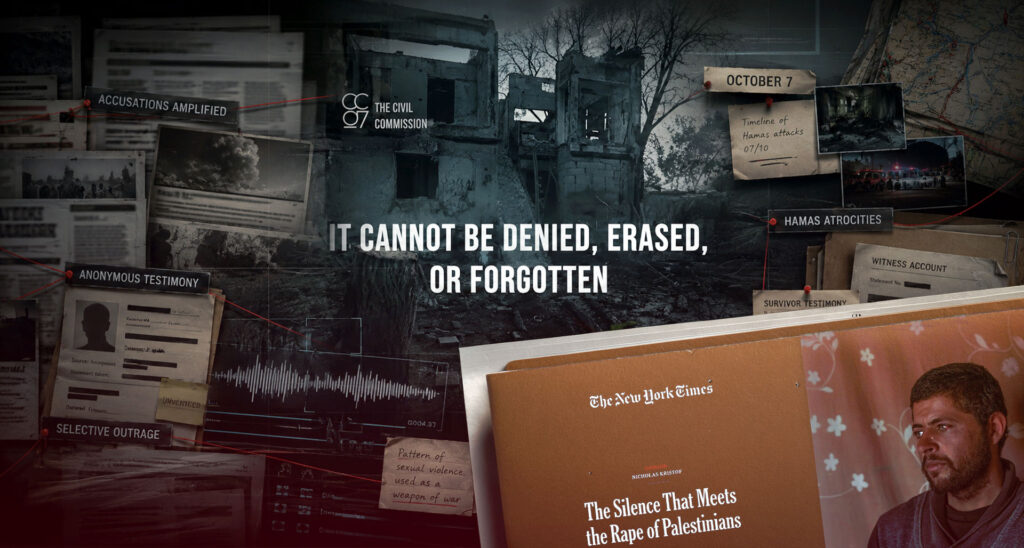
The publication of the story came immediately before the release of a major report detailing Hamas’ systematic sexual violence during the October 7 attacks.
There are those who have worked to deny or diminish the crimes of October 7, including the mass rapes that were committed.
Now, the full investigation, published today, into the horrors inflicted upon Israeli civilians by Hamas on Oct. 7, reveals a recurring pattern of:
✖️rape… https://t.co/20NX31jTqz pic.twitter.com/9OxYY1tqOz
— HonestReporting (@HonestReporting) May 12, 2026
That timing is difficult to ignore.
Kristof’s article portrayed Israelis as sexual abusers, creating a narrative environment designed to blunt the impact of renewed scrutiny on Hamas atrocities.
It now appears that the New York Times and Kristof knew in advance about the release of the Civil Commission’s report on sexual violence.
Instead of allowing attention to focus on documented crimes committed against Israelis, the Times shifted the conversation back toward alleged Israeli misconduct.
Now we know @nytimes & @NickKristof knew precisely the timing of the release of a new major report on Hamas’ sexual violence on 10/7. They declined to publish a story about it and then they preempted its release with the fake “dog rape” and Hamas front Euro-Med trash. Shameful. https://t.co/xo69RcKxzy
— Aizenberg (@Aizenberg55) May 12, 2026
When Israelis are victims, the evidence is interrogated endlessly. When Israel is accused, suspicion quickly becomes accepted truth.
And when a major report about Hamas atrocities threatens to dominate headlines, the New York Times accuses Israel of sexual abuse?
That is not coincidence. It is narrative framing.
The real story this week is not Israeli misconduct. It is the willingness of one of the world’s most influential newspapers to shape coverage in a way that once again redirects scrutiny away from Hamas and back onto Israel.
Narrative Activism
The issue is not whether Israel should face scrutiny. Democracies should be scrutinized, especially during wartime. The issue is whether that scrutiny is applied consistently, fairly, and proportionally.
When the New York Times repeatedly amplifies the weakest allegations against Israel while approaching Hamas atrocities with hesitation and skepticism, it stops looking like rigorous journalism and starts looking like narrative activism.
The simultaneous publication of its story was revealing not because of what it uncovered, but because of what it appeared designed to accomplish: redirect attention, shape perception, and ensure that even as new evidence emerges about Hamas’ crimes, Israel remains the primary focus of condemnation.
That double standard is precisely why media accountability matters.
Liked this article? Follow HonestReporting on Twitter, Facebook, Instagram and TikTok to see even more posts and videos debunking news bias and smears, as well as other content explaining what’s really going on in Israel and the region. Get updates direct to your phone. Join our WhatsApp and Telegram channels!
© Divuach Ne’eman R”A, 2025