Key Takeaways:
-
An NPR segment echoed speculation that Israel is bringing the Bnei Menashe to boost right-wing votes and alter demographics—claims that collapse under basic math and timeline realities.
-
The community’s aliyah is rooted in a decades-long relationship with Israel, rabbinic recognition, family reunification, and urgent safety concerns in northeast India.
-
Portraying the Bnei Menashe as political tools erases the deeper story: a community preserving Jewish tradition for centuries and seeking to return to the Jewish homeland.
In a recent segment on National Public Radio (NPR), veteran Haaretz editor Judy Maltz was interviewed about the recently-adopted plan for thousands of members of the Bnei Menashe community in northeastern India to move to Israel over the coming years.
After briefly explaining who the Bnei Menashe are, Maltz claims that there’s speculation about why the government has agreed to bring thousands of Bnei Menashe to Israel. According to Maltz, the theory is that they are brought in order to “strengthen the Orthodox Jewish community in Israel, which tends to be quite right-wing” and that they are seen as a bloc of potential new voters for the government.
In addition, Maltz insinuates that the Bnei Menashe are being brought to the Galilean town of Nof HaGalil (formerly Nazareth Illit), a mixed Jewish-Arab town, as an attempt to bolster the town’s Jewish population in the face of ethnic tensions between the Arab and Jewish communities (as is common in mixed areas).
Both of these claims about why the Bnei Menashe are allegedly being brought to Israel beggar belief.
The first claim, that the Bnei Menashe are being brought to boost the right-wing electorate in Israel, is absurd given that there are approximately only 10,000 members of the Bnei Menashe community. This represents less than a quarter of one percent of eligible Israeli voters. Even if they would all support the Israeli government, they would represent a negligible difference in the final tally of votes.
As well, the program to bring 6,000 Bnei Menashe community members to Israel is to be spread out over five years, ending in 2030. The next Israeli election is set for October 2026 at the latest. If the government were only bringing the Bnei Menashe in to bolster their electoral support, those potential voters are not going to arrive in time for one of the most contentious elections in Israeli history.
With regards to the second claim, it is an insinuation that is not backed up by the facts. The Bnei Menashe are indeed being brought to the absorption center in Nof HaGalil (due to the town mayor’s connection to the community), but this is not the only absorption center that is accepting them – they have the choice of going to Nof HaGalil or the Haifa suburb of Kiryat Yam. If they were being brought to Israel to bolster the Jewish population in mixed Jewish-Arab areas, why would they have the choice of immigrating to less tense areas of the Jewish state?
This second claim is further discredited by the fact that Nof HaGalil has less of a history of ethnic tensions than other mixed Jewish-Arab areas. This special attribute of the town was profiled by Haaretz following an outbreak of Jewish-Arab tensions in 2021, when Nof HaGalil did not experience the same disturbances as other areas. The writer of this piece? Judy Maltz.
To really understand why the Bnei Menashe are immigrating to Israel, we have to take a look at the history of the community, its relationship with the Jewish state, and why it is back in the news.
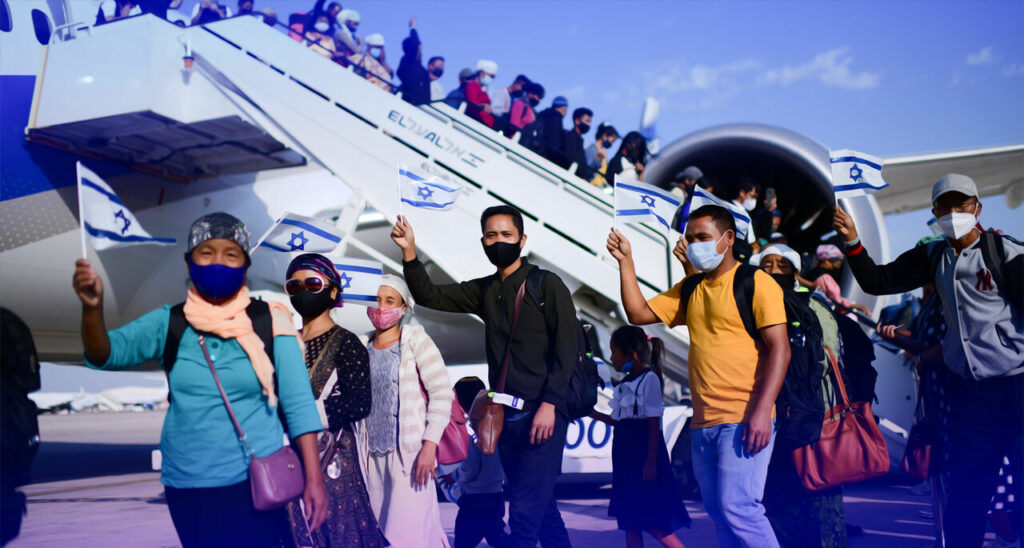
5,800 members of the Bnei Menashe community will make aliyah by 2030 under a new Israeli government plan.
For a community that preserved Jewish tradition for thousands of years in India, this is more than immigration.
It’s a homecoming. pic.twitter.com/MIXwor3dFz
— Hen Mazzig (@HenMazzig) November 24, 2025
Who Are the Bnei Menashe?
To understand the Bnei Menashe, we first have to go back to the time of the Bible. In the eighth century BCE, the Kingdom of Israel (which was made up of ten of the Tribes of Israel) was conquered by the Assyrian Empire, and its inhabitants were exiled to other lands. These tribes were assimilated into the cultures to which they were exiled and are considered to be “lost tribes.”
Despite the assimilation of the ten lost tribes, various peoples around the world claim to be descended from these original Israelite tribes.
One of these peoples is the Bnei Menashe community of northeastern India, which claims to be descended from the lost tribe of Menashe.
The community has no written history but has a strong oral tradition, with customs passed down from one generation to the next. According to the community, they are descended from a forebear named “Menassia.”
After Christian missionaries introduced the community to the Bible, they discovered several similarities between their communal traditions and Judaism. This includes the celebration of a festival similar to Passover and an ancient burial chant that recalls the community’s progenitors, including Menassia, Gelet, and Ulam. These names are similar to the name “Menashe” and the names of his descendants per the Hebrew Bible.
The Bnei Menashe & Israel
It was only during the 1970s that the Bnei Menashe community came into contact with other Jewish communities in India and in Israel. It was an Israeli rabbi, Eliahu Avichail, who gave them the Hebrew name, “Bnei Menashe” (sons of Menashe).
This contact with traditional Jewish communities led to the Bnei Menashe adopting a more traditional Jewish lifestyle, including circumcision and the building of Mikvaot (ritual baths).
Members of the community began moving to Israel in the 1990s, but this immigration was briefly stopped in 2003 by the Israeli government before being restarted by a later government.
In 2005, the Sephardic Chief Rabbi of Israel, Shlomo Amar, ruled that the Bnei Menashe were descended from ancient Israelites. However, the position of the Chief Rabbinate is that members of the community must undergo a Jewish conversion to be considered Jews.
At the same time, it should be noted that DNA tests conducted on members of the community in the early 2000s show little Middle Eastern descent, possibly due to generations of intermarriage with peoples from India and the surrounding Himalayan region.
Due to this split status (believed to be descended from ancient Israelites but not considered Jewish), the immigration of Bnei Menashe community members requires Israeli government approval and has only occurred in drips and drabs. Prior to the current immigration plan, the last major immigration wave occurred in 2020.
Why the New Immigration Plan?
Contrary to Judy Maltz’s speculations about why the Israeli government has agreed to a plan to bring the majority of the Bnei Menashe community to Israel, the actual reasons are much more compelling and straightforward.
According to the government, the plan is largely about family reunification. With roughly 40% of the community in Israel and 60% of the community in India, many families have been split and have not seen each other for many years. This plan allows these families to be reunited in Israel.
In addition, the 2022 murder of Yoel Lhengal, an 18-year-old member of the Bnei Menashe community in Israel, prompted the government “to improve both the image and standing of the Bnei Menashe community within Israeli society.”
As well, since 2023, the Bnei Menashe in India have been trapped in the midst of a war between two local tribes. This dangerous escalation has made their immigration to Israel all the more urgent.
The story of the Bnei Menashe is a fascinating blend of ancient roots and modern religion.
The upcoming immigration of the vast majority of the community to Israel deserves a comprehensive and nuanced media approach that touches on their historic claims and ties to the modern Jewish community, not one in which this community is simplistically portrayed as tools of Israeli political machinations.
Liked this article? Follow HonestReporting on Twitter, Facebook, Instagram and TikTok to see even more posts and videos debunking news bias and smears, as well as other content explaining what’s really going on in Israel and the region. Get updates direct to your phone. Join our WhatsApp and Telegram channels!
© Divuach Ne’eman R”A, 2025