Gaza continues to produce a remarkable stream of professional news imagery. Anadolu says Israel’s blockade is forcing journalists to repair old cameras. After nearly three years of war, there is another question a photographer might ask: how has this professional camera ecosystem remained operational at all?
I’ve spent nearly 40 years working with cameras. Looking at these photographs from Gaza, my attention went straight to the equipment.
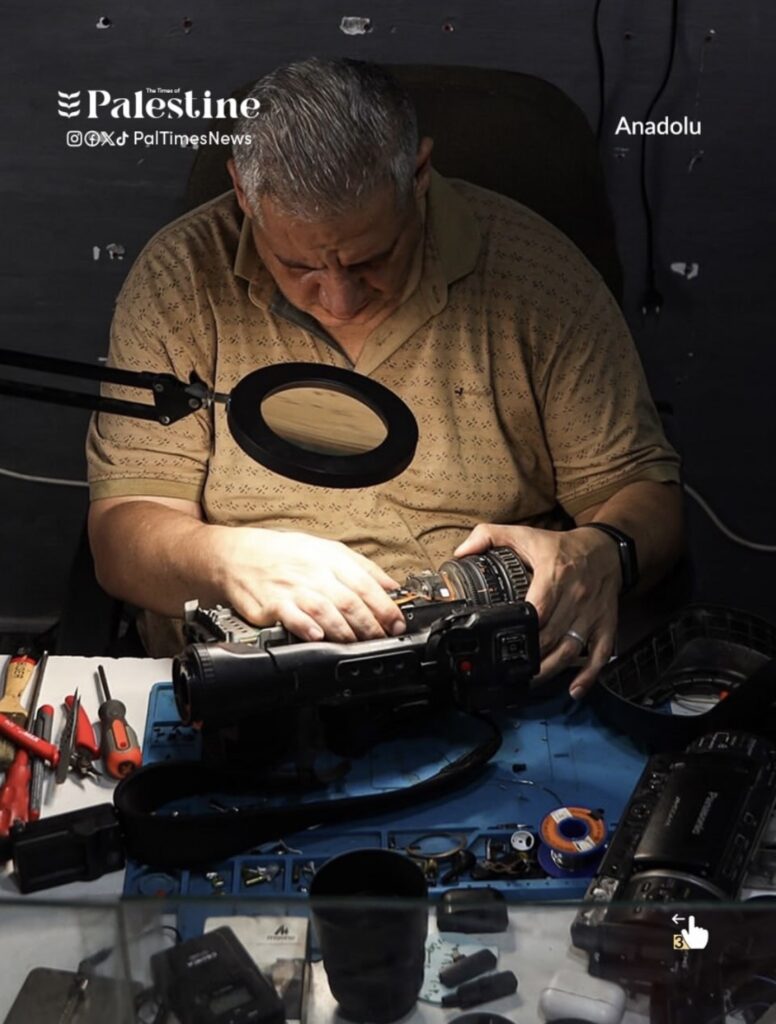
Anadolu photographer Abdalhkem Abu Riash photographed 55-year-old camera technician Raid Kehil at his Gaza City workshop on September 8. Kehil is surrounded by professional cameras, lenses, electronic components and the tools needed to repair them.
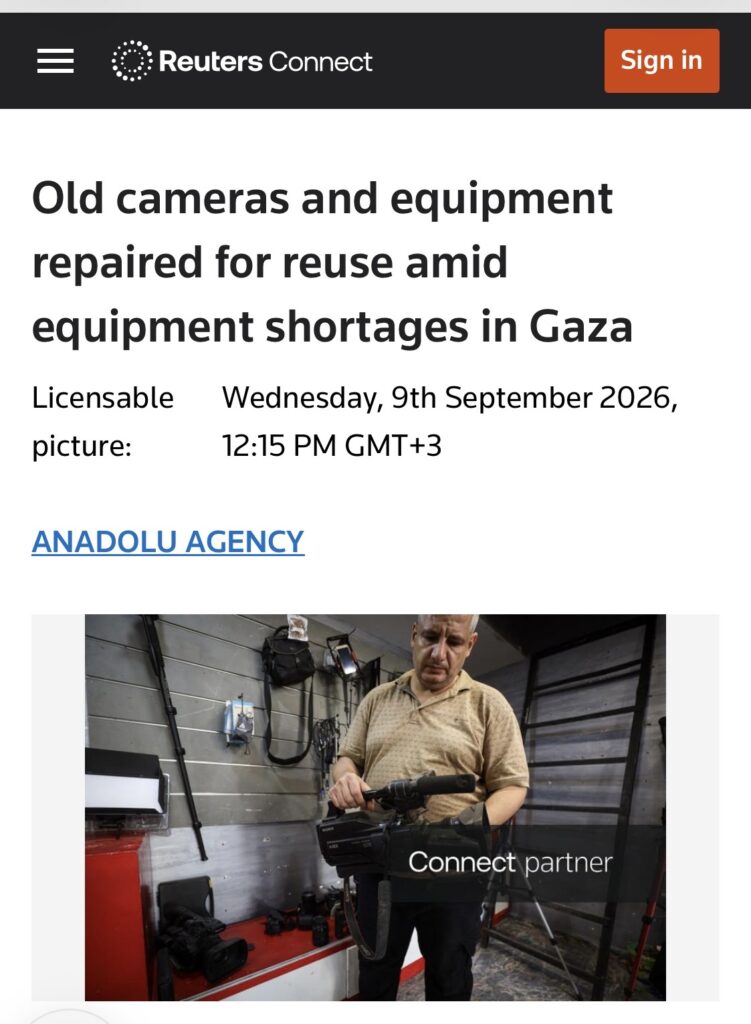
The pictures were subsequently shared by The Times of Palestine under the headline: “Gaza journalists repair cameras under Israeli blockade.”
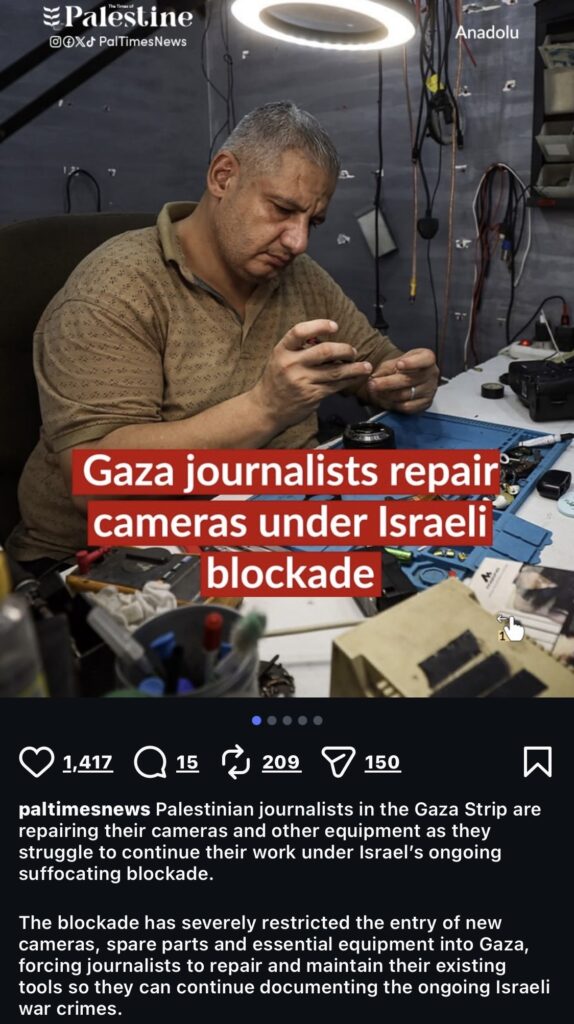
Its accompanying text goes considerably further. Palestinian journalists, it says, are struggling under Israel’s “ongoing suffocating blockade,” which has restricted cameras, spare parts and equipment, forcing them to maintain existing gear so they can continue documenting what it calls Israeli “war crimes.”
That’s quite a lot of politics to extract from a camera repair bench.
And it isn’t quite how Anadolu’s original caption describes what we’re seeing.
Anadolu says high prices for spare parts and “limited entry of new equipment” have made repairs increasingly important. Limited entry is not the same thing as no entry. More importantly, the caption doesn’t tell us how much new equipment is entering Gaza, where it comes from or how the wider professional camera infrastructure has remained operational.
A follow-up Anadolu video provides part of the answer. Kehil says technicians salvage components from damaged cameras to repair others. Journalist Mohammed Abu al-Subh says that after losing equipment, he has continued working with borrowed gear.
All perfectly plausible.
But look at the bigger picture.
Cameras are remarkably resilient pieces of equipment, but they are not indestructible. Dust is particularly unforgiving. So are repeated knocks, constant field use and exposure to difficult conditions. Lenses develop problems. Connections fail. Batteries eventually stop holding charge. Chargers, cables and memory cards need replacing. Some components can be cannibalized from another camera. Others cannot.
Yet after nearly three years of war, Gaza continues to generate a remarkable quantity of professional photographs and video.
So what has kept all those cameras working?
How large was the pool of professional equipment already inside Gaza? How much equipment has entered since the war began? Who supplied it? Where are batteries, chargers, memory cards and replacement components coming from? What role, if any, do the international news organizations consuming Gaza’s imagery play in supplying or maintaining equipment used by their photographers?
I went looking for answers.
There is evidence of local expertise. In fact, this isn’t even Anadolu’s first story about it. In October 2025, the agency photographed journalist Hamza Abdulkerim al-Shami in Khan Younis repairing damaged equipment for other journalists while continuing his own reporting.
But I could find no public documentation establishing a systematic pipeline through which international agencies are supplying replacement cameras or maintaining equipment for Gaza-based photographers. That means it would be wrong to claim such a pipeline exists.
It also means the question remains unanswered.
And that’s what makes these latest photographs interesting.
The intended story is about scarcity. Look at what Gaza’s journalists are reduced to doing because of Israel’s blockade.
A photographer can look at exactly the same pictures and notice something else: a functioning specialist workshop maintaining professional broadcast and photographic equipment in the middle of a war.
That doesn’t prove that equipment is freely available. It clearly isn’t proof that anybody is secretly supplying it. Nor does the continued flow of imagery tell us how individual photographers are managing.
But after nearly three years in conditions routinely described as catastrophic, the survival of Gaza’s professional photographic infrastructure is itself a legitimate story.
Anadolu has shown us one way the cameras are being repaired.
What it hasn’t explained is how the cameras keep rolling.
Liked this article? Follow HonestReporting on Twitter, Facebook, Instagram and TikTok to see even more posts and videos debunking news bias and smears, as well as other content explaining what’s really going on in Israel and the region. Get updates direct to your phone. Join our WhatsApp and Telegram channels!
© Divuach Ne’eman R”A, 2025