I was born within the sound of Bow Bells. That makes me a Cockney, an Eastender, and someone who still feels a very personal connection to London, however many years I have lived away from it.
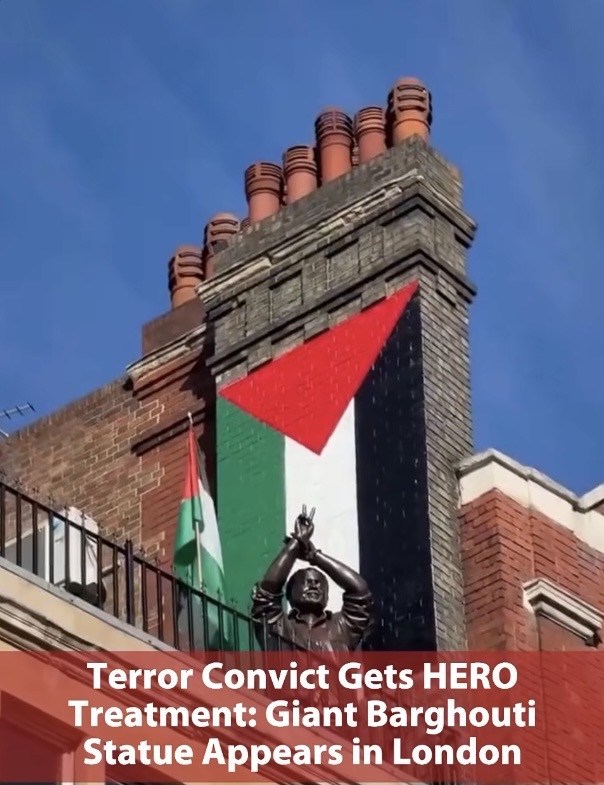
So when I saw the photograph of a giant statue of Marwan Barghouti displayed above a London street, I felt something considerably stronger than disappointment.
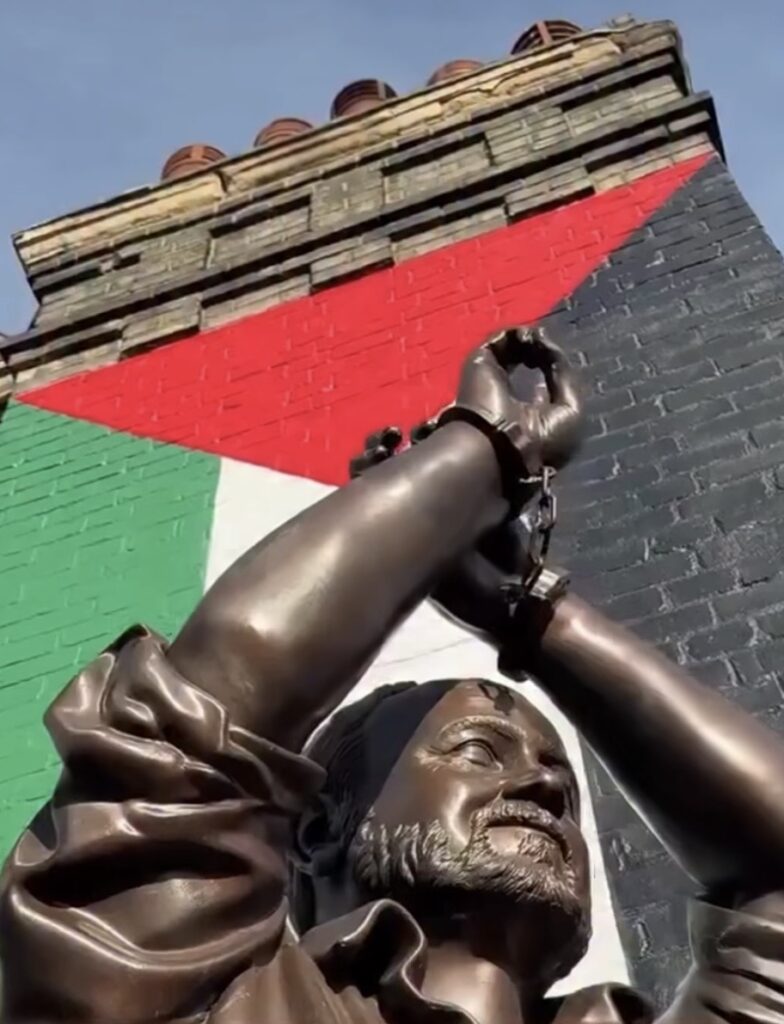
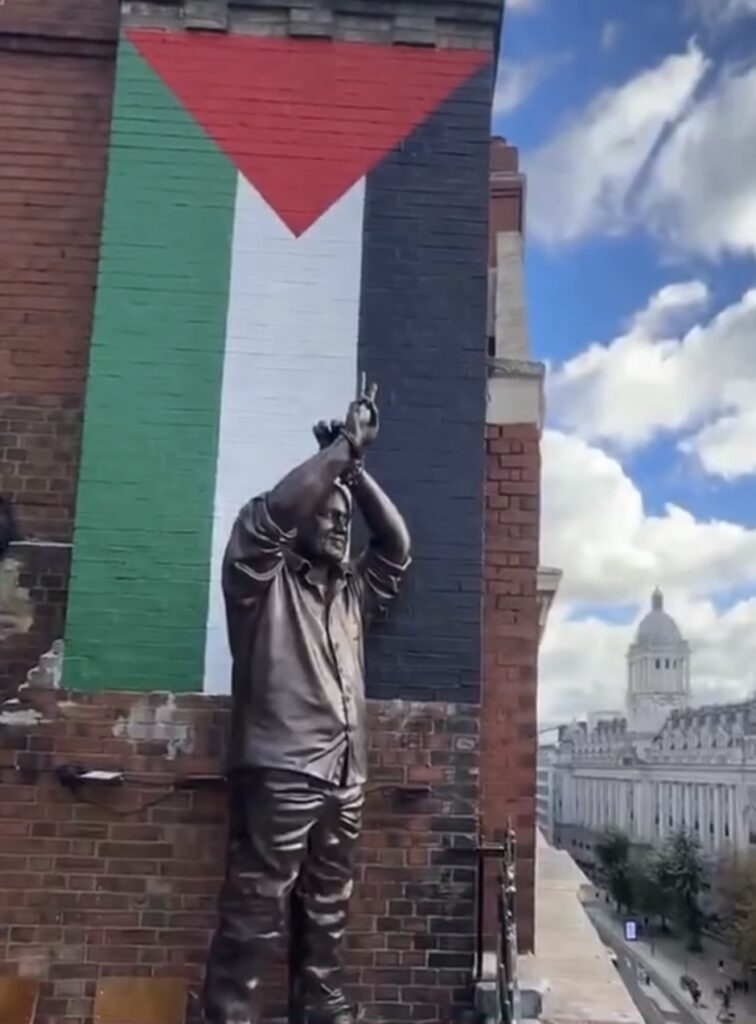
The statue has appeared on the balcony of Palestine House in High Holborn, against an enormous Palestinian flag. It depicts Barghouti with his hands raised above his head, joined by handcuffs. From the street, the figure presents an unmistakable image of defiance, intended to transform a convicted terrorist into a symbol of Palestinian resistance.
I understand perfectly well what the people responsible for this display want us to see. A prisoner, defiant despite his captivity, presented as a man struggling for freedom.
What the image doesn’t tell us is why he is in prison.
In May 2004, an Israeli court convicted Barghouti of five murders connected to three terrorist attacks during the Second Intifada. Among the victims was a Greek Orthodox monk murdered in the West Bank in 2001. An Israeli woman was killed near Givat Ze’ev in January 2002, while three people were murdered in an attack on a Tel Aviv seafood restaurant that March.
Barghouti was sentenced to five consecutive life terms plus 40 years. He rejected the legitimacy of the Israeli proceedings, and his supporters continue to challenge the convictions. Nevertheless, the court’s findings are part of the historical record, documented at the time by The Guardian.
There is something particularly revealing about the statue’s design. The handcuffs are not an incidental detail. They are the entire visual argument.
By emphasizing Barghouti’s imprisonment, the display directs attention away from the people whose murders resulted in his conviction. The viewer is invited to identify with the prisoner rather than consider his victims. It is an effective piece of political imagery, and I suspect that is precisely why it was chosen.
This is not even the first attempt to give Barghouti a prominent place in London. In June, campaigners tried to install a statue of him in Parliament Square. Police intervened and prevented the installation.
The Mandela comparison comes from the campaign surrounding Barghouti itself. Supporters seeking his release have promoted him internationally as a “Palestinian Mandela,” presenting his imprisonment as part of a struggle for national liberation. It is a powerful piece of political branding, but one that risks obscuring a fundamental part of Barghouti’s history: he is serving five life sentences following his conviction for five murders.
Whether the statue now displayed at Palestine House is the same one brought to Parliament Square has not been established. The political message, however, is remarkably similar.
And there is something else about London that has been troubling me.
Only days ago, pro-Palestinian demonstrators climbed the Battle of Britain Memorial on Whitehall during protests in central London. Memorial wreaths were reportedly trampled and broken, and six people were arrested on suspicion of criminal damage.
These were separate events, and there is no evidence connecting those demonstrators to the Barghouti statue. But seeing both incidents within days of one another has left me deeply uncomfortable about what is happening in the city where I grew up.
London has always been a city of protest, political disagreement and competing opinions. But there is a considerable difference between political advocacy and publicly elevating a man serving five life sentences for murder into a heroic symbol.
I also grew up surrounded by the history of a city that had endured the Great Fire, the Blitz and the extraordinary determination of ordinary Londoners to carry on through catastrophe. Later, working in London, I experienced the years when IRA terrorism brought bomb warnings, evacuations and the knowledge that innocent people could be murdered simply because they happened to be in the wrong place.
I remember those years rather well.
Perhaps that is why I find the image from High Holborn so disturbing. The London I remember understood the difference between political disagreement and the deliberate murder of civilians, whatever cause the perpetrators claimed to represent.
And yet here, above a London street, is a man serving five life sentences for murder, presented not through the crimes for which he was convicted but through the imagery of heroic resistance.
The photograph is powerful. Whoever arranged the display clearly understood the effect of placing those raised, handcuffed hands against the Palestinian flag. The sculpture asks us to admire his defiance, while leaving the reasons for his imprisonment outside the frame.
What the photograph cannot show are the five people whose deaths led to Barghouti’s conviction.
They have no place in this carefully constructed image.
I was born a Londoner, and I will always consider myself one. But looking at that statue, I find myself wondering what has happened to the city I once knew.
Liked this article? Follow HonestReporting on Twitter, Facebook, Instagram and TikTok to see even more posts and videos debunking news bias and smears, as well as other content explaining what’s really going on in Israel and the region. Get updates direct to your phone. Join our WhatsApp and Telegram channels!
© Divuach Ne’eman R”A, 2025