Key Takeaways:
- The BBC’s April 12 interview with Tucker Carlson did not simply “challenge” his views; it legitimized them by treating him as a credible participant in mainstream debate.
- Carlson advanced a coherent conspiratorial framework portraying Israel, and by extension Jews, as a hidden force controlling Western leaders and global events, echoing long-standing anti-Jewish narratives.
- By platforming such claims, even with limited pushback, the BBC contributed to the normalization of ideas that have historically been used to distort, marginalize, and endanger Jews.
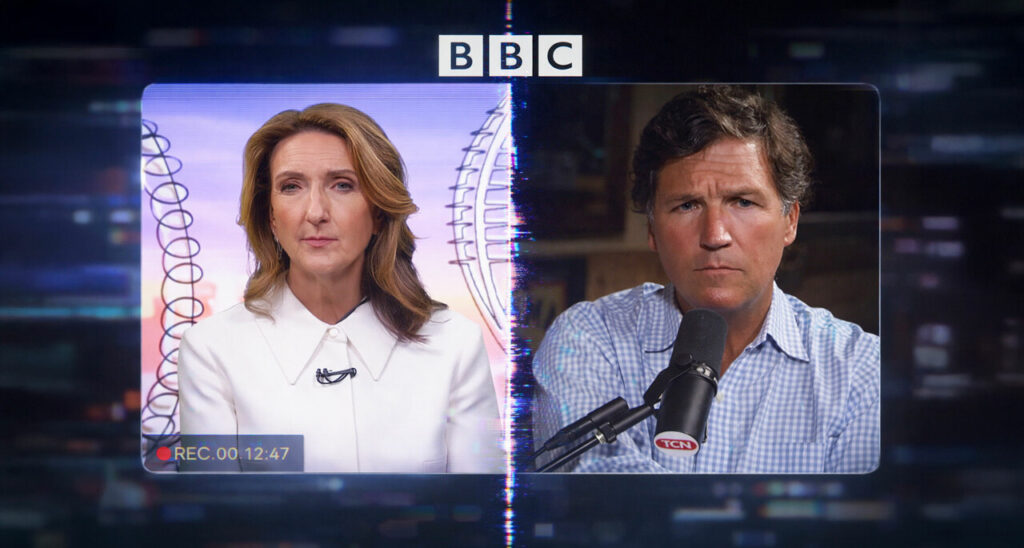
On April 12, in an interview with BBC journalist Victoria Derbyshire, Tucker Carlson was handed a mainstream platform to air a series of conspiratorial claims about Israel, the United States, and Western leadership.
Some have framed the exchange as “robust journalism,” pointing to moments of pushback. But this misses the central issue.
The problem is not whether Carlson was challenged.
It is that he was treated as a legitimate participant in the conversation at all.
No. This isn’t “pressing” Tucker Carlson on allegations of antisemitism.
If Victoria Derbyshire wanted to do some pressing, she could have confronted Carlson over the countless antisemitic conspiracy theories and outright lies he’s spread about Jews and Israel.
But then,…
— HonestReporting (@HonestReporting) April 12, 2026
Platforming as Legitimacy, Not Scrutiny
During the interview, Carlson recycled a familiar set of conspiratorial claims:
- That Donald Trump and Keir Starmer are effectively “enslaved” by Israel
- That figures like Melania Trump and Jeffrey Epstein were part of Israeli kompromat operations
- That Israel manipulates Western politics through sex scandals
- That it dictated UK policy, including the banning of Palestine Action
- And the now routine accusation of “genocide”
Taken individually, these claims may appear provocative. Taken together, they form something far more dangerous: a worldview in which Israel, and by extension Jews, are cast as a hidden force controlling global affairs.
Carlson himself made that framework explicit. He claimed that the United States had gone to war “at the behest and then the demand of Israel,” arguing that this was not an isolated incident but part of a pattern spanning decades of American foreign policy.
Speaking about Trump, he stated: “I feel sorry for him, as I do all slaves. He is not free in this moment to do at all what he thinks is best.” He went on to suggest that while it may not be “as simple” as direct control by Benjamin Netanyahu, “you could summarize it that way.”
He then posed what he presented as an open question: how does a country of nine million people control a country of 350 million? He did not offer an answer. He did not need to. The structure of the claim does the work on its own.
Really quite a shameful day for the BBC when they invited Tucker Carlson on to expound his obsessive antisemitic hatred towards Israel over 10 mins. He claimed Trump and Starmer are both ‘enslaved’ by Israel while Melania Trump and Epstein was also a likely Israel op. And, of… pic.twitter.com/SkOrBXUhw6
— Nicole Lampert (@nicolelampert) April 12, 2026
From Criticism to Conspiracy
Let’s be clear: this is not legitimate policy criticism.
Criticism of Israeli government decisions is entirely valid.
What Carlson advanced is something else – a conspiratorial framework built on the idea of hidden control, unseen mechanisms, and disproportionate power exercised by a small Jewish state over far larger nations.
This is how modern antisemitism often operates. Not always through explicit hostility, but through insinuation and narrative framing. It’s the same underlying logic as The Protocols of the Elders of Zion: the idea that Jews secretly control global events.
Carlson doesn’t need to say it outright. The structure of his argument does the work.
When challenged, Carlson insisted he wasn’t an antisemite and fell back on a familiar defense: that accusations of antisemitism are used to silence criticism of Israel.
On the surface, this sounds like a free speech argument. In reality, it serves a different purpose: It blurs the line between criticism and conspiracy, it reframes scrutiny as bad faith, and it allows antisemitic narratives to go unchallenged.
The result? The speaker becomes the victim, not the propagator of dangerous ideas.
The BBC cannot claim ignorance. Carlson’s record is well established, including:
- Named “Antisemite of the Year” in 2025 by StopAntisemitism
- Hosted Nick Fuentes, a Holocaust denier, without challenge
- Promoted Darryl Cooper while amplifying Holocaust revisionism
- Circulated the “Khazar theory,” which seeks to delegitimize Jewish identity
This is not incidental. It reflects a consistent pattern: recasting Jews not as a people, but as a shadowy force.
2/
Carlson helped normalize antisemitism by hosting Nick Fuentes – a known antisemite, white supremacist, and Holocaust denier – on his show without pushing back on any of Fuentes’ hateful rhetoric. The silence was deafening.And that’s not all.https://t.co/Hcx1CKJ8Hf
— HonestReporting (@HonestReporting) April 12, 2026
The reaction to the interview reflected an awareness of what was at stake. UK politician Patrick Hurley publicly questioned why the BBC was platforming Carlson at all. The Jewish Leadership Council’s David Toube warned that the BBC’s longstanding informal “cordon sanitaire” around extremist figures appears to have collapsed.
These responses point to something that goes beyond this single interview. They highlight a broader shift in how boundaries are drawn and in what is considered acceptable within mainstream discourse.
That inconsistency is further exposed by the reaction of Owen Jones, who criticized the BBC’s coverage, but notably took issue with the inclusion of pro-Israel voices rather than the decision to platform Carlson himself. In his response, the BBC referencing figures like U.S. politician Randy Fine was framed as the problem, while Carlson’s conspiratorial claims about Jewish power and control were not treated as disqualifying in themselves.
When the Boundaries Collapse
Platforming is not a neutral act. Inviting someone onto a major broadcaster does more than “question” them. It confers legitimacy. It signals their views fall within acceptable discourse. And it normalizes their framing. Even with pushback, that signal remains. And that is where the BBC crossed the line.
This is where the BBC’s decision becomes consequential. In an environment where antisemitic narratives are increasingly repackaged in more sophisticated and less overt forms, the threshold for who is granted that legitimacy matters more, not less.
The issue is not disagreement or the presence of controversial views. It is the normalization of narratives that have historically functioned to marginalize, distort, and endanger Jews. Once those narratives are embedded within mainstream platforms, they do not remain contained. They shape how Jews are understood, how Jewish identity is framed, and how hostility toward Jews is justified.
The BBC may view this interview as part of its commitment to open debate and pluralism. But there is a difference between facilitating debate and legitimizing a framework built on conspiracy. On April 12, that line was not just approached. It was crossed.
Liked this article? Follow HonestReporting on Twitter, Facebook, Instagram and TikTok to see even more posts and videos debunking news bias and smears, as well as other content explaining what’s really going on in Israel and the region. Get updates direct to your phone. Join our WhatsApp and Telegram channels!
© Divuach Ne’eman R”A, 2025