Headline A
“An Indian airline captain is hailed as a hero after a cockpit attack on a FlyDubai flight”


A personal message from Jacki Alexander, President & CEO.
Same Story. Different Headlines.
How much can a headline shape what you understand?
Please take our quiz belowThree news outlets covered the same FlyDubai incident. Each chose a different starting point. Compare their headlines, answer three quick questions, and consider what each leaves you thinking.
Note We’ve temporarily hidden the publication names. You’ll see the sources afterward.
“An Indian airline captain is hailed as a hero after a cockpit attack on a FlyDubai flight”
“UAE investigates if Flydubai attack was ‘terrorist activity’”
“Co-pilot who tried to crash FlyDubai jet was ‘radicalized,’ Israel says”
Question 1 of 3
Question 2 of 3
Question 3 of 3
Reflect
If you saw only one of these headlines, what would stay with you?
Notice how each headline directs your attention.
Sources Revealed
Headline A
Emphasis: The captain’s heroism · no motive
Headline B
“UAE investigates if Flydubai attack was ‘terrorist activity’” (opens in a new tab)
Emphasis: The investigation · possible terrorism
Headline C
“Co-pilot who tried to crash FlyDubai jet was ‘radicalized,’ Israel says” (opens in a new tab)
Emphasis: Radicalization · Israel as the source
AP emphasizes the captain’s heroism and leaves motive out. The Financial Times emphasizes the UAE investigation and raises the possibility of terrorism. The Washington Post emphasizes the co-pilot’s alleged radicalization and attributes that claim to Israel.
Those choices shape what readers notice first and what they may miss if they never read further.
Different framing does not automatically establish bias. It gives us a reason to look more closely:

You’ve just practiced examining emphasis, context, and attribution. These are skills people can bring to the news they encounter every day.
Through HonestIQ, HonestReporting helps teens and adults understand and critically evaluate the messages they encounter every day—through news, social media, and the many ways information reaches us.
Your gift helps bring this education to more young people, educators, and communities, alongside our work challenging inaccurate and biased coverage of Israel.
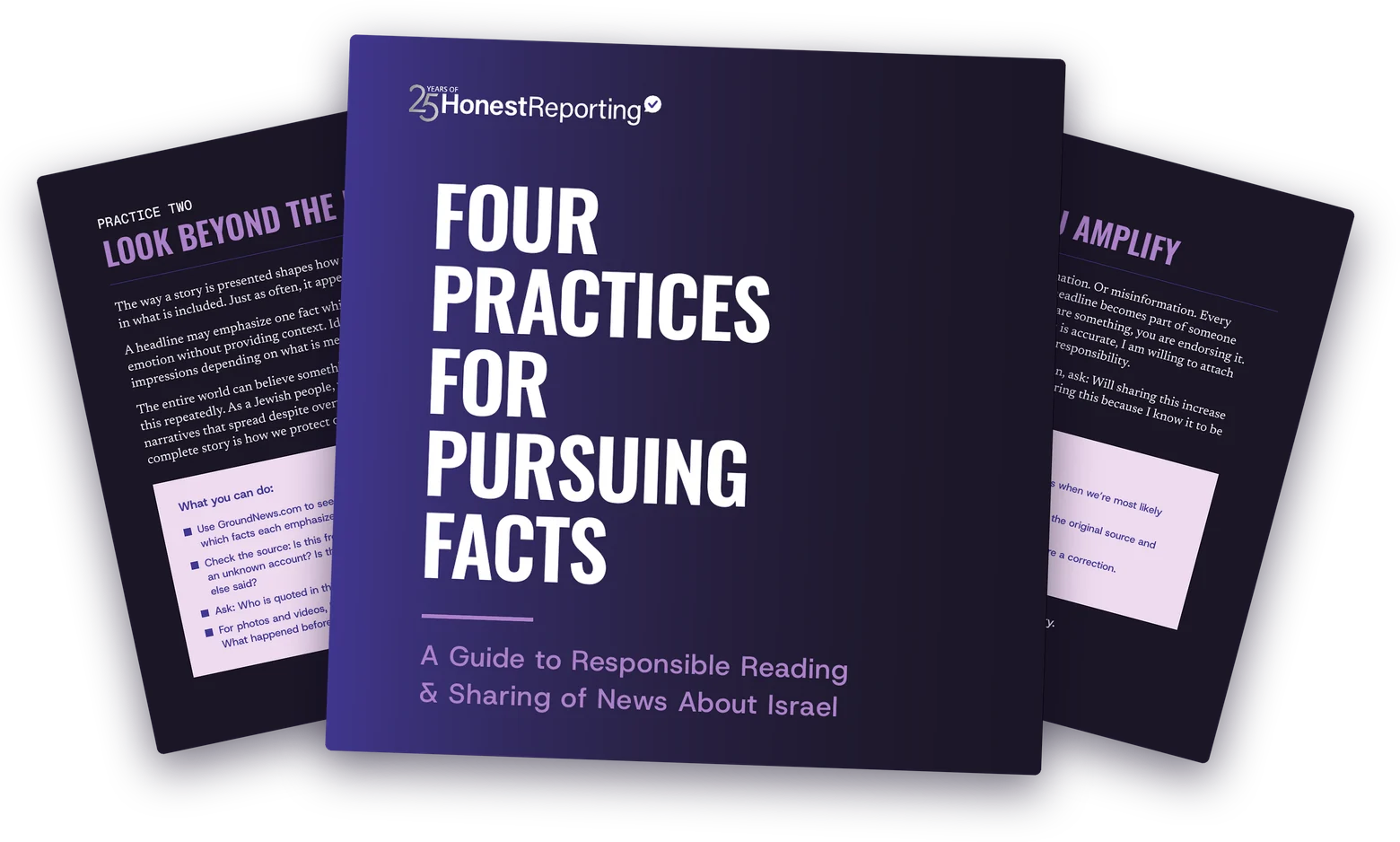
Free Guide
Four simple practices for reading the news more carefully and sharing it more responsibly.