History professor Paul Thomas Chamberlin makes the case for talking to terrorists using President Nixon’s decision not to deal with the PLO as a case study.
He writes in a New York Times op-ed:
By failing to strengthen moderates within the P.L.O. and effectively locking the Palestinians out of the Arab-Israeli peace process, American officials sidelined potential peacemakers and pushed Palestinian national ambitions to the back burner. The decision to label all armed Palestinian groups “terrorists” postponed negotiations with the P.L.O. by 15 critical years, during which time the Lebanese civil war and the intifada helped spawn more militant groups like Hezbollah and Hamas. By the time relations were finally established in the late 1980s, Hamas’s star was already rising.
This historical revisionism requires you to willfully overlook three points:
- The “moderate” PLO openly called for Israel’s destruction during the 70s.
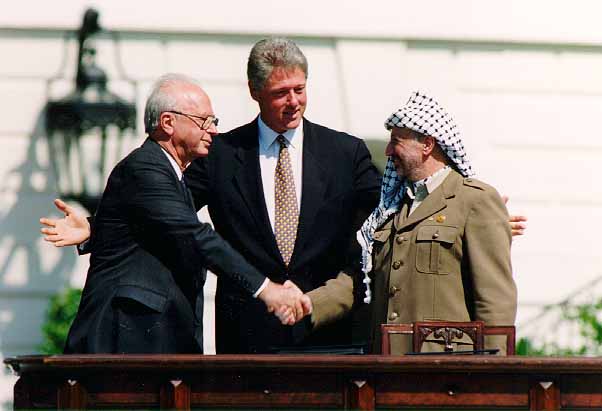
- The “moderate” PLO only got a seat at the table by paying lip service to renouncing violence in the 90s.
- Once in power, the “moderate” PLO fueled a violent intifada.
Yet Chamberlin concludes:
The lesson of America’s reaction to Munich is that the blanket charge of terrorism, coupled with absolute nonrecognition, is too unwieldy a tool for dealing with multiple complex political organizations. For violent groups like Al Qaeda and Islamic Jihad, which have unshakable commitments to destroying Israel or re-establishing the Islamic Caliphate, a forceful approach may be appropriate. But Washington shouldn’t rule out alternatives when dealing with groups that may have more limited long-term goals, like Hezbollah and Hamas.
The only difference between the long-term goals of the Chamberlin’s “violent groups” and “moderate groups” is what happens on the day after Israel’s destruction.
© Divuach Ne’eman R”A, 2025