Key Takeaways
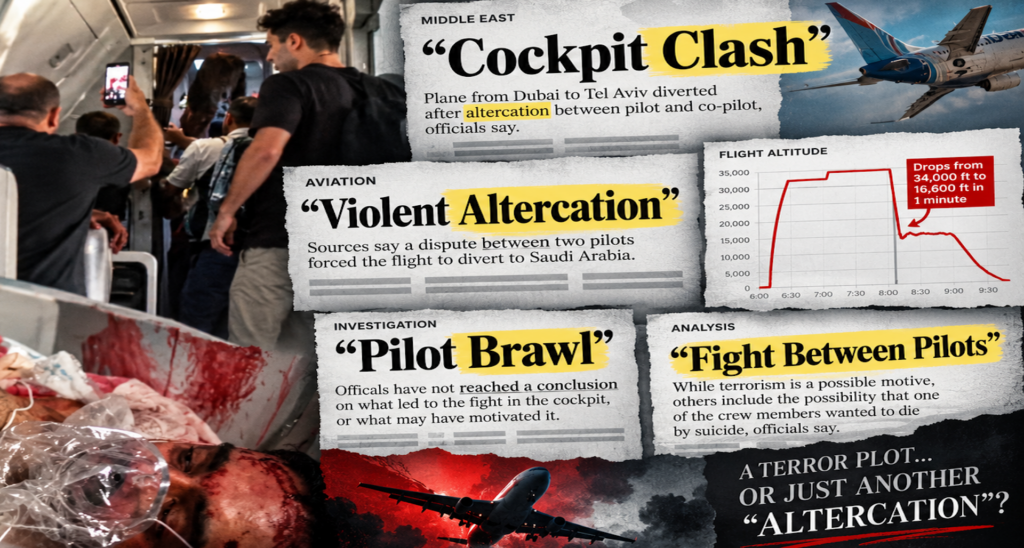
- The evidence pointed early to an attempted hijacking, not a “pilot fight.” Major outlets still used “brawl,” “clash” and “altercation.”
- The New York Times repeatedly foregrounded doubt even as its own reporting documented the stabbing, plunge and attempted takeover.
- The coverage reflected a broader problem the media appears to have with Israeli victims: an instinct to soften, qualify and cast doubt on attacks targeting them.
Wednesday’s attempted hijacking of Flydubai Flight FZ1073 carried chilling echoes of an earlier era of aviation terrorism. Fifty years after Entebbe – when Palestinian and German terrorists hijacked an Air France flight originating in Tel Aviv and separated Jewish and Israeli hostages before an audacious IDF rescue – a commercial jet packed with Israelis once again became the target of an attempted mass-casualty terror attack.
This time, catastrophe was averted not by commandos arriving on the ground, but by the extraordinary actions of those already in the air. A badly wounded captain managed to release the cockpit door, allowing passengers and crew to rush in and overpower the attacker before reserve pilots aboard the flight took control of the aircraft.
The footage emerging from passengers’ phones captured just how terrifying those moments were: screams as the aircraft plunged, blood inside the cabin, a wounded captain and the aftermath of a desperate struggle to prevent the plane from crashing.
Here is what we now know:
- Flight FZ1073 was traveling from Dubai to Ben Gurion Airport carrying more than 170 people, mostly Israelis.
- The aircraft first transmitted 7700, the international code for a general emergency. Minutes later it transmitted 7500, the code used to signal unlawful interference, including a possible hijacking.
- Flight-tracking data show the Boeing 737 plunging over 14,000 feet in under 30 seconds.
- The co-pilot, an Omani national, stabbed Captain Smit Machchhar, an Indian national. Despite being seriously wounded and covered in blood, Machchhar managed to release the reinforced cockpit door, allowing passengers to get inside. The co-pilot has since been arrested in Saudi Arabia.
- Several passengers rushed the cockpit and subdued the co-pilot as he reportedly attempted to sabotage the aircraft’s controls. A reserve Flydubai crew traveling aboard then took control and landed the aircraft safely in Tabuk, Saudi Arabia.
A co-pilot tried to hijack a plane headed to Israel, stabbed the captain, and sent the plane plunging thousands of feet.
— HonestReporting (@HonestReporting) October 1, 2026
Israeli passengers subdued him, tied him up, and helped save all 174 people on board, including 30 children.
Yet major outlets called it a “violent incident”… pic.twitter.com/fI16ZgNy9D
Not every detail was known when the first alerts flashed across newsrooms. But enough was: from the outset, virtually every available sign pointed in the same direction – this was an attempted hijacking and terror attack.
The hijack-related transponder code was publicly visible through flight-tracking services. The aircraft’s extraordinary descent was recorded in real time. Almost immediately after the emergency landing, videos filmed by passengers began circulating online showing bloodied men inside the aircraft and passengers describing an attack.
In other words, the nature of what had happened was already emerging from the aircraft itself, not hours later through official briefings.
And yet, across much of the international media, one phrase proved remarkably difficult to dislodge: a fight between pilots.
What happened on the Flydubai flight today was an ATTEMPTED TERROR ATTACK.
— HonestReporting (@HonestReporting) September 30, 2026
The captain was allegedly stabbed by his co-pilot. The plane sent the hijack emergency code. Israel says terrorism was the motive.
5 outlets. 5 headlines still calling it a “fight between pilots.” pic.twitter.com/AIUoHyX7MF
Numerous outlets, including CNN, Sky News, The Guardian, USA Today and the Financial Times, continued after the aircraft had landed in Saudi Arabia to describe what had happened variously as a “fight between pilots,” “cockpit brawl,” “violent altercation” or “clash.” Sky News told viewers the pilots had “got into a fight mid-flight.” USA Today ran with an “apparent pilot fight.” The Guardian was still referring to an “apparent brawl” in a later live-blog summary that, remarkably, also reported that one pilot had stabbed the other and tried to crash the aircraft. CNN likewise continued using “violent altercation” even while reporting the stabbing and a 17,000-foot plunge.
“Got into a fight mid-flight.”@SkyNews, describing an attempted plane hijacking. https://t.co/ibml0H95z9 pic.twitter.com/SwfAceoJL8
— HonestReporting (@HonestReporting) September 30, 2026
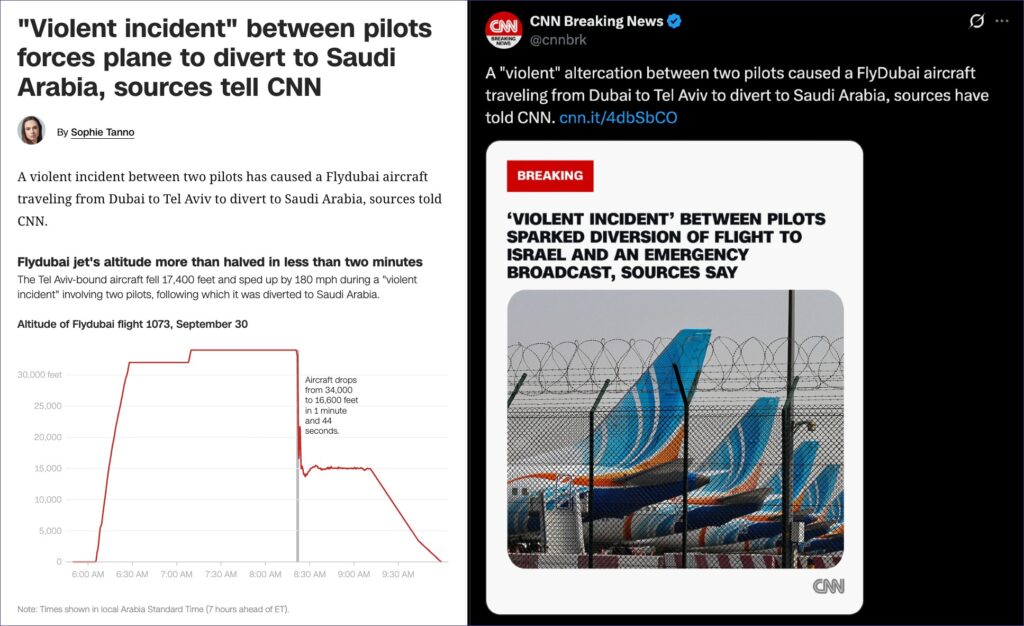
By then, these were no longer simply cautious descriptions written in the confused first minutes of a breaking story. They were remnants of an earlier narrative that the emerging evidence had overtaken.
“Cockpit brawl.” Seriously, @FT?
— HonestReporting (@HonestReporting) September 30, 2026
An attempted terror attack targeting Israelis. A pilot stabbed. A plane nearly brought down.
Shameful. https://t.co/gGVAnPHvj2
Perhaps the clearest example came from the New York Times, whose live reporting, social-media posts and subsequent defense of its coverage managed to turn a serious question of journalistic judgment into a story of its own.
Its live coverage for hours was under the headline “Flight to Israel Is Diverted After Pilots Clash in Cockpit,” while its report described a “bloody clash between two pilots.”
Yet virtually alongside that language, the Times was telling readers that one pilot had stabbed the other and “apparently attempted to crash the plane with its passengers on board.” It reported that passengers had forced their way into the cockpit, that the attacker had been interfering with the aircraft’s systems and that the plane had transmitted an unlawful-interference signal before losing altitude.
By then, this was no longer a question of semantics. “Fight,” “clash” and “altercation” all imply two sides engaged in a confrontation. They were simply inaccurate descriptions of what was already known to have happened on board.
You don’t hate the @nytimes enough.
— HonestReporting (@HonestReporting) September 30, 2026
A co-pilot stabs the captain and tries to crash a plane carrying over 160 Israelis.
NYT: “a clash in the cockpit.”
The plane plunges 14,000 feet in an attempted mass-casualty terror attack.
NYT: “possible motive” unclear. https://t.co/1A3pMPgRRZ pic.twitter.com/uEbtoTBVA7
And still the euphemisms persisted.
On X, the Times told its millions of followers that the aircraft had been diverted following an “altercation between the pilot and co-pilot.” The post was subsequently hit with a Community Note supplying the rather crucial context that one pilot had stabbed the other, the aircraft had plunged thousands of feet and passengers had intervened to regain control.
A later report led by Jerusalem bureau chief David M. Halbfinger acknowledged the stabbing, the attempted crash and the passengers’ “minutes of mortal terror.” Yet when it came to terrorism, the framing became noticeably more skeptical. Readers were told that “two far-right Israeli government ministers” had called it a foiled terror attack; that the aircraft was still far from Israeli airspace; and that investigators were also considering whether the attacker simply intended to kill himself along with everyone aboard.
None of that meaningfully undercuts terrorism as an explanation. Suicide terrorism is hardly a contradiction in terms: the 9/11 hijackers deliberately died while turning passenger aircraft into weapons. Nor does being outside Israeli airspace tell us much about whether a plane packed overwhelmingly with Israelis was being targeted.
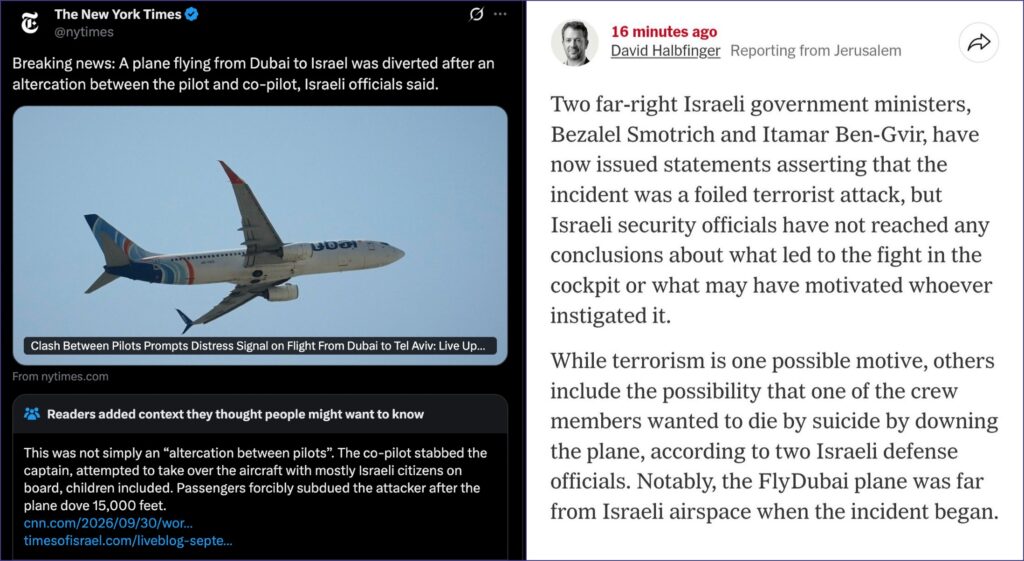
That is what made the framing so striking. Faced with an Israel-bound aircraft, a stabbed captain, a hijack-related distress code, a catastrophic plunge and passengers fighting to save the plane, the Times seemed remarkably eager to foreground reasons why terrorism might somehow not be the explanation.
Then came the Times’ communications department.
Responding to criticism, @NYTimesPR insisted its reporting contained only what it could confirm, adding with unmistakable condescension: “Unlike activists and partisans, we don’t publish speculation or unverified information.”
That defense would be rather easier to swallow if it squared with the Times’ own record. After the Al-Ahli hospital explosion in 2023, the newspaper was forced to acknowledge that its initial coverage had “relied too heavily on claims by Hamas” and failed to make clear that those claims could not immediately be verified, leaving readers with an “incorrect impression” of what was known.
…except when you’re reporting Hamas claims from Gaza, apparently. 😉
— HonestReporting (@HonestReporting) September 30, 2026
Remember Al-Ahli? Let's remind you. pic.twitter.com/yEhWtdJrQ9
So the problem is not that the Times refused to invent an ideological motive. Nobody was asking it to. There were any number of accurate formulations that preserved uncertainty: suspected hijacking; apparent attempt to seize control of an Israel-bound aircraft; co-pilot accused of stabbing the captain and trying to crash a plane carrying more than 170 people.
Instead, readers repeatedly got “fight,” “altercation,” “clash” and “brawl.”
That is not simply caution. Caution qualifies what remains uncertain. It does not dilute what is already known. And that is where the Times’ defense becomes particularly difficult to reconcile with its own journalism.
The attempted hijacking of Flydubai Flight FZ1073 exposed a broader problem in the media’s treatment of Israeli victims. Again and again, the instinct was to downgrade, qualify and sow doubt around what had happened.
Passengers who survived an attempt to bring down their aircraft were not presented first as the targets of extraordinary violence, but as participants in a “fight,” a “clash” or an “altercation.” Even as the evidence mounted, the framing kept reaching for ambiguity.
The effect was unmistakable: Israeli victimhood itself was treated as something requiring qualification. The possibility of terrorism had to be caveated, politically attributed or counterbalanced with alternative explanations, while the violence actually inflicted on those aboard was linguistically softened.
That is more than poor word choice. It is a profound failure of framing.
Uncertainty over an attacker’s precise motive does not transform an attack into an altercation. And Israelis do not stop being victims simply because their victimhood appears to make some newsrooms uncomfortable.
Liked this article? Follow HonestReporting on Twitter, Facebook, Instagram and TikTok to see even more posts and videos debunking news bias and smears, as well as other content explaining what’s really going on in Israel and the region. Get updates direct to your phone. Join our WhatsApp and Telegram channels!
© Divuach Ne’eman R”A, 2025