Key Takeaways:
- The New York Times’ communications team has repeatedly turned substantive criticism into something easier to dismiss, whether an “editing error,” “cherry-picked data” or simply a baseless attack.
- Instead of answering the strongest criticisms directly, its defenses often lean on credentials, reputation and institutional authority while sidestepping the underlying evidence.
- Media accountability does not end when a newspaper issues a statement. When the Times responds to criticism with deflection rather than answers, those defenses deserve the same scrutiny as the journalism they are protecting.
If the New York Times was not already enough of a punchline for critics of bad journalism, the past week has certainly helped.
The latest contribution came courtesy of an “editing error” in an article by the paper’s Jerusalem reporter, Isabel Kershner. Israelis, readers were informed, “still largely view themselves as the victims of Oct. 7.”
That would be October 7, 2023: the Hamas-led massacre in Israel in which roughly 1,200 people were murdered and more than 250 were abducted into Gaza. Yet almost three years later, according to the Times, Israelis are still, problematically, viewing themselves as the victims of that attack. As opposed, presumably, to the Palestinians.
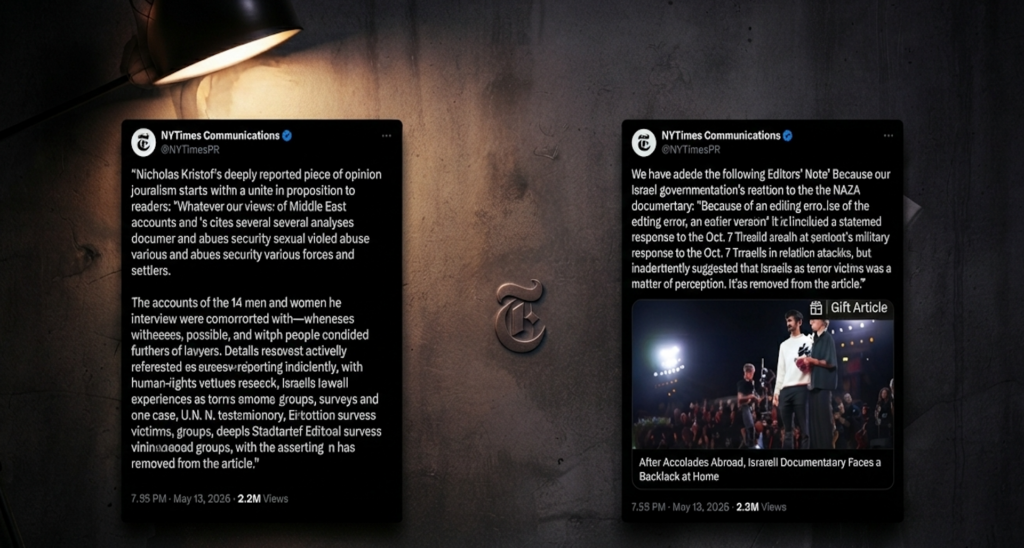
Quite rightly, the line was pilloried on social media and beyond. An editor’s note swiftly appeared on the article, while the New York Times’ press relations department swung into action on X to explain that the offending sentence had appeared as the result of an “editing error.”
That may well be true. Indeed, given Kershner’s previous reporting, there is good reason to think she was not the author of the line and that it was introduced during editing. Whether “error” is quite the right word for a fully formed sentence that made its way into the editing process is another matter. One might reasonably wonder whether somebody simply wrote what they meant.
But that is almost beside the point.
More revealing was the language of the Times’ response. There was no apology for publishing such a grotesque formulation. No acknowledgment of what, exactly, made it so objectionable. Just an “editing error” and a note that the offending line had since been removed from the article.
But the Times Communications account has form in this regard. Since the beginning of this year, it has been particularly busy on X, repeatedly riding to the rescue of some of the newspaper’s shoddiest journalism.
Here are five occasions when the paper’s press office seemed more interested in defending the indefensible than addressing how it ended up in the Times in the first place.
1. When Oct. 7 Victimhood Became an “Editing Error”
In September, The New York Times published a report on the backlash in Israel to “NAZA,” a documentary accusing Israeli forces of widespread unlawful killings in Gaza. Discussing divisions within Israeli society over the war, the article included one extraordinary sentence: “But Israelis still largely view themselves as the victims of Oct. 7.”
The problem hardly requires explanation. Israelis do not merely “view themselves” as the victims of October 7. Hamas-led terrorists invaded Israel, murdered roughly 1,200 people and abducted 251 into Gaza. They were the victims of October 7. Not, presumably, the Palestinians whom the sentence rather conspicuously seemed to place on the other side of that equation.
After the line attracted widespread criticism, the Times removed it. But its subsequent response suggested remarkably little appreciation of just how appalling the formulation had been. There was no meaningful apology. Instead, the Times Communications team blamed an “editing error,” explaining that the sentence had actually been intended to refer to Israelis’ perception of their government’s subsequent military response.
That explanation raises almost as many questions as the original wording. This was not a misspelled name or a mistyped figure. A complete, perfectly comprehensible sentence had been written, edited and published that transformed the victims of a massacre into people who merely view themselves that way. Removing it was necessary. Describing it as an editing error, however, neatly reduced a serious failure of framing to an unfortunate mishap somewhere in the production process.
We have added the following Editors' Note to our recent coverage of the Israeli government's reaction to the NAZA documentary: "Because of an editing error, an earlier version of this article included a statement that was intended to convey Israelis’ perception of the…
— NYTimes Communications (@NYTimesPR) September 16, 2026
2. Analyzing 1,559 Articles Is “Cherry-Picking”
Only days before the October 7 “editing error,” the Communications team on X had been deployed against a rather different problem: an academic study of The New York Times itself.
Yale School of Management professor Edieal Pinker examined 1,559 New York Times news articles published between October 7, 2023 and June 7, 2024 that referenced both Israel and Gaza. Published in the peer-reviewed journal Studies in Conflict & Terrorism, the study found a dominant framing that assigned disproportionate agency and responsibility to Israel while diminishing Hamas’ role in sustaining the conflict. Israeli casualties after October 7, Hamas combatant deaths and subsequent Palestinian violence were frequently omitted, while personal accounts of Palestinian suffering appeared far more regularly than comparable Israeli accounts.
The Times’ response was not to identify a faulty calculation or offer competing data. Instead, its Communications department accused advocates behind media-bias studies of “cherry-pick[ing] data” that supported their beliefs, while invoking the paper’s mission to “seek the truth.” Yet it offered no specific explanation of what Pinker had supposedly cherry-picked. If the methodology was flawed, the Times could have shown how. It didn’t.
And the appeal to its own truth-seeking credentials is particularly awkward given that the Times has itself previously acknowledged that its early reporting on the al-Ahli hospital explosion “relied too heavily on claims by Hamas” and left readers with an incorrect impression of what was known.
The advocates behind multiple studies on media bias cherry-pick data that supports their beliefs while ignoring any evidence to the contrary. Our work has exposed violations of international law and grave human rights abuses. War crimes prosecutors have cited our investigations…
— NYTimes Communications (@NYTimesPR) September 14, 2026
3. In Defense of Nicholas Kristof’s “Rape Dogs” Fantasy
In May, longtime New York Times columnist Nicholas Kristof published “The Silence That Meets the Rape of Palestinians,” alleging widespread sexual abuse of Palestinian detainees by Israeli prison guards, soldiers, interrogators and others. The column included the most sensational allegation imaginable: that dogs had been “coached” to sexually assault prisoners, a claim for which the Times produced no veterinary expert or medical literature showing that dogs could be trained to perform such an act on command.
Within hours, HonestReporting began pulling apart the sourcing. We found that two named sources had given changing accounts of their alleged abuse, while Kristof also relied on Euro-Med Human Rights Monitor, whose leadership has documented links to Hamas and from which the “rape dogs” allegation has clearly been sourced. HonestReporting’s thread went on to be viewed more than a million times and became source material for wider criticism of the column.
The Times Communications account responded not by addressing those discrepancies, but by reaching for Kristof’s résumé: two Pulitzer Prizes, decades reporting on sexual violence and his reputation as an on-the-ground reporter. It later stressed that he had interviewed 14 people and that the piece and, even more absurdly, claimed it had been extensively fact-checked.
The awkwardness only grew. Former Israeli prime minister Ehud Olmert said Kristof had misrepresented his remarks so they appeared to validate allegations he said he could not substantiate. Then, in July, Times executive editor Joe Kahn acknowledged that the newsroom “wouldn’t have done that exact piece.” Naturally, the Communications account promptly stepped in again to insist his remarks had been taken out of context.
— NYTimes Communications (@NYTimesPR) May 13, 2026
4. The Pulitzer Controversy: Declare It “Baseless” and Move On
When Gaza photographer Saher Alghorra won the 2026 Pulitzer Prize for Breaking News Photography for his work for the Times, HonestReporting raised serious questions about both the images selected and the circumstances in which they were produced. One of the winning photographs showed masked Hamas terrorists carrying what was described as the remains of an Israeli hostage. This was not a distant shot of an unfolding street scene. It was a close, carefully composed image of a highly controlled Hamas operation, which raised questions about coordination, proximity and trust between photographer and terrorist group. Another winning subject, a two-year-old presented as an emblem of starvation, had meanwhile been photographed by multiple photographers from several agencies in remarkably similar circumstances.
The Times Communications account had a rather simpler answer: the criticism was “baseless.” It praised Alghorra for documenting starving and malnourished children “at personal risk” and invoked the Pulitzer jurors, who had described his work as a “distinguished example” of breaking-news photography and his coverage as “spontaneous.”
That sweeping dismissal also skated past an inconvenient piece of history. In July 2025, the Times had put another Alghorra photograph, of the severely emaciated 18-month-old Mohammed Zakaria al-Mutawaq, on its front page alongside a story about starvation in Gaza. Five days later, it added an editor’s note acknowledging that the boy had pre-existing health problems affecting his brain and muscle development.
So “baseless” did quite a lot of work. It allowed the Times to dismiss questions about Hamas access, repeated subjects, selective framing and missing medical context in one word, without actually answering any of them. And invoking the supposedly “spontaneous” nature of the photographs hardly addressed why some of those same subjects were simultaneously being photographed by multiple news agencies.
Saher Alghorra has documented hundreds of starving and malnourished children in Gaza, conducting intrepid photojournalism at personal risk so readers can see the consequences of war. This attack on his work is baseless. 1/2
— NYTimes Communications (@NYTimesPR) May 5, 2026
5. The Iran “Fact-Check” That Fact-Checked One Thing
In March, after the Jewish News Syndicate published a video criticizing the Times’ coverage of the Iran war, the Communications account announced that it contained “numerous inaccuracies.” The Times even published a formal response entitled “Fact-Checking False Claims About Our Iran Coverage.” Yet for all that billing, it identified one concrete error: the video’s hyperbolic claim that the Times was “losing their license.” As a newspaper, the Times has no broadcast license to lose.
And then the fact-checking rather abruptly stopped. Instead of listing the promised “numerous inaccuracies,” the Times simply asserted that the article under criticism had provided “full context,” contained no political agenda and formed part of its wider body of “fact-based, independent reporting.” Those are defenses of its journalism, not fact-checks of the criticisms being made.
In effect, the Communications team found the easiest mistake in the video, corrected it, and then treated that as an answer to the much broader criticism of how the Times had framed the Iran war. One error was rebutted, while the rest was simply declared wrong.
@JNS_org @meirakofficial your video about @nytimes coverage of the Iran war includes numerous inaccuracies https://t.co/GOPxneDpUc
— NYTimes Communications (@NYTimesPR) March 27, 2026
Five cases, five defences, and one remarkably consistent response: minimize, deflect and move on.
A communications team is supposed to defend its institution. But when PR repeatedly substitutes for answering substantive questions about the journalism itself, that points to a deeper problem. For the so-called Paper of Record, its press office seems to spend an awful lot of time explaining why the record should not be taken quite so seriously.
Liked this article? Follow HonestReporting on Twitter, Facebook, Instagram and TikTok to see even more posts and videos debunking news bias and smears, as well as other content explaining what’s really going on in Israel and the region. Get updates direct to your phone. Join our WhatsApp and Telegram channels!
© Divuach Ne’eman R”A, 2025