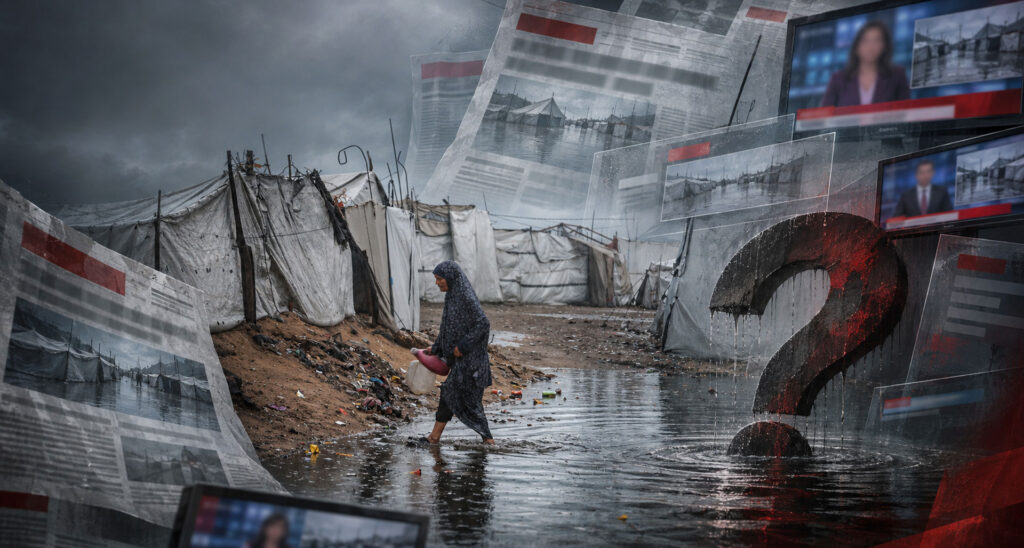
Key Takeaways:
- During a recent autumn storm, the Hamas-run Gaza Government Media Office said 70,000 tents were flooded and three million dollars of damage had been caused by the rainfall.
- Media outlets uncritically echoed these unverified claims, disregarding elementary concerns about how quickly Hamas obtained these very specific statistics.
- Throughout the Israel-Hamas war, there have been repeated instances of media outlets spreading unverified and baseless statistics as part of their anti-Israel narrative.
Over the weekend, an autumn storm passed over the eastern Mediterranean, showering Israel, Lebanon, Syria, and the Gaza Strip.
Like in previous rainy seasons since the war between Israel and Hamas began on October 7, 2023, various media outlets were quick to publish photos of displaced Gazans dealing with flooded tents, impassable roads, and destroyed personal possessions, framing the photos in order to elicit a strong emotional reaction from their respective audiences. There is no doubt that any suffering experienced by displaced Gazans is tragic, but amid a genuine problem is a concerted propaganda effort to capitalize on the situation.
As with previous years, Gaza storm coverage entailed the uncritical regurgitation of Hamas statistics about the effect of the storm on the local population, regardless of how questionable these numbers were.
Soon after the rains reached their zenith this weekend, the Hamas-run Gaza Government Media Office announced that over the previous 12 hours, 70,000 tents of displaced Palestinian families had been flooded and that the initial losses caused by the storm were estimated to be roughly three million dollars.
This claim, that tens of thousands of tents had been flooded in half a day, was then echoed by both state-run anti-Israel media outlets (such as Turkey’s Anadolu Agency and Qatar’s Al Jazeera) as well as more mainstream platforms (such as the BBC and Reuters).
It appears that these news organizations wanted to re-publish Hamas’ talking points so quickly that they never stopped to ask basic questions about what they were spreading to their audiences.
For example, how could Hamas, in a matter of hours and during a downpour, definitively know that 70,000 tents had been flooded? Did the Government Media Office receive tens of thousands of calls from people reporting that their tents were flooded while simultaneously trying to rescue their personal belongings? Did Hamas send out inspectors in the rain to count the number of flooded tents? In other countries, after a disaster strikes, it can take up to a few days for officials to even attain a preliminary estimate of the scope of the damage. In war-torn Gaza, Hamas was able to calculate this figure in less than one day, even as the coastal enclave continued to be battered by rain.
Further, the same Hamas-provided statement that provided the 70,000 tents figure also initially estimated that the damage caused by the rains was three million dollars. This dollar figure included damage to tents as well as unstable buildings that had collapsed in the storm.
Think about this for a second. On the face of it, three million dollars is quite a large sum of money. However, when you divide three million dollars by 70,000 that comes to roughly 43 dollars a flooded tent. Factor in the damage done to buildings and that figure drops even lower. How can it be that 70,000 tents were flooded, damaging and destroying many personal possessions inside those tents, but the damage per tent was roughly 40 dollars? For a family of four living in a tent, the damage was only 10 dollars a person?
A further question that should have been raised by those media outlets that spread Hamas’ press release is why didn’t the terror group, which administers over the part of the territory that holds Gaza’s 2 million residents, take any precautionary steps in anticipation of the coming rain? This was a rainstorm, not an earthquake or typhoon. Meteorologists had been forecasting it for days. The DFLP, another Palestinian terror group based in Gaza, had posted a statement about the coming storm on November 5. Why didn’t Hamas take any measures, such as sandbag placement or ditch digging? Why did no journalist raise these questions at the same time that they parroted Hamas’ talking points?
This isn’t the first time during the Israel-Hamas war that news outlets have uncritically shared unverified statistical claims (all of them portraying Israel in a negative light) without even questioning if the provided numbers were accurate or believable.
Remember the explosion outside Al-Ahli Hospital, when Hamas claimed minutes after it happened that hundreds of people had been killed by an Israeli bomb and this claim was spread like wildfire by the international media?
Or when UN humanitarian chief Tom Fletcher made the absurd claim in May 2025 that 14,000 babies would die in 48 hours if the UN could not get to them and several media organizations ran the story without even second guessing the ridiculous claim?
Or how about how, over the past three years, the media have built an entire anti-Israel narrative out of the Hamas-provided casualty statistics even though these numbers have been marred by inconsistencies and contradictions from day one?
This weekend’s storm is but the first of probably several that will hit the Gaza Strip over the coming winter months, bringing more sorrow to those already suffering the consequences of Hamas’ bloodthirstiness and selfishness.
Will the media’s coverage of the winter in Gaza contain any iota of critical thinking or will news outlets continue to spend these cold months blindly parroting Hamas’ statistics, no matter how ridiculous they become?
Liked this article? Follow HonestReporting on Twitter, Facebook, Instagram and TikTok to see even more posts and videos debunking news bias and smears, as well as other content explaining what’s really going on in Israel and the region. Get updates direct to your phone. Join our WhatsApp and Telegram channels!
© Divuach Ne’eman R”A, 2025