Key Takeaways:
- The National doxxed a Jewish gathering in Glasgow. Protesters turned up at the synagogue, and some attendees stayed away.
- Editor Laura Webster defended naming the venue. She dismissed Jewish security concerns as “shameful whataboutery.”
- After Ben M. Freeman spoke out, David Miller shared a Powerbase page exposing his former family home address and his relatives’ details.
I know that synagogue well. I attended services there growing up. I went to youth events there. Later, I worked there for five years. In 2025, I launched my latest book, The Jews: An Indigenous People, there, surrounded by the community that made me, including the wonderful and beloved Rabbi and Rebbetzin of the synagogue itself.
When I saw footage of the protest outside Giffnock and Newton Mearns Synagogue on Sunday evening, November 22, I knew exactly where those people were standing.
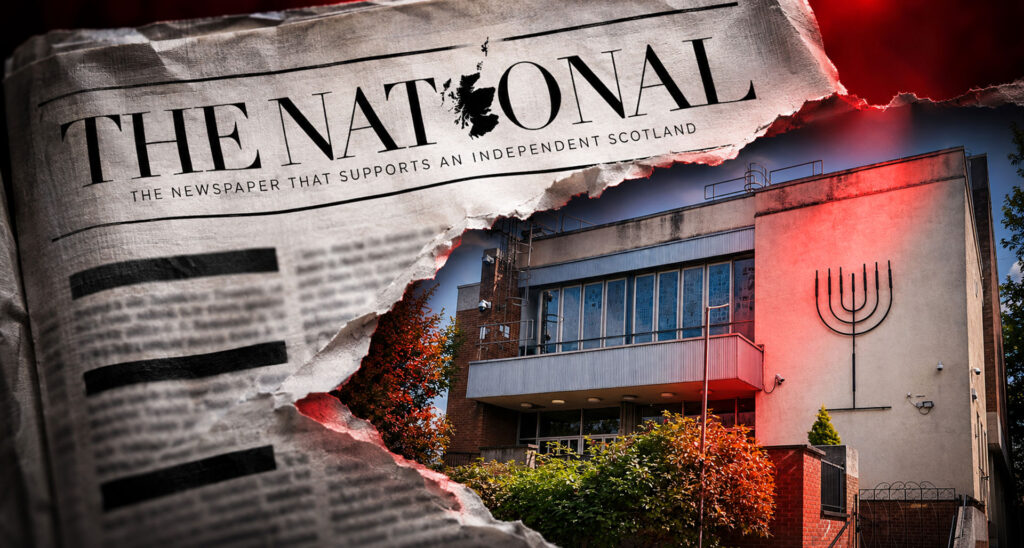
Police Scotland confirmed that officers attended a protest at around 6:15 p.m. and would carry out additional patrols in the area. Demonstrators held placards reading “Zionism is racism.” According to the organizers, protesters chanted “There is only one solution: intifada revolution” outside a synagogue in the heart of Scotland’s largest Jewish community. Some people who had planned to attend stayed away.
When I saw the footage, I said it was sickening. I stand by every word.
What The National Published
Jewish communities in Britain, and indeed around the world, withhold the venues of gatherings in advance because of the very real threat we face. In October 2025, two Jewish men, Adrian Daulby and Melvin Cravitz, lost their lives in the Yom Kippur attack at Heaton Park Hebrew Congregation in Manchester. That same year, the Community Security Trust recorded 3,700 antisemitic incidents across the UK, the second-highest total it had ever logged. British Jews know what that number feels like. We feel it at the door of every shul we enter.
The National, a pro-independence Scottish newspaper, published the venue ahead of the event. Its headline promised that the location had been “revealed.” The story itself said campaigners “believe” the event would be held at Giffnock and Newton Mearns Synagogue. On that basis, a national newspaper named the venue and gave readers details of the planned protest. Anyone who wanted to demonstrate outside the gathering had the information they needed to turn up.
People in Glasgow know where the synagogue stands. What The National revealed was that Jews would be gathering there on a particular evening for an event that campaigners were already mobilizing against. That was the information the community had taken care to withhold. That was what the paper chose to publish.
What Actually Happened Inside
Laura Webster, the editor of The National and the Sunday National, justified the coverage by saying Shivat Zion was “actively promoting emigration to illegal settlements in the West Bank.” This is simply not true, and I can prove it.
I spoke directly to Dov Newmark, an independent Aliyah consultant, who ran the session.
The event held in Glasgow on Sunday evening was purely informational and focused exclusively on the Aliyah process, providing practical guidance on how to prepare for a successful Aliyah and the factors to consider when choosing a suitable community. No particular community was promoted or highlighted, and no political matters were discussed. The event was entirely educational in nature and did not involve any activity or discussion contrary to UK charity guidelines.
I made Aliyah myself this year. I know what it is to have a hundred practical questions about a decision that will change your life. You have to work out what documents you need, which offices to speak to, and what to do when you arrive. Those are the questions people went to my old synagogue to ask. I can imagine sitting in that room because, before I moved, I had questions like theirs.
I know, too, what it meant to me to go. Israel is where our people were born, where our language and our civilization were formed, and the land toward which Jews have turned in prayer for generations. That history was part of my life in Glasgow long before I booked a flight or filled out a form. I learned it in the very community that The National exposed to a protest. I made Aliyah because I wanted to live in the indigenous homeland of my people. I understand why other Jews in Glasgow might want to do the same.
“No Matter the Building”
I challenged Webster directly. To suggest this was “simply Jewish communities gathering,” she wrote on X, was “disingenuous nonsense.” When I told her that Jews in Britain face appalling levels of Jew-hate, and that we protect the venues of our gatherings because of the threat we face, she called it “shameful whataboutery.” The event, she said, “was in the public interest no matter the building it takes place in.”
No matter the building.
The building is a synagogue. It is where Jewish children go to youth club and where Jewish families, including friends of mine, mark the moments that shape their lives. It is where I went to services, where I worked, and where I launched a book. The people arriving that evening were walking into their own community. They had every reason to expect to be able to do that without passing a crowd chanting for intifada.
If Webster believed there was a story about Shivat Zion, she could report it. She could ask what the organization does, who funds it, what advice it gives, and whether what it says publicly matches what it tells people in private. Every one of those questions could have been pursued without publishing where Jews would be gathering that Sunday evening. What public interest did naming the synagogue before the event serve? I have yet to hear her answer that question. Calling Jewish fear “shameful whataboutery” tells me how little weight she gave it.
Then They Came for Me
After I spoke out, anti-Jewish Iranian regime mouthpiece David Miller pointed people to a page about me on Powerbase, the website run by the organization he co-founded. Powerbase published the full address of my former family home and used electoral registers to name members of my family and list the years each of us was registered there. It went through birth, marriage and death records, old newspaper notices and photographs from a Jewish charity dinner in 2011 to identify my parents and siblings. It traced possible relatives back generations, publishing names, maiden names and old addresses along the way. It published photographs of me, my parents and old friends.
That dinner was held at Giffnock and Newton Mearns Synagogue.
My family’s details have no bearing on anything I said about The National. Neither do the identities of the people I sat with at a Jewish charity dinner fifteen years ago. They were there for an evening in their own community. Now photographs from that dinner are being used to identify them and work out how they might be related to me. Powerbase files my own Aliyah under the heading “settlement in occupied Palestine.” I consider the decision to publish my family’s details in that context an act of anti-Jewish racism.
Doxxed, Then Defended
None of this began on the sidewalk outside Giffnock and Newton Mearns Synagogue. It began in The National’s newsroom, under the editorship of Laura Webster.
The National chose to publish the location of a Jewish gathering. People who had intended to go stayed away. That is what doxxing a community looks like. When I told Laura Webster why British Jews take such care over where we gather, she did not apologize. She called it “shameful whataboutery” and insisted the story was in the public interest “no matter the building.”
I grew up in that shul. I worked there for five years. I know what it means to the people who stayed away that night. The National doxxed their gathering. Its editor defended that decision even after she was told what it meant for Jews in Glasgow. I consider that Jew-hate.
Liked this article? Follow HonestReporting on Twitter, Facebook, Instagram and TikTok to see even more posts and videos debunking news bias and smears, as well as other content explaining what’s really going on in Israel and the region. Get updates direct to your phone. Join our WhatsApp and Telegram channels!
© Divuach Ne’eman R”A, 2025