Key Takeaways:
- On November 19, the International Court of Justice ruled that Myanmar committed genocide against the Rohingya minority as part of a 2017 military operation.
- The New York Times, The Guardian, The Wall Street Journal, The Telegraph and Reuters each ran an article linking the Myanmar verdict to South Africa’s genocide case against Israel.
- Three genocide cases were pending at the International Court of Justice when Myanmar was found guilty but the media only focused on the case against Israel.
On November 19, 2026, the International Court of Justice (ICJ) found Myanmar guilty of committing genocide against the Rohingya minority.
The case against Myanmar had been brought before the United Nations’ court of law by The Gambia following a 2017 military campaign that saw the killing of 10,000 Rohingya Muslims and the displacement of over a million others to neighboring countries, particularly Bangladesh.
Following the announcement of the ICJ’s 9-to-6 ruling, media outlets rushed to not only report on the guilty verdict but also to link it to South Africa’s ongoing genocide case against Israel in the ICJ.
ICJ Ruling Coverage Analysis
An HonestReporting analysis of articles published in the days following the Myanmar verdict found that there were tens of articles about the ICJ decision that referenced the case against Israel. Some of these articles mentioned the case against Israel in passing, some dedicated entire paragraphs to it, and some of these articles were entirely focused on the verdict’s effect on South Africa’s allegations against the Jewish state.
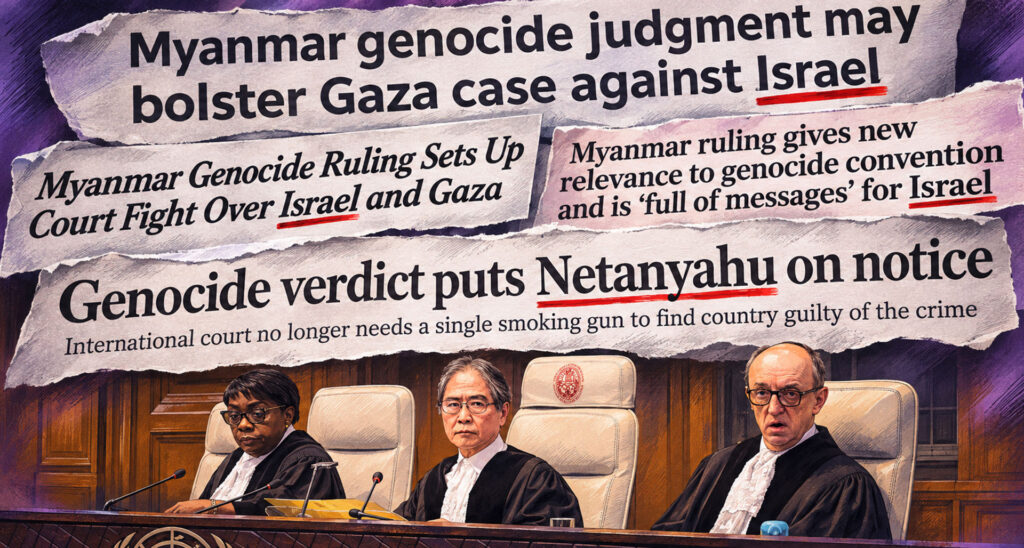
Examples of the latter category include articles published by leading newspapers in both the United States and United Kingdom, including The New York Times (“Myanmar Genocide Ruling Sets Up Court Fight Over Israel and Gaza”), The Guardian (“Myanmar ruling gives new relevance to genocide convention and is ‘full of messages’ for Israel”), The Wall Street Journal (“How the Myanmar Genocide Ruling Raises the Stakes for Israel”), The Telegraph (“Genocide verdict puts Netanyahu on notice”), and Reuters (“Myanmar genocide judgment may bolster Gaza case against Israel”).
While it might appear that this focus on Israel’s connection to the Myanmar case is justified due to Israel facing a similar charge before the ICJ, a closer look finds that the conflation of the two cases has more to do with the media’s obsession with Israel and less to do with an objective analysis of the ramifications of the ICJ verdict for Myanmar, the Rohingya people, and the adjudication of future genocide cases.
Differences Between Myanmar and Israel Cases
First, despite the attempt to create the impression that the cases against Myanmar and Israel are similar, as Yonah Jeremy Bob in The Jerusalem Post notes, there are several key differences between the two states.
Unlike Myanmar, Israel is a democracy with independent institutions and a robust justice system. This should give greater weight to Israeli submissions and evidence presented to the ICJ than what was attributed to Myanmar’s submissions to the Court.
As well, several facets of the crime of genocide that Myanmar was found guilty of are not applicable in the Israeli case. For example, Myanmar was found guilty of preventing births and of forcibly displacing the Rohingya outside their territory. The same cannot be said of Israel’s actions in Gaza, where no anti-Palestinian birth campaign has been undertaken and the vast majority of the roughly two million Palestinians who lived in Gaza on October 7, 2023 still reside within the coastal enclave.
Similarly, Myanmar was also found guilty of systemic rape and of attacking fleeing civilians while also not providing them with safe corridors. The rape accusation has no relevance to the case against Israel and, despite complications that arose, Israel provided safe passage for Gazan civilians to flee battle zones for safer areas throughout the war.
Media Ignores Other Genocide Cases
In addition to the genocide case against Myanmar and the genocide case against Israel not being entirely similar, the media’s attempt to wedge Israel into reports on the ICJ verdict against Myanmar is even more misleading when you realize that there are two other genocide cases before the ICJ at the moment.
In 2022, Ukraine initiated a case against Russia under the Genocide Convention in response to Russia’s invasion of its western neighbor in February of that year. In June 2026, the Democratic Republic of Congo began proceedings in the ICJ against Rwanda, accusing its neighbor of having committed genocide and other crimes on its territory over the past 30 years.
Despite there being three genocide cases currently before the ICJ when the Myanmar verdict was given, news outlets jumped on connecting the verdict to Israel’s case, ignoring the other two contemporary cases.
It is clear that, by wedging Israel into reports on the genocide verdict that was brought down against Myanmar, the media was satisfying an obsession that it has with the Jewish state. If there are three genocide cases currently pending before the ICJ, why did the media only focus on how the Myanmar decision will affect Israel? If there are substantial differences between the actions of Myanmar and Israel, why did the media seek to draw a parallel between the two cases?
As bad enough as it is for the media to try to bend its coverage of the Myanmar case in order to make it about Israel, what makes this even worse is that it removes the spotlight away from the Rohingya Muslim victims of Myanmar’s actions.
Disproportionate focus on Israel as part of media coverage of the Myanmar verdict is not only journalistic misconduct but is morally reprehensible.
Liked this article? Follow HonestReporting on Twitter, Facebook, Instagram and TikTok to see even more posts and videos debunking news bias and smears, as well as other content explaining what’s really going on in Israel and the region. Get updates direct to your phone. Join our WhatsApp and Telegram channels!
© Divuach Ne’eman R”A, 2025