Key Takeaways
- One call, five stories: The Obama–Mamdani exchange was framed in five different ways – proving how headlines shape perception.
- Bias hides in framing: Each outlet stuck to facts but used tone and emphasis to steer readers toward its own narrative.
- Media literacy matters: In a headline-driven world, understanding how news is told is as vital as knowing what happened.
As New Yorkers prepare to go to the polls on Tuesday, November 4, what once appeared to be a comfortable victory for Democratic frontrunner Zohran Mamdani has turned into what appears to be a tight contest. Nearest rival Andrew Cuomo has, according to polls, steadily closed the gap in recent days, injecting a new level of tension into an already polarized race.
Against this backdrop, one short phone call between former U.S. President Barack Obama and Mamdani became the story of the weekend – not because of what was said, but because of how it was reported.
Last week, Obama reportedly phoned Mamdani, praising his campaign as “impressive to watch” and offering to serve as a “sounding board” should Mamdani win. It was a polite, measured gesture – the kind of encouraging outreach that seasoned politicians often extend to rising figures in their party. What it was not was an explicit endorsement.
Yet depending on which outlet one read, the same exchange was either an emphatic seal of approval, a discreet act of political backing, or a quiet rebuke. In less than 24 hours, headlines from across the media spectrum transformed a single conversation into five radically different realities.
1/
?Less than 24 hours before NYC votes for its next mayor, headlines about one phone call show exactly why media literacy matters.Did Barack Obama really endorse Zohran Mamdani?
Let’s look at what he said – and how media outlets spun the same story.? pic.twitter.com/iyJgO6TN1o
— HonestReporting (@HonestReporting) November 3, 2025
The New York Post: Rejection as Headline
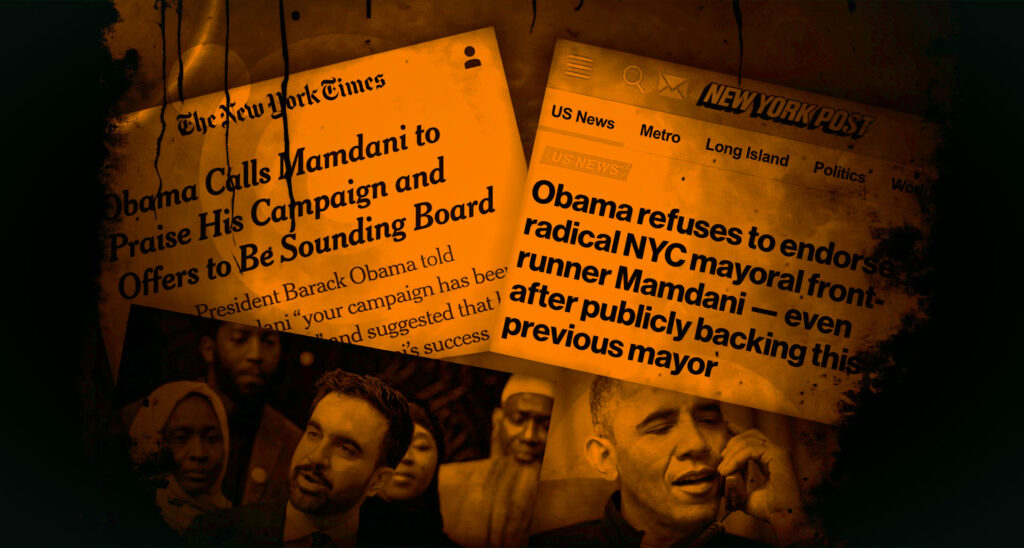
“Obama refuses to endorse radical NYC mayoral front-runner Mamdani,” read the New York Post’s headline.
Technically, it was true: Obama did not offer a public endorsement. But the framing was unmistakably negative. The word “refuses” suggests deliberation and disapproval, implying that Obama consciously distanced himself from Mamdani’s politics.
This is one of the oldest tricks in the media playbook: use a technically accurate phrase to imply a story that doesn’t exist. The Post headline fits neatly within its broader editorial stance, which tends to highlight divisions within the Democratic Party.
The New York Times: Praise as Endorsement
At the opposite end of the spectrum, The New York Times led with: “Obama calls Mamdani to praise his campaign and offers to be sounding board.”
While factually accurate, the story’s tone conveyed something more than mere admiration. By emphasizing that Obama was “invested in Mamdani’s success beyond the election,” the Times effectively framed the call as a tacit endorsement.
The Times didn’t fabricate quotes, but its selective emphasis shaped perception just as powerfully. Omitting what Obama didn’t say – namely, any encouragement to vote for Mamdani – allowed readers to infer enthusiasm that wasn’t explicitly expressed.
The Telegraph: Invention by Interpretation
In the United Kingdom, The Telegraph took the story several steps further. “Obama privately backs radical socialist Zohran Mamdani for New York mayor,” its headline declared.
The phrase “privately backs” is a contradiction in terms. Endorsements are, by definition, public. To describe a phone call as a “private backing” is to cross the line from interpretation into invention. The headline neatly served the British paper’s favored narrative of the American left’s radical drift – but accuracy was sacrificed in the process.
Fox News and CBS: The Appearance of Neutrality
Fox News took a simpler approach: “Obama calls NYC mayoral frontrunner Mamdani just days before crucial election.”
Meanwhile, CBS News opted for: “Obama, Mamdani talk as Election Day approaches.”
Both avoided overt editorializing, yet even neutrality can shape perception. “Talks” and “calls” sound harmless, but placed within an election-week context, they imply strategic coordination. By highlighting timing without clarifying content, these headlines invited readers to speculate about motives.
View this post on Instagram
Why It Matters
One phone call. Five headlines. Five interpretations.
Each version tells us less about what actually happened than about the editorial cultures that produced them. The Post turned caution into rejection. The NYT turned politeness into endorsement. The Telegraph turned inference into fiction. Even the more restrained outlets used implication as a narrative tool.
This small media experiment illustrates a larger truth: headlines don’t just report events – they frame them. The framing determines what readers believe before they even reach the first paragraph.
In an era when most people consume news through notifications, social media feeds, or screenshots of headlines divorced from their full stories, that framing power has never been greater.
Learning to identify bias, selective emphasis, and loaded language is therefore essential. It’s not about distrusting every journalist; it’s about understanding how news is constructed. Even well-intentioned reporting can distort reality through tone, omission, or context.
The Obama-Mamdani coverage was a textbook example of how five legitimate outlets can produce five versions of “truth” from one fact. For voters, that’s more than a curiosity – it’s a reminder that informed citizenship now requires a skill once reserved for editors: media literacy.
And in an even more complicated and emotive story like the Israel-Hamas war, where media coverage is part of the battlefield, media literacy is absolutely vital.
To learn how to read between the headlines and recognize bias before it shapes your views, see HonestReporting’s Quick Guide to Media Literacy.
Liked this article? Follow HonestReporting on Twitter, Facebook, Instagram and TikTok to see even more posts and videos debunking news bias and smears, as well as other content explaining what’s really going on in Israel and the region. Get updates direct to your phone. Join our WhatsApp and Telegram channels!
© Divuach Ne’eman R”A, 2025