Key Takeaways:
-
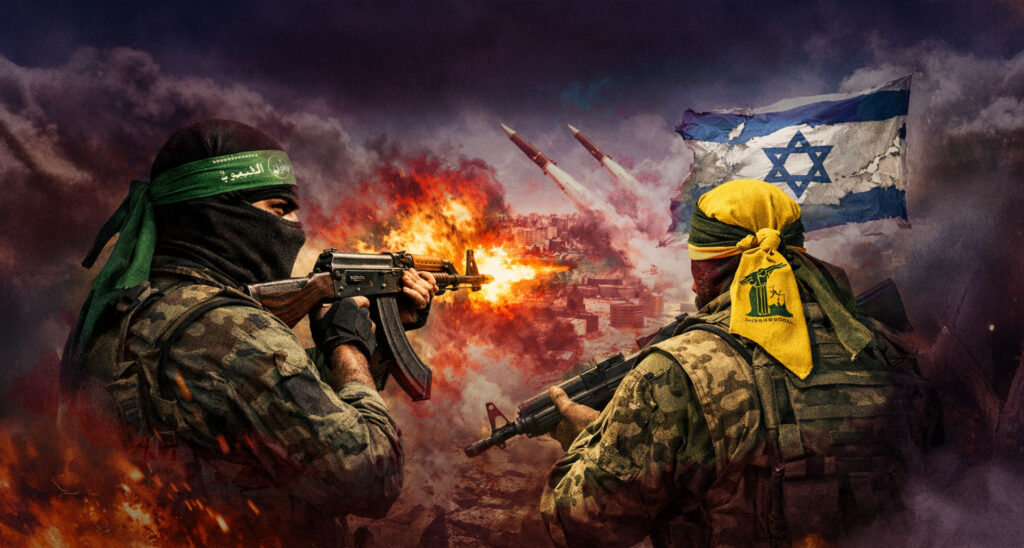
Terrorists are breaking the ceasefires, not Israel: Hamas (79 violations) and Hezbollah (nearly 2,000) have repeatedly attacked, rearmed, and sabotaged agreements meant to bring calm.
-
Israel responds to protect its citizens: Every Israeli action follows documented breaches and reflects its legal right to self-defense, not “escalation.”
-
Media misleads by omitting key facts: By downplaying violations, coverage flips blame onto Israel and obscures who is actually undermining peace.
Ceasefires are meant to bring relative quiet to the parties that have agreed to them. Unfortunately, Israel knows all too well that when dealing with terrorist organizations, quiet is rarely guaranteed, even after the signing of a ceasefire agreement.
It should be abundantly clear to the media that terrorist organizations are not interested in peace because this contradicts their very modus operandi. Yet the media has consistently omitted the ceasefire violations being committed by terrorist organizations, and instead has been shifting the responsibility for the lack of stability and peace onto Israel alone.
Israel has adhered to the agreements it signed with both Hamas and Hezbollah. Consistent violations by both of these terrorist organizations have resulted in Israel taking military action in Gaza and Lebanon to ensure the safety of its citizens and the security of the state. Only when the terrorist organizations have not upheld their end of the agreement as required has Israel taken action.
Israel-Hamas Ceasefire
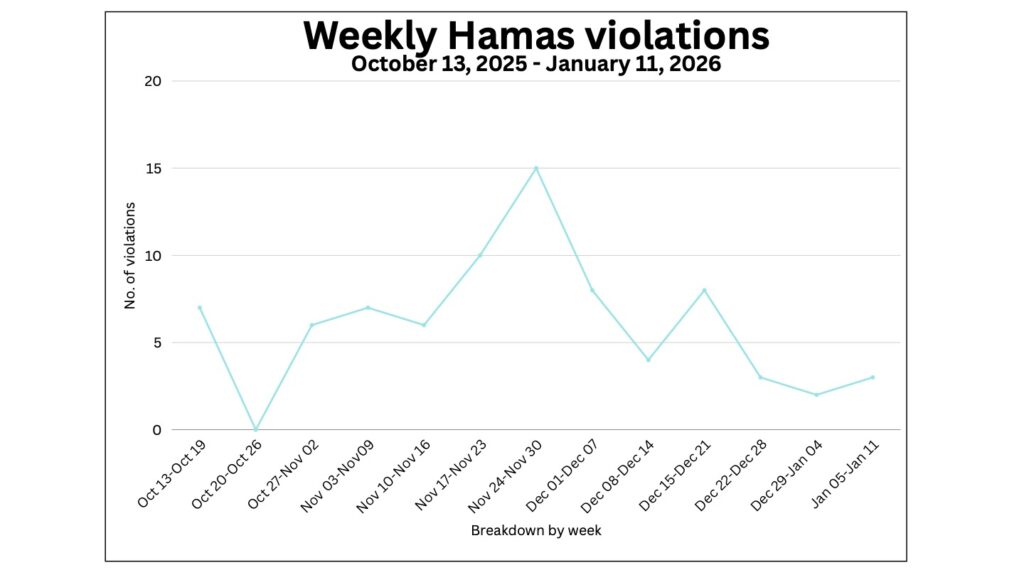
Graph based on data from The Long War Journal.
On October 9, 2025, Israel and Hamas signed a ceasefire agreement after two years of war. The Long War Journal, published by the Foundation for Defense of Democracies (FDD), has tracked every violation by Hamas since the ceasefire, up to January 8, 2026. Through a series of articles published every few weeks that detail the violations, the Long War Journal’s data shows that Hamas violated the ceasefire a total of 79 times.
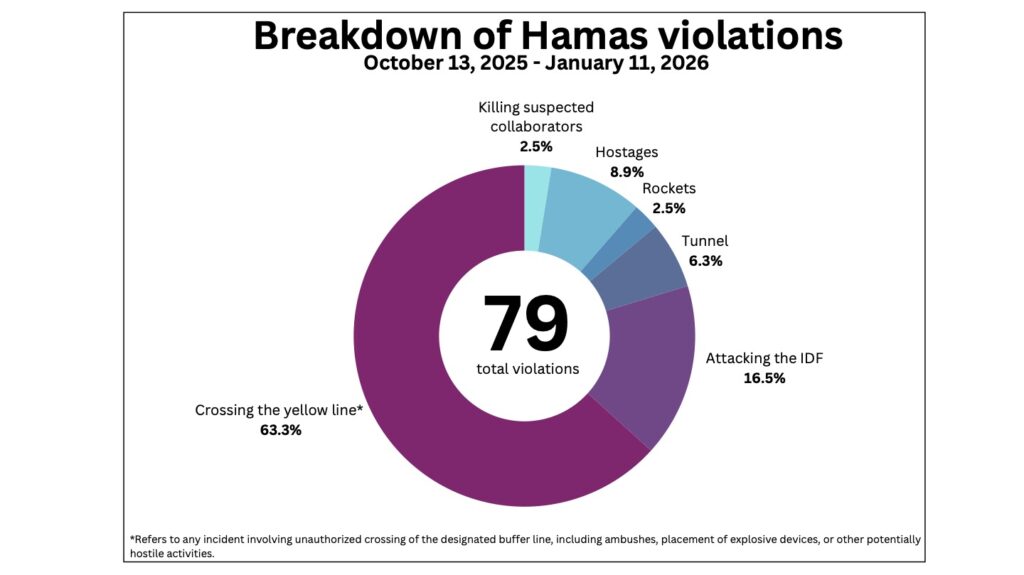
Graph based on data from The Long War Journal.
While the deal has several stages, one of the main components was the return of all hostages to Israel, both living and deceased. At the time of the agreement, 48 hostages remained in Gaza. According to the data compiled from the Long War Journal, Hamas has violated this provision seven times by delaying the release of hostages, handing over a body that was not the body of a hostage, staging the release of a body, and returning parts of a body previously recovered by the IDF.
View this post on Instagram
As of this time of writing, the body of one hostage, Ran Gvili, is still being held by terrorist organizations in Gaza. It is perhaps one of the most explicit violations of the agreement, which called for all hostages to be released within 72 hours of Israel’s withdrawal from certain areas in the Gaza Strip. While the media might be moving on to Stage 2 of the ceasefire agreement, Israel can only do so once Gvili’s body is returned.
Why not, “New blow to Gaza peace deal as Hamas still hasn’t returned the body of hostage Ran Gvili,” @IrishTimes?
Hamas hasn’t fulfilled its obligations under the ceasefire agreement. How about holding the terrorist org accountable instead of solely blaming Israel? pic.twitter.com/aHCCd666T6
— HonestReporting (@HonestReporting) January 7, 2026
Beyond the mishandling of hostages, Hamas has also violated the ceasefire by attacking the IDF 13 times, which involved sniper or RPG attacks, ambushes, detonations, storing weapons, and individual terrorist leaders advancing plots against the IDF in Gaza. Some of these violations have resulted in the deaths of IDF soldiers, underscoring that this is not a technical breach but a premeditated continuation of warfare. Terrorists have also breached the ceasefire using tunnels on five separate occasions, emerging from the underground system as an attempt to commit one of the above attacks.
Another 50 ceasefire violations come from terrorists crossing the yellow line into an area controlled by Israel, as agreed upon in stage 1. These incursions are not incidental, as many of the unauthorized crossings of the yellow line also involve terrorists seeking to ambush Israeli troops, plant explosive devices, or commit other hostile activities that pose an immediate threat to the IDF.
“Israeli fire kills three people in Gaza,” writes @Reuters.
Omitted: they were terrorists who crossed the yellow line, breaking the ceasefire.
Once again, Reuters hides the terrorism – but never misses a chance to blame Israel. pic.twitter.com/4n8oICokfm
— HonestReporting (@HonestReporting) November 4, 2025
When such violations are ignored or stripped of context, Israel’s defensive responses are falsely framed as escalations rather than obligations to protect its forces and population. Yet in reporting on the yellow line and Israel’s inevitable countermeasures, the media has more often than not omitted these critical facts and, in doing so, has distorted the reality of who is violating the ceasefire and at whose expense.
The breaking of the ceasefire is not only a danger to Israel, but also to Palestinians living in Gaza. Hamas has turned its violence inward, targeting Palestinians suspected of collaborating with Israel on at least two occasions. Additionally, Hamas has loaded or launched rockets on two different occasions. Most recently, the launch failed and fell inside Gaza near a hospital. These actions expose the central truth often missing from media coverage that Hamas’ refusal to disarm is not symbolic or political. It is an ongoing, tangible threat, and yet this continued militarization and the civilian danger it creates are routinely omitted from reporting.
Israel-Hezbollah Ceasefire
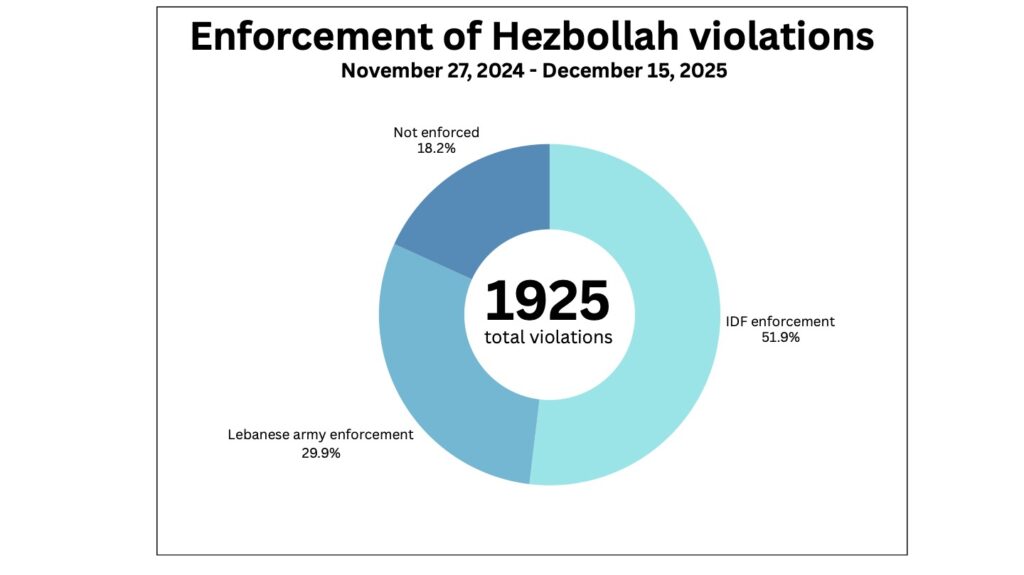
Graph based on data from Doron Kadosh.
On November 27, 2024, after just over one year of war with Hezbollah, which began following the Hamas terrorist attacks on October 7, 2023, Hezbollah and Israel agreed to a ceasefire. Since then, Hezbollah has violated the ceasefire 1,925 times. Of that, Israel has responded 998 times, and the Lebanese army 575 times.
While there is less information about each specific violation by Hezbollah, it is evident that the terrorist organization has no intention of abiding by the agreement by disarming and remaining beyond the Litani River. From January 2 until January 11, the IDF X account has reported seven different responses to Hezbollah violations. This includes the targeting of terrorist infrastructure, including weapons facilities and training compounds currently being used by terrorists, launch sites, and terrorists working to advance attacks or rebuild infrastructure.
Despite the glaringly obvious violations, the media has still worked tirelessly to turn a blind eye to Hezbollah’s consistent violations – reported to average seven per day in July 2025 – and the terrorist organization’s persistence in its goal of rearming, rebuilding its infrastructure, and destroying Israel has not withered.
“Israel hasn’t upheld their end of the ceasefire agreement,” according to @SkyNews‘s @YousraElbagir.
No mention whatsoever of Hezbollah’s failure to disarm or its efforts to rebuild and reassert itself in southern Lebanon in breach of the ceasefire agreement. https://t.co/0htPoft5NB pic.twitter.com/Vk0A3Hvb62
— HonestReporting (@HonestReporting) December 29, 2025
The ceasefire agreement explicitly states that Israel is allowed to practice its “inherent right of self-defense” while adhering to international law. With Hezbollah’s refusal to disarm and move beyond the Litani River as required by this agreement, Israel has every right to exercise acts of self-defense to ensure there will no longer be a threat on the northern border.
Except Hezbollah hasn’t ceased, and that’s why Israel is firing.
Not firing rockets into Israel is only a small part of Hezbollah’s ceasefire obligations. Rebuilding its forces in southern Lebanon is a violation.@CNN‘s @bencnn won’t give you the full picture. pic.twitter.com/71hEHsJcQf
— HonestReporting (@HonestReporting) November 30, 2025
Because Hezbollah is a multifaceted hybrid, deeply embedded within Lebanese society, the media’s reporting frequently minimizes or obscures the extent to which it is classified as a terrorist organization. In doing so, Hezbollah is implicitly absolved of its requirement to uphold the agreement.
Terrorist groups, @AP.
That’s the term you’re looking for. pic.twitter.com/V1WxWZYWM2— HonestReporting (@HonestReporting) January 8, 2026
Despite the ceasefires with Hezbollah and Hamas, the threat of both terrorist groups looms as they refuse to abide by the deal, most crucially by declining to give up their power and disarm. As a result, Israel has had to take action against both terrorist organizations to restrain them and ensure the security of the state.
For the past two and a half years of war, the Western media has found any excuse to shift the blame onto Israel, and the aftermath of the ceasefires is no different. The context of terrorist groups refusing to adhere to the agreement is frequently missing from reporting. Any article that mentions the fragility of the ceasefires must include the violations by the terrorist organizations or otherwise risk obscuring the truth on the ground and covering for terrorists.
Liked this article? Follow HonestReporting on Twitter, Facebook, Instagram and TikTok to see even more posts and videos debunking news bias and smears, as well as other content explaining what’s really going on in Israel and the region. Get updates direct to your phone. Join our WhatsApp and Telegram channels!
© Divuach Ne’eman R”A, 2025