Key Takeaways:
- When Saudi Arabia is reported to be urging continued war, it is treated as routine diplomacy. When Israel is alleged to do the same, it is framed as manipulation and control.
- Claims that Israel “pushed” the United States into war are widely asserted, despite limited proof.
- All governments lobby for their interests and attempt to shape outcomes. What is unique is not the behavior, but how Israel’s actions are consistently reframed as sinister.
“Trump Keeps Iran War Going After Pressure From Saudi Crown Prince”
“Saudi Arabia Drives Trump’s Decision to Continue Iran War”
“Trump Continues Iran War to Serve Saudi Interests, Sources Say”
You didn’t read those headlines.
But you would have if the media treated every country the way it treats Israel.
Instead, these are hypothetical headlines. A thought experiment. Because when it comes to Israel, this is precisely how complex geopolitical dynamics are flattened into a simple, familiar accusation: manipulation.
On Tuesday, The New York Times reported that Saudi Arabia’s Crown Prince Mohammed bin Salman had used recent calls with President Donald Trump to “push” him to continue the war against Iran.
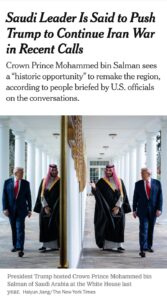
Citing unnamed U.S. officials, the report claims that bin Salman sees the conflict as a “historic opportunity” to reshape the region, and believes Trump “must press toward the destruction of Iran’s hard-line government.”
The article is clear: Saudi Arabia is advocating for regime change in Iran and pressing the United States to see the war through.
The same report states that bin Salman warned Trump that Iran poses a long-term threat to the Gulf that can only be eliminated by removing its current leadership.
It also draws a contrast between Saudi and Israeli objectives. According to the Times, Israel would accept a weakened Iranian state, one consumed by internal turmoil and less capable of projecting power outward. Saudi Arabia, by contrast, allegedly views such an outcome as dangerous: instability on its doorstep rather than a neutralized adversary.
It also notes that both Saudi and American officials fear a prolonged war could expose Saudi oil infrastructure to sustained Iranian retaliation and drag the United States into an extended conflict.
And yet – despite the weight of these claims – the framing is strikingly restrained.
There is no suggestion that Saudi Arabia is driving American policy. No breathless speculation about undue influence. No sweeping narrative about Riyadh “dragging” Washington into war.
Instead, readers are presented with a familiar diplomatic reality: allies advocate for their interests. Leaders speak and arguments are made.
The story remains – as it should – one of competing strategic perspectives, not shadowy control.
Now compare that to how Israel is covered.
For weeks, a different narrative has saturated headlines, commentary, and social media: that Israeli Prime Minister Benjamin Netanyahu pressured or even pushed the United States into war with Iran.
Search the phrase “Netanyahu pressured Trump into war,” and you are met with a flood of results.
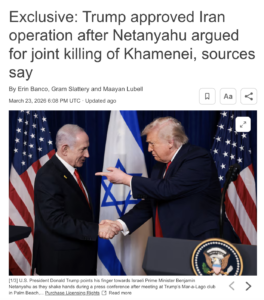
Just days ago, Reuters published an “exclusive” report that Trump approved military action after Netanyahu argued for a joint strike on Iran’s leadership. The implication, repeated across platforms, is unmistakable: Israel didn’t merely advocate for its security interests, but engineered the war itself.
This narrative has been present since the very start of the war, a month ago.
It was amplified by figures like former counterterrorism head Joe Kent, who, following his resignation, quickly entered the conspiratorial podcast circuit, including an appearance with Tucker Carlson, where he advanced increasingly absurd claims.
Among them: that Israel, or Israel-aligned actors, bore responsibility for the killing of Charlie Kirk.
But it was Kent’s broader assertion – that the United States went to war at Netanyahu’s behest – that gained real traction.
As HonestReporting has shown, that claim was rapidly spread by coordinated networks, including hostile non-Western accounts linked to Russia and Pakistan with a clear interest in fracturing U.S.-Israel relations.
? THREAD: This was coordinated.
Joe Kent goes on Tucker Carlson. Within minutes, the exact same clip, same caption, same outrage floods the internet.
Not organic. Not coincidence.https://t.co/JyoNJTTBSh Labs tracked it in real time.
What we found will shock you. pic.twitter.com/U7Mdg7ygCH— HonestReporting (@HonestReporting) March 19, 2026
And yet, when presented with similar reporting that Saudi Arabia is actively encouraging the continuation of the war, the reaction is… muted.
No viral outrage. No accusatory headlines. No sweeping claims of manipulation.
When Israel speaks, it is cast as controlling; when others speak, it is diplomacy. When Israel argues for its security, it is framed as coercion; when others do the same, it is strategy.
The reality is straightforward: world leaders advocate for their national interests, make their case to allies, and attempt to shape outcomes. That is not unique to Israel. It is the foundation of international relations. And in Israel’s case, it is not even clear that such pressure occurred in the way it has been so confidently asserted.
What is unique is how Israel’s actions are consistently reframed, stripped of context, inflated in intent, and recast as something far more sinister. If the same standards were applied evenly, the headlines would look very different. But they aren’t. And that speaks volumes.
Liked this article? Follow HonestReporting on Twitter, Facebook, Instagram and TikTok to see even more posts and videos debunking news bias and smears, as well as other content explaining what’s really going on in Israel and the region. Get updates direct to your phone. Join our WhatsApp and Telegram channels!
© Divuach Ne’eman R”A, 2025