Key Takeaways:
- Mainstreaming the fringe: The Green Party’s rise is bringing ideas once confined to activist spaces into British electoral politics, giving them greater legitimacy and reach.
- Identity as shield: Party leader Zack Polanski’s Jewish background is not incidental. It functions within the discourse to deflect scrutiny and reframe criticism, complicating how anti-Jewish narratives are perceived and challenged.
- Narratives over events: Media coverage is not just reporting developments but shaping them, normalizing certain frameworks while reframing criticism as attack, creating a layered system that reinforces legitimacy.
From Fringe to Force
For American readers, the Green Party of England and Wales is not typically seen as a major political force. It has long existed on the fringes of British politics, associated primarily with environmental campaigning and a broader activist left.
But that positioning is shifting in ways that matter. Polling in late March placed the Greens in second place nationally, behind Reform UK, and their recent by-election win in Gorton and Denton confirmed that this is no longer a protest party but an emerging political force. What was once marginal is now entering the mainstream, and with that shift comes not only greater visibility, but greater influence over how political language itself is shaped.
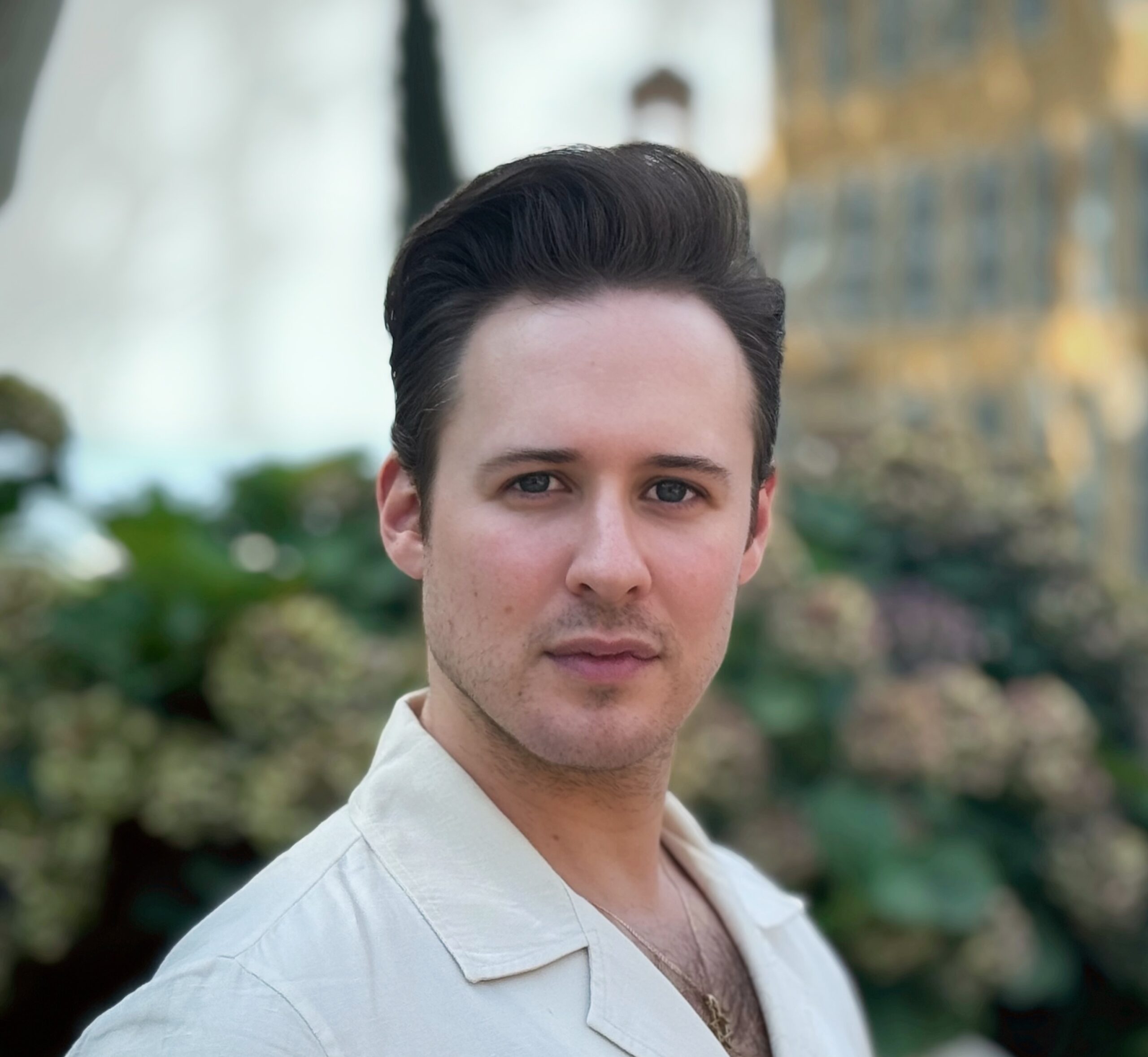
That rise is closely tied to figures like Zack Polanski, who has positioned himself, and been positioned by others, as part of a new left-wing alternative. For American readers, he is often compared to Jeremy Corbyn, whose leadership of Labour became defined by prolonged and deeply contested debates over Jew-hate and the boundaries of political discourse around Israel. Those debates did not disappear. They migrated. They re-emerged in new political spaces, and they are now unfolding within a party that is itself gaining electoral legitimacy.
Identity, Legitimacy, and Political Framing
Polanski’s own Jewish background adds another layer to this dynamic. He has spoken about his Jewish heritage and family history, which makes his political positioning particularly salient within these debates. Identity, however, does not determine how that identity is expressed. In some cases, it can intersect with broader ideological frameworks in ways that critics argue reflect a form of internalized anti-Jewishness, where Jewish identity is articulated through external narratives that challenge Jewish collective self-definition.
Zack Polanski – the useful court Jewhttps://t.co/jLkX8fuI2B
— The Jewish Chronicle (@JewishChron) March 30, 2026
That tension is not abstract. It has reportedly surfaced within his own family, with claims that relatives have said they would consider leaving the country if he were to come to power. Whether understood as anecdotal or symbolic, it reflects the extent to which these questions are no longer confined to political theory but are being experienced as immediate and personal.
This process of legitimization is reinforced across multiple layers of the media. Mainstream outlets such as The Guardian have framed the Greens’ growth as a story of political renewal, while also portraying Polanski in explicitly moral and civic terms. At a large anti–far-right rally, he was quoted as saying: “There have been dark times. I know people have been scared, and we have been afraid, but days like this are here to send a message, a message to Tommy Robinson, to Nigel Farage, to those who appease them.”
That framing matters. It presents him not simply as a political actor, but as part of a broader democratic resistance to extremism. In doing so, it reinforces his legitimacy and embeds him within a moral narrative that is widely recognizable and politically resonant.
Other outlets reinforce this dynamic in different ways. Coverage in The National has focused on Polanski’s pushback against accusations of Jew-hate, framing the issue as one of media distortion or bad-faith reporting rather than substantive concern. This shifts the center of gravity away from the content of the allegations and toward the motives of those reporting them, further stabilizing his public position.
Narratives of Power and the Media Ecosystem
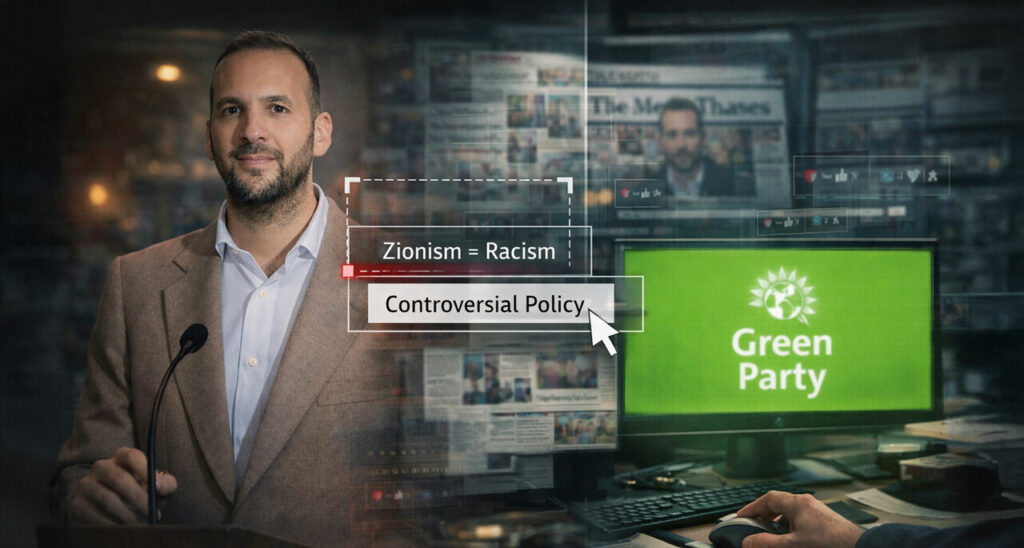
The immediate controversy centers on a motion within the Greens seeking to define Zionism as racism. That framing has a long history, but what transformed this into a broader story was not simply the motion itself, but how its delay was interpreted and reported. The vote was delayed amid internal disruption, a not uncommon feature of party conferences.
But the explanation that began to circulate reframed the situation entirely. Journalist Nicole Lampert reported that a WhatsApp message described the delay in the following terms: “What we experienced yesterday was the power of the US-Israel lobby controlling our party and disrupting our democracy.”
It’s day 2 of the Green Party online conference and some people are still smarting that they ran out of time to debate the hateful ‘Zionism is racism’ motion which thousands of activists had joined the party to vote for.
A few hours ahead of a workshop on fighting antisemitism…— Nicole Lampert (@nicolelampert) March 29, 2026
That sentence does not simply describe an event. It introduces a framework. It shifts the explanation from internal political dynamics to the idea of external, coordinated interference. What could be understood as procedural failure or factional disagreement is instead recast as the result of hidden influence.
This is where the reporting itself becomes central to the story. Because the issue is not only what happened inside the party, but how that moment was narrated, amplified, and contested across different media ecosystems.
On one side, coverage has highlighted the conspiratorial implications of invoking a “U.S.-Israel lobby,” placing it within a broader pattern in which Jews, or those associated with Jewish collective interests, are framed as exercising hidden power.
On the other, a spectrum of left-wing and activist media has worked to invert that framing. Outlets such as Novara Media have suggested that allegations of Jew-hatred function as a political tactic aimed at undermining the Greens, while platforms such as The Canary go further by treating the language of “Israel lobby” influence as a legitimate explanatory framework rather than something requiring scrutiny.
The result is not a single narrative, but a layered system of reinforcement. Mainstream outlets normalize the party’s rise and position its leadership within the language of democratic legitimacy. Adjacent outlets defend it. Activist platforms reframe criticism as attack or validate the underlying claims. Social media accelerates all of it simultaneously. The effect is cumulative. The event itself becomes secondary to the narratives constructed around it.
What makes this more than a routine political dispute is the recurrence of a particular explanatory pattern. Political processes are rarely smooth. Votes are delayed. Motions are contested. Internal factions clash. But when those dynamics are repeatedly interpreted through the lens of hidden Jewish or pro-Israel influence, something deeper is taking place.
The language shifts from politics to suspicion. From disagreement to insinuation. It introduces the idea that outcomes are not the result of democratic contestation, but of unseen actors exerting control from outside it.
At the same time, the individuals and ideas associated with these frameworks are being normalized through media coverage that emphasizes their role as legitimate actors within democratic politics, particularly as a counterweight to the far right. That dual process matters. It allows language that would otherwise be interrogated to circulate within a space that is increasingly treated as politically credible.
1/
The UK Green Party’s Zack Polanski is not representative of & doesn’t identify with the UK’s mainstream Jewish community.He speaks as a politician, not as a Jew.@SkyNews mentions his Jewish background only to present Polanski as a fig leaf for its own anti-Israel agenda. pic.twitter.com/IU1zb9nZxy
— HonestReporting (@HonestReporting) September 10, 2025
For an American audience, the significance of this moment lies not only in the internal dynamics of a single UK political party, but in what it reveals about how legitimacy is constructed. The Greens’ rise in the polls means that ideas once confined to activist spaces are entering the mainstream.
But they are not entering it neutrally. They are being carried, shaped, and in some cases shielded by a media environment that does not simply report political change, but participates in defining its boundaries.
The result is a political space in which actors advancing what critics would describe as anti-Jewish frameworks can simultaneously be positioned as legitimate participants in democratic life. That tension is not incidental. It is produced through the interaction between politics and media, and it is what makes this moment worth paying attention to.
Liked this article? Follow HonestReporting on Twitter, Facebook, Instagram and TikTok to see even more posts and videos debunking news bias and smears, as well as other content explaining what’s really going on in Israel and the region. Get updates direct to your phone. Join our WhatsApp and Telegram channels!
© Divuach Ne’eman R”A, 2025