Key Takeaways:
- A New York Times interview identifies Tucker Carlson’s antisemitic tropes but repeatedly fails to rigorously challenge or fact-check his claims about Israel and Jewish influence.
- By allowing Carlson’s assertions about Israel driving U.S. wars to go largely unanswered, the interview risks legitimizing conspiracy theories in mainstream discourse.
- The New York Times is more comfortable discussing antisemitism as rhetoric or perception than directly confronting false factual narratives about Israel.
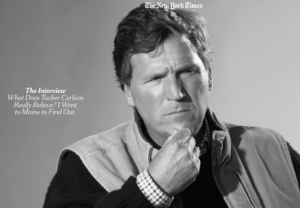
Like everyone who has sat down in recent months to interview Tucker Carlson, the New York Times’s Lulu Garcia‑Navarro too often allows him to do what he does best: answer anything and everything with a mixture of sophistry, dishonesty and vagueness.
She does a better job than most. Economist editor‑in‑chief Zanny Minton Beddoes, for example, all but avoided Carlson’s most insidious claims about Israel and Jews in her own interview, preferring to spar with him on safer, domestic territory. Garcia‑Navarro, by contrast, doesn’t duck the subject at all.
Naming the Trope Without Truly Challenging It
She pointedly asks him about “rhetoric where everything is blamed on Israel, where Israel is seen as the core of all of these problems,” and notes how his rhetoric “has echoes of the Protocols of the Elders of Zion,” rhetoric that “opens the door to this idea that there is a very powerful sect of Jewish people who want global war and global conflict.” She challenges his platforming of Nick Fuentes and ties it to Holocaust denial and to the way dehumanizing language paves the way for mass violence.
“The Holocaust didn’t start with the gassing of Jews. It started with the dehumanization of Jews, with the way that they were spoken about, with the language that was used,” she tells him. It is a powerful line. But she follows it with a curiously soft question: “Why do you think you get tagged so often with antisemitism?”
“Tagged” as antisemitic? Tagged? Why ask Carlson how he feels about the label rather than confront him with his own words? Why press him him on his claim that Dick Cheney’s office was “completely controlled… by people who were putting Israel’s interests above America’s interests,” or his description of Donald Trump as a “slave” to Benjamin Netanyahu and his “advocates in the United States,” and ask him directly how that is not trafficking in classic antisemitic narratives about Jews driving wars? Why not force him to account for his line that “Israel pushed the United States president” into war with Iran and sought to keep the conflict going until Iran was “destroyed and chaotic, which is the Israeli goal”?
The Question Garcia-Navarro Never Really Asked
What Garcia‑Navarro too often fails to do is what so many interviewers before her have also failed to do: ask Carlson for evidence and stay on the claim until he either substantiates it or admits he cannot. When he portrays Trump as a “hostage” and “slave” to Netanyahu and suggests Israeli leaders drove both the Iraq and Iran wars, she largely lets those claims stand without demanding proof in the moment.
At his most evasive, Carlson falls back on one of his most familiar tactics: either feigning ignorance or retreating into an undefined “they.” To her credit, Garcia‑Navarro does at one point press him on that famous “they” – asking him explicitly who “they” are when he talks about shadowy forces pushing Trump toward war. That, precisely, is what a good interviewer should do.
1/5
The viral @nytimes clip where Tucker Carlson toys with calling Trump the “Antichrist” is clickbait. The most revealing parts of the interview – in clips below – aren’t about theology at all, but about Israel, where his worldview and conspiratorial ideas are laid bare. ⬇️⬇️⬇️ pic.twitter.com/MDV5ZVgn5O— HonestReporting (@HonestReporting) May 7, 2026
Carlson’s “They” and the Return of Old Conspiracies
But then, at other moments, she lets him wriggle away. She raises the Protocols of the Elders of Zion herself, clearly aware of how central that forged text is to the idea of a Jewish cabal manipulating global events. Carlson responds by saying he has merely “heard references to it” and that it is “like a Tsarist forgery or something.” This is one of the most prominent right‑wing media figures in America, a man who opines constantly about antisemitism, Jews, and Israel. How is it conceivable that he has not properly “heard of” one of the foundational antisemitic texts of the last century? Why not simply ask that? Why not point out that he is disavowing knowledge of the book while reproducing its very structure in his claims about shadowy pro‑Israel forces controlling presidents and forcing wars?
Letting Conspiracy Theories Stand Unchallenged
Carlson deserves to be challenged at the level of evidence, not just rhetoric. On Iraq, he makes the claim that former U.S. Vice President Cheney’s office was being controlled before concluding, “I would say the Iraq war was to a great extent a product of that.” On Iran, he similarly claims that “Israel pushed the United States president” and that Israeli strikes on civilians in Lebanon were designed to sabotage diplomacy and “keep this going until Iran was destroyed and chaotic, which is the Israeli goal.”
On the latter point, Garcia‑Navarro mostly restates his claims and tacitly accepts the framing by asking why Trump has been uniquely susceptible compared with previous presidents. On both wars, she never puts to Carlson the obvious counter‑facts: post‑9/11 doctrine, U.S. intelligence assessments, the role of Gulf states, or Iran’s own conduct. She never tests whether “Israel did it” is anything more than a monocausal conspiracy theory.
Israel’s Legitimacy Treated as an Open Question
The same pattern holds for Israel’s basic legitimacy. Carlson is allowed, repeatedly, to pivot to his preferred talking points. He questions whether Israel has any “unique right to exist” based on scripture and whether “people whose ancestors didn’t live here now occupy the land.” Garcia‑Navarro does note that this rhetoric veers into delegitimizing Israel as the homeland of the Jewish people, but she does not test his reasoning. Israel is not a case of “Bible or bust.” There are non‑theological bases for its legitimacy – UN partition, international recognition, state practice – that never enter the conversation.
By keeping the debate locked inside Carlson’s chosen frame – is Israel’s biblical claim valid? – the interview ends up treating the very question of Israel’s right to exist as an open, almost abstract dilemma. Would Garcia‑Navarro ever entertain, in the same way, the question of whether Algeria or Pakistan “really” have a right to exist, on the grounds that their borders are disputed and their populations include people “whose ancestors didn’t live there” a hundred years ago?
The New York Times Problem
In that sense, Garcia‑Navarro becomes a proxy for broader New York Times tendencies. She is very good at naming labels: antisemitism, “cabal” tropes, the Holocaust, genocide, “delegitimizing Israel.” But when Carlson makes concrete empirical claims – that Israel decides U.S. wars, that it deliberately targets civilians in Lebanon to blow up peace talks, that “hundreds” of people in Britain have been arrested simply for “criticizing Israel,” that Israel practices “collective punishment” – she rarely forces him to supply proof or confront counter‑evidence.
The Times is comfortable talking about antisemitism as a feeling or fear. It is much less comfortable adjudicating factual narratives about Israel, even when those narratives echo some of the oldest antisemitic myths in circulation.
Antisemitism as Rhetoric, Not Fact-Checking
That asymmetry runs through the interview. Throughout, Garcia‑Navarro seems more at ease challenging Carlson on certain narratives than others. She pushes repeatedly on his theological musings about Trump as a possible “Antichrist” and on Christian morality in the age of Trump. Yet she takes a comparatively light touch toward Carlson’s sweeping claims about Israel’s agency and Israel as the prime driver of Middle Eastern conflict.
That choice is particularly striking because Garcia‑Navarro is not a novice on these issues. She has previously hosted ADL chief executive Jonathan Greenblatt to discuss antisemitism, anti‑Zionism and “double standards” toward Israel, and she has reported extensively on Israel and the Palestinians. She knows that “Israel controls U.S. policy” narratives are a staple of modern antisemitism. Precisely because she knows this, the decision to let so many of those claims pass without forensic challenge is important.
When Caveats Replace Journalism
When a platform as powerful as The New York Times invites Tucker Carlson to explain why Israel supposedly drives American wars, the minimum journalistic standard cannot be to name the antisemitic tropes and then leave his assertions hanging in the air. It has to be to interrogate them, to demand evidence, and to put his story about Israel alongside the facts about how U.S. policy is actually made. Otherwise, even a well‑meaning interview risks laundering a familiar narrative – that a small, uniquely suspect Jewish state and “its advocates” pull the strings – into the mainstream with only the thinnest of caveats.
Liked this article? Follow HonestReporting on Twitter, Facebook, Instagram and TikTok to see even more posts and videos debunking news bias and smears, as well as other content explaining what’s really going on in Israel and the region. Get updates direct to your phone. Join our WhatsApp and Telegram channels!
© Divuach Ne’eman R”A, 2025