Key Takeaways:
- Reporting from Beirut’s suburbs, the BBC attempts to portray Israel as intentionally targeting civilians while downplaying Hezbollah’s entrenched presence and exploitation of civilian infrastructure.
- The BBC interviews a man whose son was killed in an airstrike, while omitting publicly available evidence indicating that the son was affiliated with Hezbollah.
- Despite the BBC’s effort to construct a narrative that places responsibility solely on Israel, its own reporting repeatedly points to Hezbollah’s terrorism tactics, including embedding its infrastructure and operatives within civilian population centers.
It is well established that Hezbollah has not only turned southern Lebanon into a base for terrorism targeting Israel, but has also embedded itself deep within Beirut’s civilian suburbs.
Yet when the BBC reports from those same areas, it appears determined to obscure that reality.
That may not be surprising. As HonestReporting previously documented, Hezbollah tightly controls access and information available to foreign journalists. What reporters see — and therefore what international audiences are shown — is often filtered through Hezbollah’s interests.
When a Sky News crew reported from Lebanon earlier this year, journalists openly acknowledged the restrictions imposed on them. Hezbollah limited where they could go and what they could film following Israeli airstrikes, likely to conceal evidence of terrorist activity.
So when BBC reporters arrive in Lebanon two months later and somehow fail to find evidence of Hezbollah’s presence, it is hardly coincidental.
Related Reading: Hezbollah’s Message to Journalists: Report What We Want or Face the Consequences
The “BBC traces how 10 minutes of Israeli bombing brought devastation to Lebanon” investigation attempts to portray Israel as deliberately targeting Lebanese civilians. But the report itself repeatedly undermines that narrative.
1/
Even as @BBCNews wanders around Beirut attempting to prove that Israel deliberately targets civilians, it can’t avoid revealing some inconvenient truths.Let’s take a closer look at how the BBC can’t help covering for Hezbollah. ? pic.twitter.com/WWs14Xwuwd
— HonestReporting (@HonestReporting) May 6, 2026
The very case study the BBC highlights gives the game away.
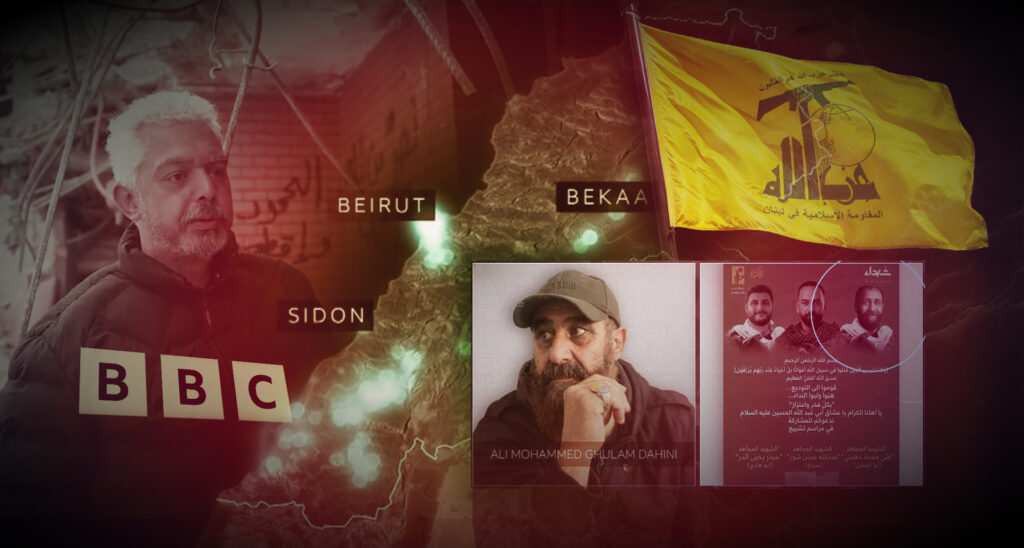
In Beirut’s Hay el Sellom suburb, a BBC journalist interviews Mohammed, whose son Abbas was killed in an Israeli airstrike on an apartment building in April 2026.
2/
We meet Mohammed, whose son was killed after Israel struck their apartment building.He tells the BBC he would never have stayed there had he known Hezbollah operatives were in the building… before showing his support for them when interviewed by local media. pic.twitter.com/Q6c8cDI09K
— HonestReporting (@HonestReporting) May 6, 2026
Mohammed claims that had he known Hezbollah operatives were nearby, he would have left. But that admission directly undermines the BBC’s broader framing. It reinforces the reality that Israel’s operations are linked to Hezbollah’s presence, not random or indiscriminate attacks against civilians.
Another interviewee claims Israel is bombing Lebanon in an attempt to “take over” the country. Yet the report’s own details point to something else entirely: a campaign directed at Hezbollah infrastructure and operatives in an effort to restore security along Israel’s northern border.
According to the IDF, the April 8 strikes that reportedly killed Abbas also targeted more than 250 Hezbollah terrorists.
Ironically, while touring the suburb, the BBC journalist also filmed martyr posters of Ali Mohammed Ghulam Dahini, reportedly killed in the same strikes — corroborating Israeli media reports identifying him as a Hezbollah operative.
Yet the BBC still avoids acknowledging the obvious implication: these strikes were targeting Hezbollah personnel embedded within civilian areas.
Civilian deaths in war are tragic. But tragedy alone does not determine intent.
Under the laws of armed conflict, counterterrorism operations require assessing proportionality — weighing anticipated military advantage against potential civilian harm. In each example highlighted by the BBC, evidence of Hezbollah’s presence at the strike locations is difficult to ignore.
The report itself notes that Mohammed expressed support for Hezbollah in Arabic-language interviews, praising the group for “defending Lebanon.” But Lebanon would not require “defending” from repeated wars had Hezbollah not transformed civilian neighborhoods into military infrastructure.
The BBC acknowledges that Mohammed gave pro-Hezbollah views when speaking to local media. Yet Mohammed presents himself differently to international English-speaking audiences. That discrepancy raises an obvious question: why?
The answer may lie even closer to home.
Investigative journalist David Collier revealed that Mohammed’s son, Abbas Khair al-Din, was himself affiliated with Hezbollah, citing martyr posters and Hezbollah imagery at his grave.
Well I found him – and I found his son. This is his son’s grave – full of martyr images and clear Hezbollah affiliation.
These are Hezbollah’s people.
Did your journalist not bother to look at all? Why are you spreading terrorist propaganda? 3/5 pic.twitter.com/Kcm5bJjerF
— David Collier (@mishtal) May 6, 2026
Had the BBC acknowledged these Hezbollah ties, its central framing — that Israel was recklessly targeting civilians — would have become far more difficult to sustain.
This is not the first time the BBC has minimized or erased Hezbollah’s presence in Lebanon.
By omitting Hezbollah’s systematic use of civilian infrastructure, the outlet constructs a narrative in which responsibility falls almost exclusively on Israel while Hezbollah’s role fades into the background.
Most remarkably, despite the evidence presented throughout the report, the BBC still repeats Hezbollah’s denial that it embeds itself among civilians.
5/
The report also repeats Hezbollah’s denial that it embeds itself among civilians.Instead, the terror group claims Israel deliberately targets civilians to pressure them.
The problem? Mohammed’s own words undermine that narrative. pic.twitter.com/nWelmpCFjL
— HonestReporting (@HonestReporting) May 6, 2026
The contradiction is striking: the BBC’s own reporting repeatedly points to Hezbollah activity within civilian areas, yet the outlet still amplifies Hezbollah’s denials with minimal scrutiny.
Not all Lebanese civilians support Hezbollah. But the BBC’s inability — or unwillingness — to feature meaningful Lebanese criticism of the terrorist organization reveals how selective the report truly is.
Hezbollah has effectively held Lebanon hostage, exploiting civilians while dragging the country into repeated cycles of conflict.
There is genuine dissent within Lebanon. Many Lebanese are exhausted by Hezbollah’s dominance and want a future free from perpetual war. Yet those voices are almost entirely absent from the BBC’s report.
View this post on Instagram
The BBC intended its report to portray Israel as conducting a campaign against Lebanese civilians.
Instead, it inadvertently documented something else entirely: Hezbollah’s deep entrenchment within civilian infrastructure.
The report repeatedly presents evidence of Hezbollah activity, Hezbollah support, and Hezbollah-linked individuals in the very locations Israel targeted — while simultaneously attempting to deny or downplay the implications.
When media outlets obscure Hezbollah’s use of civilian areas, they do more than distort the story. They sanitize the conditions Hezbollah itself created.
And in this case, the BBC’s own reporting ultimately undermines the narrative it set out to build.
Liked this article? Follow HonestReporting on Twitter, Facebook, Instagram and TikTok to see even more posts and videos debunking news bias and smears, as well as other content explaining what’s really going on in Israel and the region. Get updates direct to your phone. Join our WhatsApp and Telegram channels!
© Divuach Ne’eman R”A, 2025