Key Takeaways:
-
Hezbollah actively intimidates journalists: Reporting from Hezbollah-controlled areas in Lebanon often occurs under direct supervision, pressure, or threats, limiting what journalists can investigate or show.
-
Narratives are carefully managed: Incidents involving Sky News and other outlets illustrate how Hezbollah guides journalists to specific locations and scenes designed to reinforce its preferred narrative.
-
Press freedom faces asymmetric constraints: While democratic states face open media scrutiny, terrorist organizations like Hezbollah influence coverage through intimidation, creating a distorted reporting environment.
Press freedom is frequently invoked as a core value of modern journalism. Reporters rightly protest when governments attempt to restrict their work or influence their coverage.
But what happens when the pressure comes not from a state, but from a heavily armed terrorist organization?
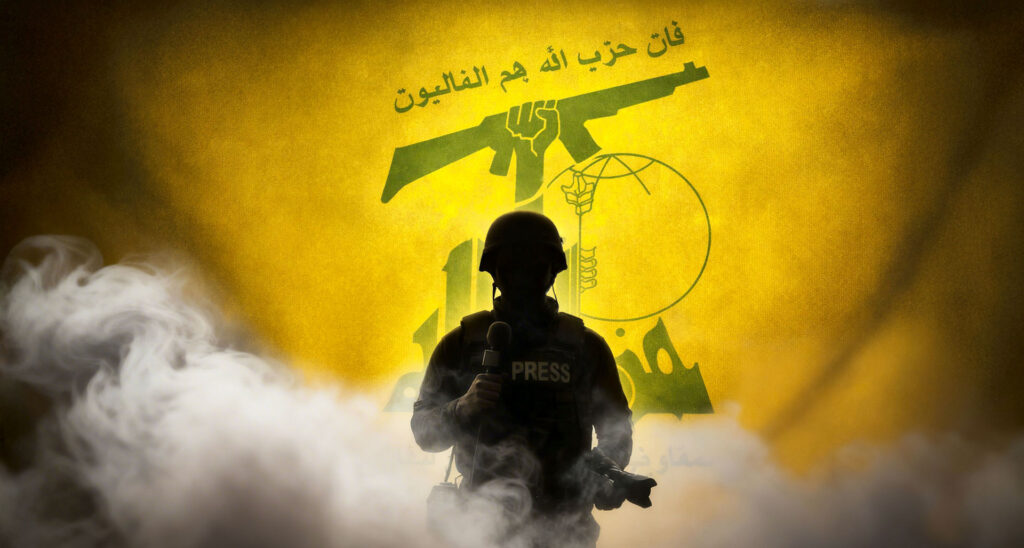
Recent events in Lebanon highlight a reality often overlooked in international coverage: Hezbollah does not merely shape the narrative – it actively seeks to intimidate journalists who challenge it.
Just ask Sky News correspondent John Sparks, who ventured to the edge of the most dangerous part of the Lebanese capital – the Hezbollah-dominated Dahiya neighborhood, where Israeli airstrikes on terrorist targets aren’t the only threat.
More than 95,000 people have evacuated southern Beirut as the city is rocked by heavy strikes.
Sky’s @sparkomat is on the ground in Beirut ⬇️
Latest ? https://t.co/36J6iTQ5NF pic.twitter.com/iwuIdC0Snt
— Sky News (@SkyNews) March 6, 2026
Sparks makes it clear that “a Hezbollah member has offered to take us to a bomb site… but told us we’d have to be quick.” He and his cameraman are given two minutes to film a debris-strewn street containing shops and restaurants — precisely the image Hezbollah wants broadcast.
Sparks has to leave swiftly, presumably on the orders of the invisible Hezbollah member accompanying him. To his credit, Sparks openly states the reason he was allowed to film there was that Hezbollah wanted him to see that the site was a market area full of shops, “not a Hezbollah command center, not a weapons storage facility.”
What Sparks might have uncovered without that escort – Hezbollah infrastructure embedded in civilian areas, for example – remains unknown.
Sparks and his cameraman are then stopped and questioned by a different Hezbollah group that prevents them from leaving. They only depart after the unexpected distraction of what Sparks believes were Israeli warning shots intended to prompt civilians to evacuate.
But Sparks may have got lucky.
When Reporting Becomes Dangerous
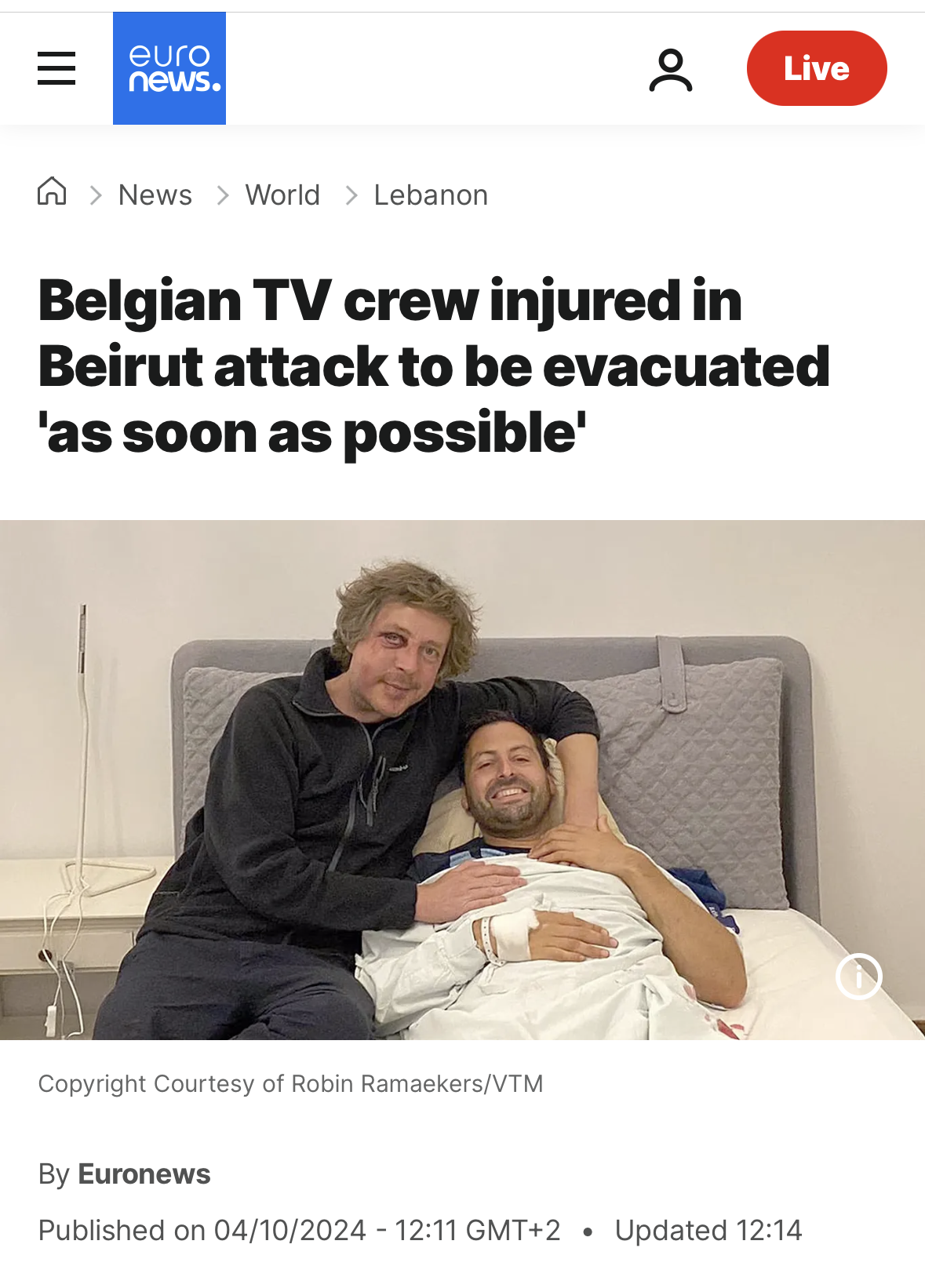
The risks of reporting in Hezbollah-controlled environments are not theoretical. In October 2024, a Belgian television crew was injured in Beirut after being attacked while covering the conflict.
The same month, an RAI TG3 crew from Italian state television was attacked by an unknown assailant while covering the site of a bombing near the coastal city of Sidon. The crew’s Lebanese fixer had coordinated their location with Hezbollah. The incident ended tragically when the team’s local driver collapsed from a heart attack.
Such incidents offer only a glimpse of the broader environment journalists face in Lebanon – one where armed groups exert significant influence over what can and cannot be reported.
For local journalists in particular, crossing Hezbollah’s red lines can have serious consequences.
Hezbollah Targets Journalists Who Challenge Its Narrative
The organization’s hostility toward independent reporting was made clear following visits in September and October 2024 by Western journalists to southern Lebanon embedded with the IDF.
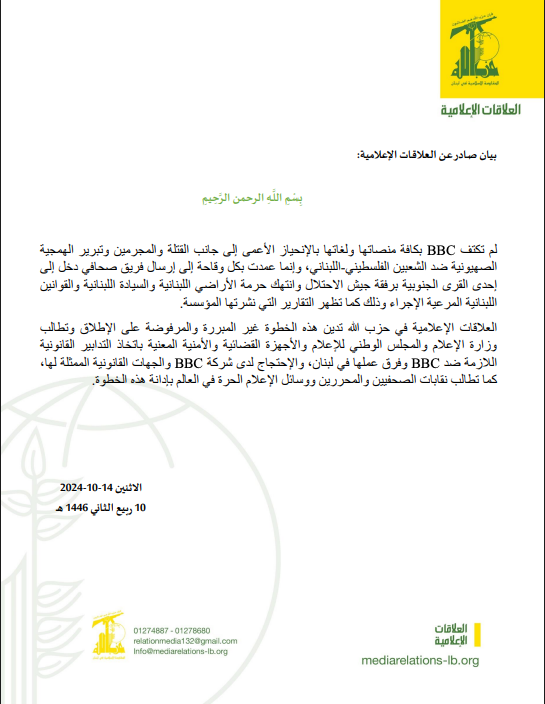
In response to the BBC’s subsequent report, Hezbollah issued a public statement condemning the visit and calling for action against the BBC and its journalists.
Hezbollah issued a statement accusing the broadcaster of bias and demanded that Lebanese authorities take legal and political measures against them.
The statement went further, urging Lebanon’s media authorities and judicial bodies to act against the journalists involved and journalists’ unions and media outlets worldwide to condemn the move.
A subsequent statement reportedly expanded the condemnation to all participating outlets.
In effect, journalists who stepped outside Hezbollah’s preferred narrative were not merely criticized – they were reported to the authorities.
The Message Behind the Threats
Hezbollah framed the journalists’ visit as a violation of Lebanese sovereignty. But the underlying message was unmistakable: journalists who cooperate with Israel or expose Hezbollah’s activities will face consequences.
That message was reinforced across Hezbollah-aligned media channels, which amplified demands for action against the reporters involved.
The aim is clear. By publicly condemning journalists and calling for legal action, Hezbollah signals that certain types of reporting are unacceptable.
Even if no formal charges follow, the pressure alone is enough to deter many reporters from crossing those lines in the future.
An Uneven Playing Field for the Media
Journalists often emphasize the need to present “both sides” of a conflict. Yet that principle assumes that both sides operate under comparable conditions of accountability.
In reality, they do not.
Democratic states face relentless scrutiny from the media. Their decisions are debated publicly, and journalists can challenge officials without fear of retaliation.
Terrorist organizations such as Hezbollah operate very differently. They exert control through intimidation, coercion, and the implicit threat of violence.
The result is a media environment where democratic governments are examined openly, while coverage of terrorist groups is shaped by fear and pressure.
Hezbollah’s History of Intimidating Journalists
This dynamic is not new.
During the 2006 Second Lebanon War, CNN’s Nic Robertson was taken on a tour by a Hezbollah “press officer.” Robertson reported that Israel appeared to be striking civilian areas, noting there was “no evidence of military equipment here,” while the press officer directed his cameraman what to film.
A week later, on CNN’s Reliable Sources, Robertson acknowledged he had no way of confirming the claims he had broadcast. Hezbollah, he explained, controlled where journalists could go and what they could see.
Other reporters described similar pressures.
Time contributor Christopher Allbritton wrote that Hezbollah possessed copies of journalists’ passports and had threatened some reporters.
NBC’s Richard Engel recalled Hezbollah handlers warning: “Look, we’re serious, we will kill you if you film these outgoing rockets.”
A Reality That Deserves Acknowledgment
Journalists working in conflict zones deserve recognition for the dangers they face. Reporting from areas influenced by groups like Hezbollah is far from easy.
But if the media is serious about defending press freedom, it must also acknowledge the forces that undermine it.
When armed organizations threaten journalists or demand legal action against them simply for reporting what they have seen, that fact should be reported just as prominently as any other development in the conflict.
Otherwise, the public is left with an incomplete picture – one in which the intimidation shaping the news itself remains largely invisible.
And that silence ultimately serves the interests of those who prefer their activities to remain in the shadows.
Liked this article? Follow HonestReporting on Twitter, Facebook, Instagram and TikTok to see even more posts and videos debunking news bias and smears, as well as other content explaining what’s really going on in Israel and the region. Get updates direct to your phone. Join our WhatsApp and Telegram channels!
© Divuach Ne’eman R”A, 2025