Key Takeaways:
- Access journalism under authoritarian regimes comes with limits. CNN’s reporting from Iran raises questions about whether those limits are being clearly acknowledged.
- Critical context is missing. Coverage has largely ignored Iran’s internal repression, anti-regime protests, and the strategic targets of Israeli and U.S. strikes.
- Unchallenged regime voices shape the narrative. Interviews with senior Iranian officials risk amplifying propaganda when not confronted with meaningful scrutiny.
Imagine the only Western news outlet allowed to report live from Iran during the war. Given that the Iranian regime maintains an iron grip on media and reporting from the country, one would hope that coverage would go to extraordinary lengths to avoid amplifying regime narratives.
Related Reading: Is CNN Sharing Iranian Propaganda Instead of Proper Journalism?
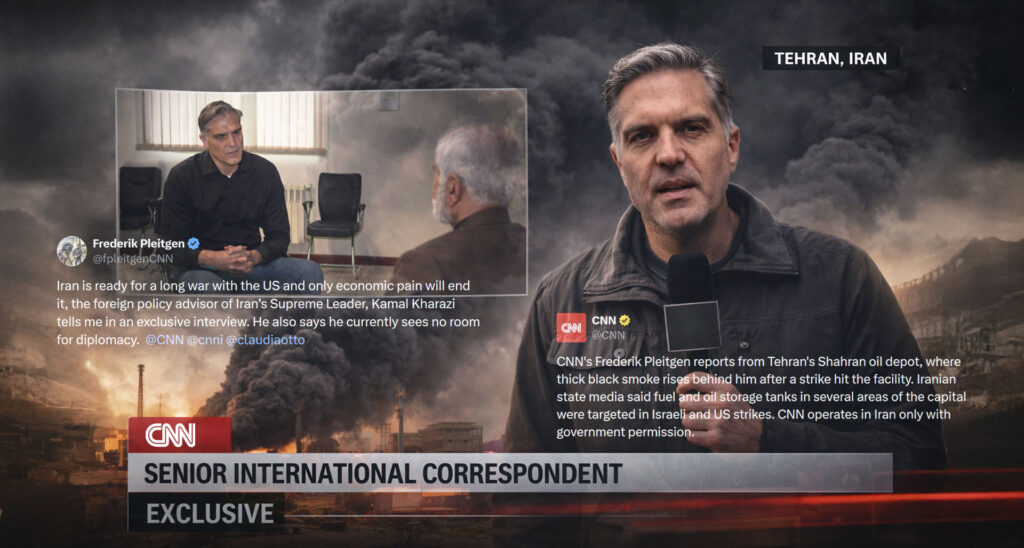
But CNN has raised questions about whether it is doing precisely that since becoming the first Western network to broadcast live from Iran during the war. While CNN can report in Iran only with government permission, the outlet maintains that it has “full editorial control over what it reports.”
But if that editorial control means leaving out key context regarding the war, sitting down with a member of the Islamic Revolutionary Guard Corps (IRGC), and pushing a narrative fed by the Iranian regime, then the claim of independence becomes much harder to take at face value.
The war Israel and the U.S. have been fighting has focused on strategic targets, targeting key institutions and leadership within the Iranian regime. Conversely, the regime has been working to project an image of internal stability, all the while targeting civilian locations in Israel and across the Gulf region.
When Frederik Pleitgen entered Iran, he portrayed the country as operating as usual – no lines at the gas station, good-tasting coffee, and stocked shelves.
The segment created an impression of calm normalcy — precisely the image the regime seeks to project.
View this post on Instagram
Every live broadcast from Iran includes the disclaimer noting that CNN’s ability to film in the country is only possible with the Iranian government’s “permission,” while insisting that the network maintains full editorial independence in its coverage.
That assurance would be easier to accept if Iran did not rank 176 out of 180 in the Press Freedom Index, making genuine editorial independence highly questionable to begin with. If the Iranian regime needs to provide permission to foreign journalists to report in the country, how free can their access truly be?
Pleitgen’s daily reporting from Iran has omitted the strategic rationale of the Israeli and American war goals. Rather than discuss the reasons for such targeted strikes, Pleitgen has taken on the language of the Iranian regime. When Israel and the U.S. coordinate airstrikes against IRGC targets, Pleitgen refers to himself as being under “full assault.” But as a foreign journalist, Pleitgen would know that it is not he, nor ordinary Iranians, that are being targeted, but rather military infrastructure and IRGC personnel.
“Massive waves of airstrikes are coming down on the Iranian capital.”@fpleitgenCNN joins OutFront for his first live report on CNN from Tehran since the war began. He and photojournalist @claudiaotto were the first journalists from a US network on the ground in Tehran. CNN… pic.twitter.com/G0moY9mnuj
— Erin Burnett OutFront (@OutFrontCNN) March 7, 2026
Less than one week into the war, the IRGC issued a “shoot to kill” order across Iran aimed at suppressing anti-regime protests. As such, the number of protests across the country has significantly dropped after demonstrations erupted nationwide in the preceding months. While this has not stopped the public from celebrating the targeted assassination of Supreme Leader Ali Khamenei, Frederik Pleitgen has made little acknowledgment of this internal dissent or the regime’s efforts to suppress it.
Beyond just turning a blind eye to the anti-regime Iranians, Pleitgen has largely avoided discussing the lead-up to the war in the first place: the anti-regime protests themselves, during which thousands of innocent civilians were murdered as they took to the streets demanding freedom.
When Pleitgen attends a pro-regime demonstration organized by the authorities, he fails to acknowledge a critical fact: the Iranian regime carefully orchestrates such gatherings to project an image of unity and control. In a country where public dissent is met with violent repression by the IRGC, large pro-regime rallies cannot simply be interpreted at face value as a spontaneous reflection of public opinion.
What is missing from this picture are the voices of the many Iranians who took to the streets demanding change. These voices have largely disappeared from view, not because the grievances have vanished, but because the cost of expressing them during wartime has become far higher.
All of this has led to Pleitgen’s interview with Kamal Kharazi, Foreign Policy Advisor to the office of the Supreme Leader, who was himself appointed by Ali Khamenei. CNN effectively gave a largely unchallenged platform to a member of a U.S.-designated terrorist organization, allowing him to push the IRGC’s agenda to thousands of Americans without facing any pushback.
While challenging Kharazi would quickly end the access CNN has to Iran, this very notion only underscores the core problem. If challenging a narrative set by the regime could jeopardize the network’s ability to report in Iran, it highlights the lack of independent editorial control CNN maintains.
This reality places an even greater responsibility on CNN to clearly explain the constraints under which such reporting takes place. Without that context, every statement, every nod, and every unanswered claim can be understood as implicit acceptance of the regime’s narrative and its goals in the war. If CNN states it has full editorial control, then allowing its coverage to mirror the messaging of the regime raises serious questions about how that control is being executed.
CNN’s presence in Iran presents a difficult test for journalism in an authoritarian wartime environment. The duty to tell the truth and report accurately is subject to the restrictions of the Iranian regime, making every comment filtered through a prism of control. The result is coverage that risks reflecting the Iranian regime’s messaging. This outcome can only be avoided if CNN acknowledges that government approval comes with strict limitations on what can be reported and how it can be reported.
Without such transparency, the truth risks being overtaken by propaganda.
Liked this article? Follow HonestReporting on Twitter, Facebook, Instagram and TikTok to see even more posts and videos debunking news bias and smears, as well as other content explaining what’s really going on in Israel and the region. Get updates direct to your phone. Join our WhatsApp and Telegram channels!
© Divuach Ne’eman R”A, 2025