Key Takeaways:
- While tens of thousands of Iranians are being killed, injured, or disappeared during an ongoing nationwide crackdown, global wire services are distributing almost exclusively pro-government imagery from inside Iran.
- The same agencies that claim they cannot operate without local stringers in Gaza are relying on state-controlled access in Iran, yet apply none of the scrutiny or skepticism they demand elsewhere.
- NurPhoto and Anadolu function as visual gatekeepers in authoritarian states, supplying sanitized regime imagery that global wire services syndicate worldwide without meaningful context or disclosure.
Iran is in the midst of one of the largest and most violent crackdowns in modern history. Protesters are being shot, tortured, blinded, and executed. Internet access has been shut down for extended periods. Journalists are imprisoned. Cameras are confiscated.
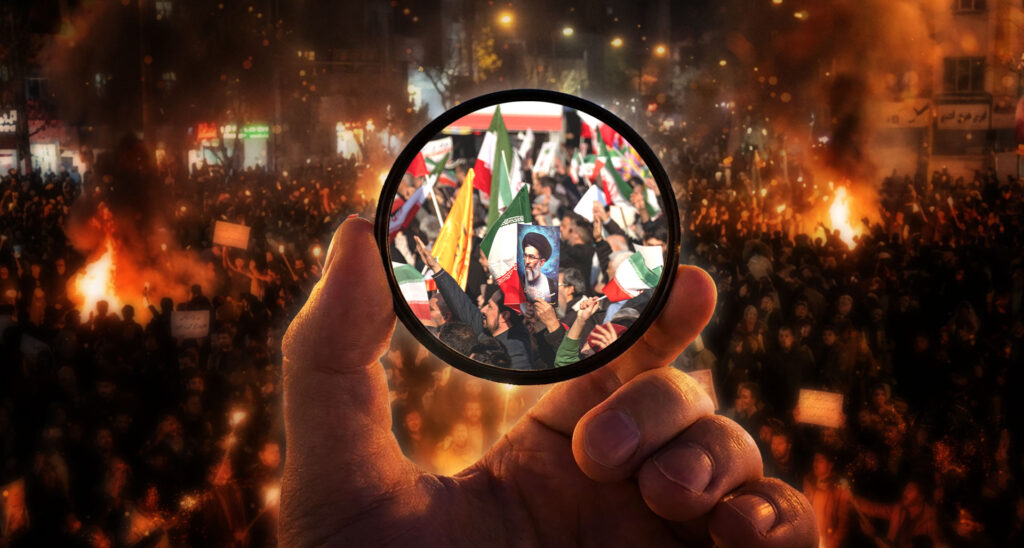
Yet if a reader were to rely solely on images circulating through major wire services, a very different story would appear to be unfolding.
The dominant visuals coming out of Iran show orderly pro-government rallies, uniformed police formations, symbolic displays of defiance toward the West, and carefully staged scenes involving children. What is missing are the images of mass repression, bloodshed, and fear that independent sources confirm are happening daily.
This is not an accident. It is the result of how visual power is controlled, and by whom.
View this post on Instagram
The Visual Gatekeepers
Before examining Iran itself, it is essential to understand who controls the imagery that reaches the world.
Two agencies dominate visual access inside Iran today: NurPhoto and Anadolu Agency.
NurPhoto, an Italy-based photo agency, distributes thousands of images daily through partnerships with Getty Images, Reuters, and Associated Press. Anadolu is Turkey’s state-run news agency, directly aligned with President Recep Tayyip Erdoğan’s government. Both agencies maintain access in Iran where most foreign journalists and photographers do not.
That access comes with conditions.
Photographers operating inside Iran must be accredited, vetted, and monitored by Iranian authorities. Any photographer who documents security force violence or protests faces arrest, long prison sentences, or worse. As a result, only imagery that aligns with regime tolerance makes it out through official channels.
Despite this, global wire services routinely publish these images under neutral bylines such as “Stringer/Getty Images,” offering readers no disclosure about access restrictions, censorship, or political alignment.
This is a structural failure, not of one outlet, but of the entire international image distribution system.
This system operates through enforcement, not persuasion. In Iran, visual media falls under the oversight of the Ministry of Culture and Islamic Guidance and security bodies aligned with the Islamic Revolutionary Guard Corps. Accreditation determines survival. Photographers who deviate from approved narratives are arrested, disappeared, or forced into exile. In this environment, regime-compatible imagery serves two masters: it humanizes destruction for Western consumption while maintaining total control over what dissent, violence, and repression are allowed to be seen.
The Massacre You Are Not Seeing
Independent human rights organizations and leaked footage confirm that Iran’s security forces have killed and maimed thousands during sustained nationwide protests. Victims include women, teenagers, and children. Many have been deliberately shot in the eyes.
During peak violence, the Iranian government imposed near-total internet shutdowns, cutting off citizen journalism and real-time documentation. Phones were seized. VPNs blocked. Messaging platforms disabled.
The result was an information vacuum, one that could only be filled by those already operating with state approval.
What is most revealing in the official imagery from Iran is not what appears, but what is systematically absent. There are no images of security forces firing into crowds, no photographs of mass arrests, no documentation of hospital corridors filled with the wounded, no visual record of blindings, executions, or nighttime raids reported by independent human rights groups. In a nation of more than 85 million people experiencing nationwide unrest, the near-total absence of such imagery is itself forensic evidence. Visual silence at this scale does not occur organically. It is produced.
Imagery That Replaced Reality
Into that vacuum flowed a steady stream of officially sanctioned visuals.
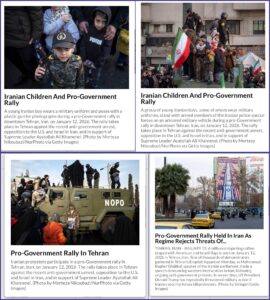
Getty-distributed images show large pro-government rallies in Tehran. Police special forces stand atop armored vehicles. Children are dressed in military uniforms, holding toy weapons. Billboards depict coffins draped in American and Israeli flags.
These images are not neutral documentation. They are ideological statements.
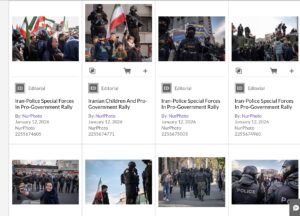
A closer visual reading reveals consistent framing techniques designed to exaggerate scale while concealing isolation. Wide-angle lenses are avoided in favor of compressed perspectives that stack bodies tightly together. Elevated shooting positions remove surrounding context and prevent viewers from assessing crowd depth or dispersal. Backgrounds are often reduced to flags, banners, or armored vehicles, eliminating spatial reference points that would otherwise reveal how contained these gatherings are. These are not neutral compositional choices. They are techniques used to manufacture the appearance of mass participation where none can be independently verified.
The presence of children in these scenes is especially striking. They are not spontaneous participants in organic gatherings. They are placed, posed, and framed to convey loyalty, continuity, and moral legitimacy for the regime.
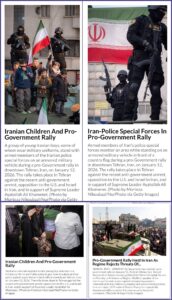
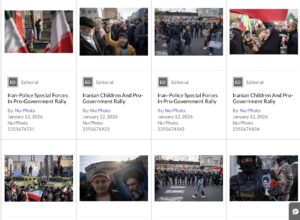
Across the distributed image sets, the number of unique children is strikingly small. The same children appear repeatedly across different scenes, outfits, and backdrops, repositioned to suggest broader participation. Tight cropping prevents viewers from seeing whether these children are surrounded by peers or standing alone amid security personnel. This repetition functions as a visual anchor. Children confer innocence, continuity, and moral legitimacy. Their reuse is not incidental. It is a controlled narrative device.
What viewers are not shown is the context surrounding these events, the fear, coercion, and repression occurring just beyond the frame.
The Gaza Double Standard
The contrast with Gaza is impossible to ignore.
In Gaza, international media relentlessly argue that Israel must allow foreign journalists full access. Any restriction is framed as evidence of concealment. Images supplied by local stringers are treated as authoritative despite operating under Hamas control.
In Iran, the opposite is true.
Foreign journalists are barred. Local photographers operate under threat of imprisonment. Yet there is almost no sustained media pressure demanding access, transparency, or accountability.
The same wire services that insist on skepticism in one conflict accept regime-filtered imagery without question in another.
The contrast is not merely political. It is methodological. In Gaza, images supplied under Hamas control are treated as evidentiary, amplified, and emotionally framed, while restrictions on foreign journalists are portrayed as proof of concealment. In Iran, where restrictions are far more severe and lethal, the same wire services accept state-approved imagery with no comparable skepticism. The standard is not access. It is convenience.
How Wire Services Launder Propaganda
This process does not require coordination or conspiracy. It relies on incentives.
Wire services need volume. Editors need visuals. Year-round, but especially during high-traffic news cycles, agencies prioritize images that are visually clean, technically strong, and easy to caption.
State-approved imagery meets those requirements perfectly.
Once syndicated, repetition normalizes the narrative. A pro-government rally becomes “what is happening in Iran.” A staged child becomes “public sentiment.” A billboard becomes “national mood.”
Context disappears. Responsibility diffuses. The system moves on.
Once accepted into the wire ecosystem, these images gain exponential authority through repetition. A photograph credited to “Stringer/Getty Images” or “Stringer/Reuters” appears stripped of origin, access conditions, and risk asymmetry. The absence of disclosure becomes part of the laundering process. Readers are never told why certain images exist while others cannot. What begins as a state-filtered photograph becomes, through syndication, a global proxy for reality.
What is happening in Iran is not invisible. It is being actively replaced.
Global audiences are not misinformed because images do not exist, but because the images that do exist are filtered, selected, and distributed through a system that rewards access over truth.
History shows that when mass repression is visually obscured in real time, accountability follows decades later, if at all. The absence of imagery does not diminish the crime. It delays recognition.
This is not just an Iranian story. It is a warning about who controls what the world gets to see.
Liked this article? Follow HonestReporting on Twitter, Facebook, Instagram and TikTok to see even more posts and videos debunking news bias and smears, as well as other content explaining what’s really going on in Israel and the region. Get updates direct to your phone. Join our WhatsApp and Telegram channels!
© Divuach Ne’eman R”A, 2025