Key Takeaways:
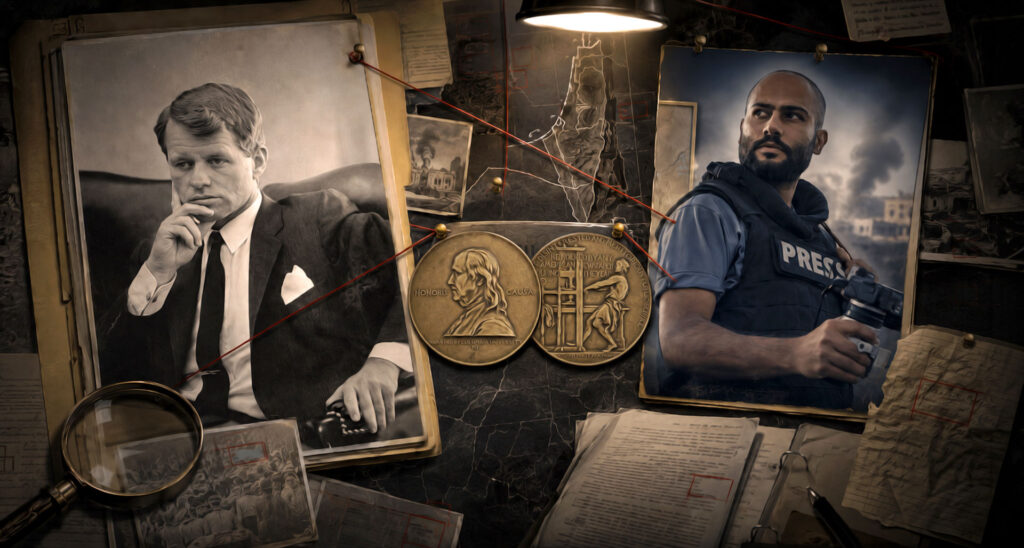
- New York Times contributor and photojournalist Saher Alghorra is the latest recipient of the Robert F. Kennedy Journalism Award for his work documenting Gaza during the war between Israel and Hamas.
- Alghorra is known for using his work to echo Hamas talking points and to craft an anti-Israel narrative for consumption by the mainstream media.
- The irony: Kennedy was assassinated by an anti-Israel extremist who was influenced by propaganda similar to that which Alghorra spreads to Western audiences.
New York Times photographer and contributor Saher Alghorra is having a banner year.
First, the Gaza-based Palestinian photojournalist was named a finalist in the World Press Photo contest. Then he won the prestigious Pulitzer Prize for Breaking News Photography for his images documenting life in Gaza during more than two years of war between Israel and Hamas.
Now, Alghorra has been named the recipient of the Robert F. Kennedy Journalism Award’s International Photo Award.
That latest accolade raises an unavoidable question: would Robert F. Kennedy have approved of his name being attached to this honor?
1/
The @PulitzerPrizes just crowned @nytimes photographer Saher Alghorra for his Gaza photos – a prize built on staged scenes, a manufactured “famine” narrative, and intimate access to Hamas terrorists.Let’s look at what, exactly, made the Pulitzer cut. ⬇️⬇️ pic.twitter.com/0aVyqEfEdD
— HonestReporting (@HonestReporting) May 5, 2026
As HonestReporting noted when Alghorra received the Pulitzer, his work is not without serious controversy.
During Hamas’ October 7, 2023 massacre – the attack that ignited the current war – Alghorra posted images of rockets being fired into Israel, accompanied by a caption echoing Hamas’ own justification for its assault.
Less than two years later, he covered Hamas’ grotesque “release ceremony” for the bodies of Oded Lifshitz and the Bibas family, referring to the murdered Israeli octogenarian and the two Bibas children, aged four and just nine months, as “prisoners.”
This is not merely a matter of poor word choice. It raises fundamental questions about journalistic impartiality and about the narratives Alghorra chooses to amplify.
The images featured in Alghorra’s Pulitzer-winning portfolio present Gaza’s devastation through a carefully curated lens: one designed to place Israel at the center of the tragedy while obscuring Hamas’ central role in creating it.
Absent is the context that Hamas initiated this war with the October 7 massacre. Missing too is any acknowledgment of the terror group’s systematic embedding of military infrastructure within civilian areas, a strategy designed precisely to produce the kind of imagery that dominates international headlines.
This is visual storytelling stripped of context.
And it is precisely this one-sided, Hamas-adjacent framing that the Robert F. Kennedy Human Rights Center has now chosen to celebrate.
The photographer bylined is Saher Alghorra. @nytimes used his pictures as recently as yesterday to cover the return of the murdered Bibas babies and Oded Lifshitz to Israel.
Does @nytimes agree that an elderly peace activist, 10 month old, and four-year-old are “prisoners?” https://t.co/8XG224VEVZ pic.twitter.com/58mFSYWUk5
— HonestReporting (@HonestReporting) February 21, 2025
The award’s namesake was one of America’s most steadfast supporters of Israel.
Robert F. Kennedy’s support for the Jewish state dated back to its founding. In April 1948, he traveled to Mandatory Palestine as a special correspondent for the Boston Post. His dispatches, published two months later, after the establishment of the State of Israel, lauded the pre-state Zionist militias’ “undying spirit” and “unparalleled courage” and celebrated the Mandate’s Jewish population as “an immensely proud and determined people.”
His admiration only deepened over the following two decades.
Bobby Kennedy’s Admiration for Israel: The senator’s unwavering support for the Jewish state strengthened American-Israeli ties—and ultimately led to his assassination by a Palestinian gunman, recounts Middlebury historian Shalom Goldman. https://t.co/ETh34z5oFn
— Tablet Magazine (@tabletmag) June 4, 2021
While campaigning for the Senate in 1964, Kennedy repeatedly emphasized his pro-Israel credentials. Speaking to a Zionist women’s group, he advocated for an increase in military aid to Israel and argued that the United States “must continue to make clear to those who threaten Israel that she is not alone.”
As a senator in 1965, he publicly advocated for Soviet Jewry and, in 1968, he pressed the Johnson administration to approve the sale of 50 F-4 Phantom fighter jets to Israel after France refused to sell fighter jets to the Jewish state in the wake of Israel’s victory during the 1967 Six-Day War.
That support came at a deadly cost.
Kennedy was assassinated in 1968 by Sirhan Sirhan, a Jordanian-Palestinian who was enraged by Kennedy’s backing of Israel, particularly his support for the fighter jet sale.
Sirhan was born in Jerusalem in 1944, but his family had moved to Jordanian-controlled territory during the 1948 Israeli War of Independence and later emigrated to the United States in 1956, when he was 12 years old.
According to reports, Sirhan was heavily influenced by anti-Israel propaganda both during his time in the Middle East as well as following his move to the U.S.
Having read about Kennedy’s push for the sale of fighter jets to Israel in the local newspaper, Sirhan was determined to kill him before June 5, 1968, the first anniversary of the start of the Six-Day War.
He waited in the kitchen of the Ambassador Hotel in Los Angeles for Kennedy to pass him by after delivering a victory speech following his win in the California Democratic primary. Shortly after midnight, as Kennedy exited the hotel through the kitchen, Sirhan emerged and shot Kennedy four times at point-blank range (including one in the back of the head), mortally wounding him and injuring five others.
Sirhan’s hatred was fueled by anti-Israel propaganda.
That historical fact makes today’s award especially jarring.
In 1968, Robert F. Kennedy was murdered in part because of his support for Israel.
In 2026, his name is being used to legitimize a photographer whose work advances a narrative that erases the context of anti-Israel terror while amplifying imagery that serves its political aims.
The Robert F. Kennedy Journalism Award was established to honor truth, moral clarity, and human dignity.
By awarding Saher Alghorra, it risks becoming something else entirely: another institution lending its prestige to a distorted narrative that Robert F. Kennedy himself would likely have rejected.
Liked this article? Follow HonestReporting on Twitter, Facebook, Instagram and TikTok to see even more posts and videos debunking news bias and smears, as well as other content explaining what’s really going on in Israel and the region. Get updates direct to your phone. Join our WhatsApp and Telegram channels!
© Divuach Ne’eman R”A, 2025