Key Takeaways:
- In amplifying a new report, The Guardian has accused Israel of exploiting food as a weapon of war in Gaza, yet the country has consistently facilitated the entry of humanitarian aid.
- Terrorist groups and gangs in other conflict zones, such as Sudan and Yemen, routinely steal food – a tactic that Hamas has also deployed in Gaza
- Equating Israel with countries and organizations that deliberately starve civilian populations distorts the fundamental differences between these conflicts, obscuring the role Hamas plays in controlling aid and exploiting civilian suffering.
Globally, hunger crises have devastated the lives of millions.
Particularly in war zones, families often struggle to survive without reliable access to food. Yet in nearly every major conflict-driven hunger crisis, civilians are not dependent on one of the warring parties to facilitate aid delivery.
Gaza is the exception.
Since the start of Israel’s war against Hamas, Israel has coordinated the delivery of an unprecedented volume of humanitarian assistance into Gaza, the overwhelming majority of it food.
According to figures released by COGAT, since the ceasefire was implemented in October 2025, Israel has coordinated the entry of approximately 600 trucks per day, with 70–80 percent of cargo consisting of food supplies.
The numbers on the ground, confirmed by the CMCC, tell the real story when it comes to food in Gaza. 600 trucks enter Gaza every day, with 70-80% of that cargo dedicated entirely to food. To date, over 1.6 million tons of food have been transferred, with zero restrictions on… pic.twitter.com/WlnRquRgsL
— COGAT (@cogatonline) May 20, 2026
To date, more than 1.6 million tons of food have entered Gaza.
If Israel were “weaponizing hunger,” as some critics claim, it would hardly be facilitating one of the largest humanitarian aid operations in a modern conflict zone.
Yet an analysis by Insecurity Insight, amplified by The Guardian, places Gaza alongside Sudan, Yemen, and Haiti as examples of hunger allegedly being used as a weapon of war.
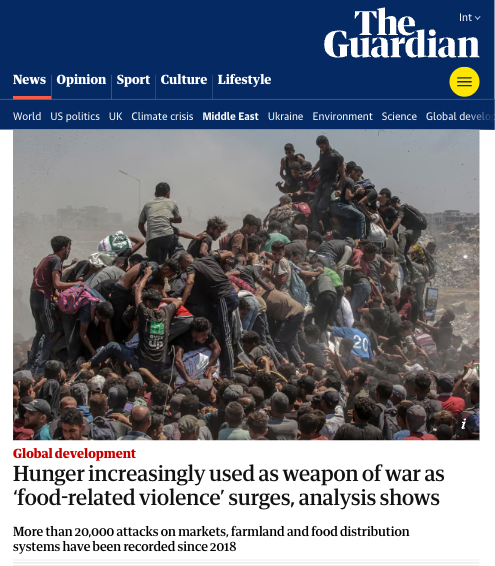
The comparison is not merely misleading.
It fundamentally distorts reality.
Food Crises in Sudan, Yemen and Haiti
In Haiti, 5.8 million people face acute hunger, with an additional 1.8 million people facing emergency levels of hunger. In Sudan, 19 million people face acute hunger. In South Sudan, 7.8 million people are experiencing severe food insecurity, while in Yemen, more than 17 million people are food insecure. Still, the amount of aid received by people in need in these locations is a fraction of the aid that Palestinians have received.
Famine in Yemen.
War in Sudan.
Crisis in Congo.Yet, Palestinians receive 10 to 35 times more aid per capita than people in need in other conflict zones.
All persons in need are equal, but apparently some are more equal than others. pic.twitter.com/4eAODA2ixi
— Israel Foreign Ministry (@IsraelMFA) August 8, 2025
Just as importantly, the conflicts themselves are fundamentally different.
The IDF specifically targets locations where Hamas has embedded its operations and operatives based on precise intelligence; the same can not be said of warring parties in Sudan and Yemen, where aid infrastructure and food supplies are targeted indiscriminately or deliberately to deprive civilian populations of essential resources.
For instance, the Houthis in Yemen harassed aid workers from the World Food Programme (WFP), resulting in the closure of its operations in northern Yemen. In March 2025 alone, the Houthis stole $1.6 million worth of WFP supplies from a warehouse in northern Yemen.
Likewise, in Haiti, gangs have stolen critical humanitarian aid intended for civilians following natural disasters and ongoing instability.
In South Sudan, thousands of cartons of ready-to-use therapeutic food were stolen. As a result of the hunger crisis there, Israel coordinated the delivery of aid in January 2025.
Taken together, these cases point to a broader pattern: in many conflicts, terrorist organizations, gangs, or warring parties deepen hunger crises by seizing aid, attacking humanitarian infrastructure, and preventing supplies from reaching civilians.
Hamas’ Weaponization of Food
But the same cannot be said of Israel, which has coordinated the entry of 1.6 million tons of food since the ceasefire in October 2025, contributing to the more than 1.7 million tons of food that entered Gaza during the war.
If anyone is blocking critical supplies from reaching the civilian population in Gaza, it is Hamas, not Israel.
Hamas, on countless occasions, has been seen stealing aid trucks, hoarding warehouses full of baby formula, and feasting on fresh fruit and meat, all the while claiming there was no food in Gaza.
Despite the headlines, there was never actually a famine in Gaza. Aid is stockpiled, markets are full, and bakeries are open. The real crisis? Hamas steals, controls, and profits from the aid.
Don’t fall for the media’s narrative—see the proof for yourself. pic.twitter.com/j3dgy3xYAg
— HonestReporting (@HonestReporting) March 4, 2025
Israeli hostages held in Gaza have repeatedly stated there was plenty of food, but Hamas’ iron grip on the population meant that terrorists were getting the vast majority. This reality only highlights the similarities between Hamas, the Houthis, and other armies, armed groups, or gangs in Sudan and Haiti that similarly exploit civilian suffering for their own benefit.
Since the ceasefire between Israel and Hamas, new restaurants have opened, and grocery stores have consistently been stocked with food, including candies to celebrate the upcoming holiday of Eid al-Adha.
Certainly, if Israel had been weaponizing hunger, none of these facts would remain true.
Terrorists Weaponize the Truth
Unlike the actors responsible for genuine hunger crises elsewhere, Israel has continued facilitating humanitarian access throughout the war, even while fighting a terrorist organization embedded within the civilian population.
When Hamas controls the narrative coming out of Gaza, the allegations of Israel weaponizing hunger should be scrutinized by the media, particularly given Hamas’ own record of such weaponization.
The evidence remains clear that Israel has not weaponized food during its war. The question now is whether the media is finally ready to acknowledge that truth and correct the record.
Liked this article? Follow HonestReporting on Twitter, Facebook, Instagram and TikTok to see even more posts and videos debunking news bias and smears, as well as other content explaining what’s really going on in Israel and the region. Get updates direct to your phone. Join our WhatsApp and Telegram channels!
© Divuach Ne’eman R”A, 2025