Key Takeaways:
- Israeli director Nadav Lapid is a fierce critic of the State of Israel who moved to France in 2021 as a form of self-exile. However, his public aversion to the Jewish state was not enough to save him from having his invitation to a Marseille-based festival revoked following pressure from anti-Israel activists.
- Lapid is but the latest in a long line of anti-Israel activists and scathing critics of the Jewish state (particularly Jewish ones) who their fellow anti-Zionists have turned on for not passing a strict ideological test set by the most fundamentalist members of the movement.
- As long as the zealots control the anti-Israel movement, they will continue to imitate the most vicious totalitarian states of the 20th century in their willingness to turn on their fellow ideologues and harshly purge them from their heterogeneous ranks.
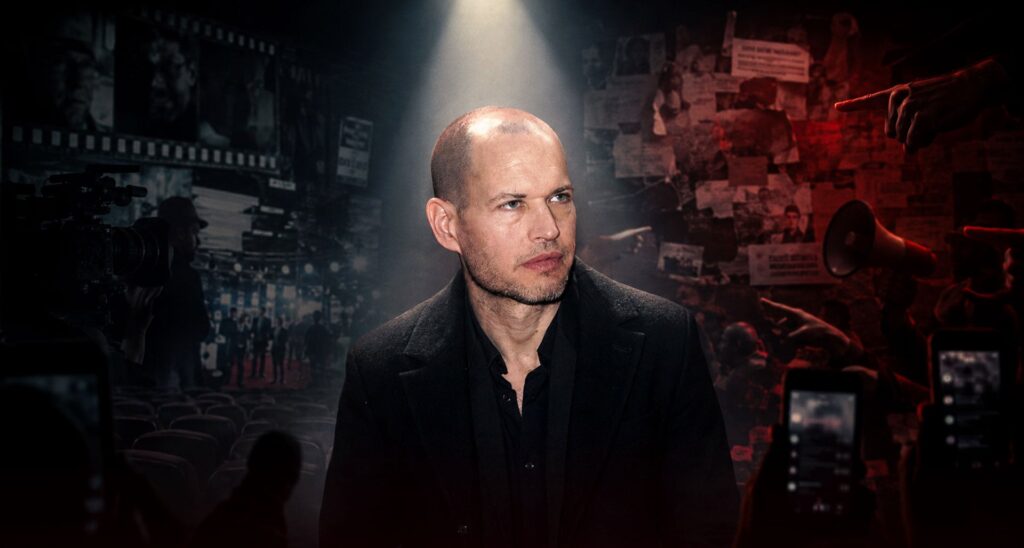
Israeli director Nadav Lapid is a fierce critic of both the State of Israel and its government.
He left Israel and went into self-exile in France in 2021 as a form of protest against the Israeli government.
He was an early proponent of a ceasefire in Gaza following the October 7, 2023 attacks.
His latest film, Yes, is a scathing critique of Israeli nationalism and society.
Yet none of this was enough to save Lapid from the baying mob of Israel boycotters.
Lapid had been invited to head the jury at the Marseille-based FID festival and was also due to be honored at a special event. But his invitation was revoked after 10 pro-Palestinian filmmakers threatened to withdraw their films from the festival.
The stated justification for the boycott was that Lapid’s films receive support from the Israeli Film Fund, which itself receives some funding from Israel’s Ministry of Culture and Sports.
But the real issue appears to be something much simpler.
No matter how critical Lapid is of the Israeli government, the Israeli military, or Israeli society, nothing can redeem him in the eyes of the boycott movement. His original sin is being Israeli.
While Lapid may have been shocked by the ugly turn against him by some of his ideological allies, the episode was entirely predictable.
Nadav Lapid, an Israeli filmmaker, is a staunch critic of Israel’s government.
As part of a political protest, Nadav moved to France in 2021, and his films often offer a critique of Israeli society. He has spoken up about Gaza many times.
He was meant to be a judge for the… pic.twitter.com/cP7sOpHxSG
— Hen Mazzig (@HenMazzig) June 9, 2026
Anti-Israel and anti-Zionist activists have a long history of turning on their own whenever an individual’s opposition to Israel fails to satisfy the movement’s increasingly rigid ideological purity tests.
Like other highly ideological political movements throughout history, such as the Soviet Union under Stalin and Mao’s China, the most zealous elements of the anti-Israel camp have little tolerance for dissent, nuance, or ideological heterogeneity. Those deemed insufficiently anti-Israel are routinely denounced, ostracized, and purged from the movement’s good graces, regardless of how much they otherwise agree with its goals.
A recent example was the response to Irish author Sally Rooney‘s decision to work with a BDS-compliant Israeli publisher in order to release a Hebrew translation of one of her novels. Although Rooney believed her actions were fully consistent with the cultural boycott of Israel, she was nevertheless attacked by fellow anti-Israel activists, accused of betrayal, and subjected to online abuse that included antisemitic invective.
Similarly, in 2025, the Oscar-winning documentary No Other Land – produced jointly by Israelis and Palestinians and sharply critical of Israeli actions – was condemned by anti-Israel activists for cooperating with an Israeli organization. The film’s Israeli co-director, Yuval Abraham, a prominent pro-Palestinian activist, was also vilified online after condemning Hamas’ October 7 massacre during his Academy Awards acceptance speech.
View this post on Instagram
Other examples of the anti-Israel movement devouring its own include:
- Bitterly anti-Israel academic Norman Finkelstein being publicly attacked by Palestinian journalist Ali Abunimah, founder of the extremist Electronic Intifada website, for allegedly failing to align completely with Abunimah’s views.
- British-Jewish journalist Rivkah Brown discovering that even her extreme opposition to Israel was insufficient to shield her from the antisemitic ire of disgraced British doctor Rahmeh Aladwan, who accused her of media manipulation and abusing the term “antisemitic.”
- The New York City-based Palestinian restaurant Ayat being condemned by anti-Israel activist Nerdeen Kiswani for hosting a public Shabbat dinner, which included attendees from far-left and anti-Zionist Jewish groups. In the minds of Kiswani and like-minded activists, even social interaction between Palestinians and Jews can constitute unacceptable “normalization.”
Taken individually, these incidents may appear isolated. Viewed together, however, they reveal a clear pattern.
The loudest and most influential elements of the anti-Israel movement increasingly demand ideological conformity and treat dissent as heresy. Nuance is discouraged. Independent thought is viewed with suspicion. Those who deviate from the accepted orthodoxy, even slightly, risk being cast out.
This dynamic is especially evident when it comes to Jewish anti-Zionists. Time and again, they discover that no amount of opposition to Israel can fully absolve them of their identity in the eyes of the movement’s most radical activists. No matter how loudly they condemn the Jewish state, they remain suspect.
Nadav Lapid is merely the latest Jewish critic of Israel to learn this lesson.
He will almost certainly not be the last.
Liked this article? Follow HonestReporting on Twitter, Facebook, Instagram and TikTok to see even more posts and videos debunking news bias and smears, as well as other content explaining what’s really going on in Israel and the region. Get updates direct to your phone. Join our WhatsApp and Telegram channels!
© Divuach Ne’eman R”A, 2025