Key Takeaways:
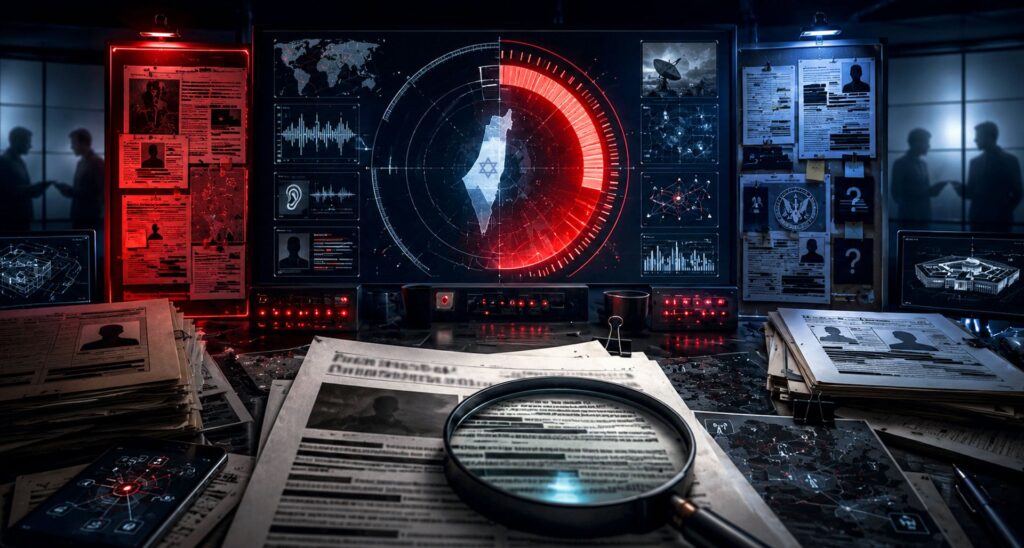
- Both NBC News and The New York Times broke a story that the Pentagon has raised the threat of Israeli espionage due to an alleged ramp-up in Israeli efforts to spy on senior Trump administration officials.
- Both stories were based on allegations from unnamed officials and purported reports that the outlets did not verify before publishing their “exclusive” stories.
- This is the latest example of how a weak story with credibility issues becomes legitimized by mainstream media outlets and then spread as a factual narrative throughout social media.
One of the most viral Israel-related stories to emerge over the weekend was a claim spread by NBC News and amplified by The New York Times: that Israel has intensified efforts to spy on senior Trump administration officials, particularly those involved in negotiations with Iran, and that concerns about Israeli espionage have been elevated within the U.S. Defense Department.
The story quickly spread from mainstream media into social media, where the usual cohort of anti-Israel accounts seized upon it as confirmation of long-held accusations about Israeli misconduct and duplicity.
The claim was circulated by figures across the American political spectrum, including Republican Representative Thomas Massie, AIPAC Tracker, conspiracy theorist Max Blumenthal, former Trump administration official Joe Kent, and anti-Zionist agitator Shaiel Ben-Ephraim.
But behind the headlines and salacious narrative, is there any evidence to actually support these allegations?
Depending on how one assesses the reporting, the story may amount to little more than unverified claims that have been spun into a major controversy for views.
Israel targeting senior U.S. officials cannot be accepted by our government.
This is not standard practice, especially considering the fact that Israel survives on our defense funding & diplomatic top cover.
Until we actually take away the support we give Israel they will… https://t.co/xaXW9ruK5x pic.twitter.com/h6yNeR3rjR
— Joe Kent (@joekent16jan19) June 6, 2026
The story was first broken by NBC News, which claimed that the Pentagon’s Defense Intelligence Agency (DIA) had recently raised the counterintelligence threat posed by Israel to its highest level amid concerns that Israel was seeking intelligence on U.S. officials involved in negotiations with Iran.
Such a serious allegation would ordinarily require substantial evidence.
Instead, NBC’s report relies primarily on claims made by three unnamed U.S. officials – two current officials and one former official.
According to the report, one of these officials said they had reviewed an internal seven-page DIA document that elevated the threat of Israeli espionage to a “critical” level.
That alleged document, which has not been made public, together with the testimony of anonymous sources, forms the core basis of NBC’s sensationalized reporting.
Notably, NBC also acknowledged that a White House official rejected the claims, calling them “false” and saying they were sourced to someone “who doesn’t have any knowledge of what’s going on.”
Without additional corroborating evidence, the story ultimately rests on anonymous sourcing and an unseen intelligence assessment. Nevertheless, it was presented to readers as an “exclusive” factual story on a significant national security development.
I had to read this latest New York Times anti-Israel piece a few times. Once you get past the definitive-sounding language, the sourcing underneath it is remarkably thin:
– “Several current and former U.S. officials” – unnamed
– “One senior official” – unnamed
– “Two senior U.S.… pic.twitter.com/5l5iB1AnLW— Hen Mazzig (@HenMazzig) June 7, 2026
Following NBC’s report, The New York Times published its own article, asserting that concerns about Israeli intelligence-gathering have increased in recent years and have intensified amid ongoing negotiations with Iran.
Like NBC’s report, the Times article relies heavily on unnamed current and former officials as well as references to intelligence assessments that have not been made public.
Despite the limited publicly available evidence, both reports quickly generated widespread attention.
As mentioned earlier, the allegations rapidly spread across social media, where many users treated them as established fact, citing the credibility associated with major news organizations.
This illustrates a familiar dynamic: a story based on limited sourcing is amplified by prominent media outlets, adopted by social media influencers and political activists, and rapidly transformed into a widely accepted narrative before the underlying claims have been independently verified.
To the best of my knowledge and assessment, Israel’s intelligence community stopped spying on U.S. soil and against American targets or individuals around the world following the Pollard affair in 1985. Period. Not Unit 8200. Not the Mossad and not the Shin Bet.
Therefore, my…
— Yossi Melman (@yossi_melman) June 7, 2026
So what should readers make of the allegations?
It is certainly possible that the reports are accurate. However, several analysts and intelligence observers have raised questions about both the evidence presented and the broader plausibility of the claims.
Haaretz intelligence correspondent Yossi Melman and academic Kobby Barda, writing in Yediot Ahronot, both argue that Israel significantly curtailed intelligence operations directed at the United States following the Jonathan Pollard affair in the 1980s.
While neither excludes the possibility that Israel continues to monitor certain American communications, both contend that the scale implied by recent reporting is inconsistent with what is publicly known about Israeli intelligence practices over the past several decades.
Barda further notes that the leaked assessment reportedly expresses “concerns” rather than presenting concrete evidence that Israel has recently expanded espionage activities inside the United States.
Both Melman and Barda also suggest that the leak itself may have been motivated by internal political or bureaucratic considerations. Melman argues that some officials may be seeking to portray Israel’s government and intelligence services as convenient scapegoats in the context of tensions surrounding Iran. Barda, meanwhile, suggests that elements within the U.S. administration may be attempting to create greater distance between Washington and Jerusalem despite growing military cooperation between the two countries.
Whatever the explanation, one fact remains clear: the allegations that Israel has become a heightened espionage threat are currently based on anonymous sources and intelligence assessments that have not been made public.
That does not necessarily mean the allegations are false. But it does mean that readers should distinguish between verified facts and claims that have yet to be independently substantiated.
In an era when narratives can spread globally within hours, that distinction remains as important as ever.
Liked this article? Follow HonestReporting on Twitter, Facebook, Instagram and TikTok to see even more posts and videos debunking news bias and smears, as well as other content explaining what’s really going on in Israel and the region. Get updates direct to your phone. Join our WhatsApp and Telegram channels!
© Divuach Ne’eman R”A, 2025