Key Takeaways:
- Challenged at Harvard over his infamous “dog rape” column, Nicholas Kristof doubled down, claiming multiple victims and independent corroboration.
- Trace that supposed corroboration and the same extraordinary allegations repeatedly resurface under different names, organizations and hyperlinks.
- Kristof invoked the UN as further support, but its document merely recorded a dog-rape allegation strikingly similar to claims already published elsewhere; it did not verify one.
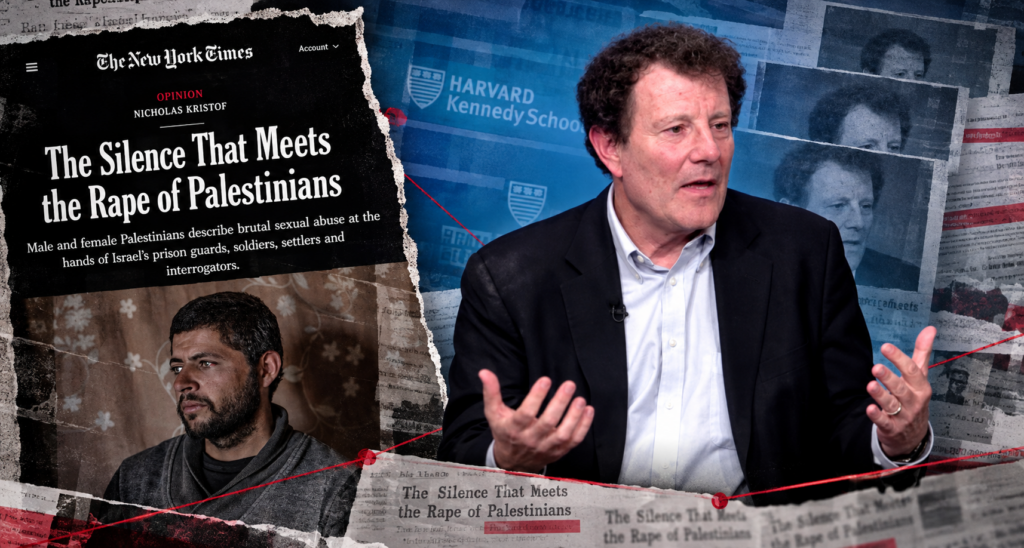
When Nicholas Kristof published “The Silence That Meets the Rape of Palestinians” in the New York Times in May, HonestReporting did something Kristof himself really should have done: thoroughly checked the sources.
Within hours, we had identified serious problems with the people and organizations Kristof relied upon to support allegations of widespread sexual violence by Israelis against Palestinian detainees, including his most grotesque claim: that Israeli guards had used dogs to rape prisoners.
The original HonestReporting thread was viewed more than a million times and subsequently informed wider scrutiny of Kristof’s reporting, including a Wall Street Journal commentary. We followed with further investigations into Kristof’s sources and a detailed examination of the Times’ increasingly strained attempts to defend the column.
The Times nevertheless dug in. Opinion editor Kathleen Kingsbury said Kristof’s reporting had undergone “rigorous vetting,” that every anecdote he personally reported had been supported by independent sources, and that editors reviewing challenges to the piece had “found no errors.”
Four months later, Kristof got another opportunity to defend himself.
Instead, he gave us an unusually revealing look at just how shaky that supposed “independent corroboration” really was.
Kristof Doubles Down at Kennedy School
On September 18, Kristof appeared at Harvard Kennedy School for the 2026 Malcolm H. Wiener Lecture. Harvard described the event as a conversation with former State Department spokesman Ned Price about some of the world’s most pressing issues.
After more than half an hour spent revisiting the Pulitzer winner’s earlier career as a New York Times reporter, Price finally raised the controversy surrounding Kristof’s May column, specifically the allegation involving dogs.
Kristof’s answer is important because he did not merely defend the original allegation, but went further, explicitly claiming there had been multiple dog rapes involving different Palestinians, independently reported across multiple human-rights organizations.
Asked whether he regretted relying on Hamas-linked Euro-Med Human Rights Monitor, Kristof insisted that he had not relied on the organization for the dog-rape allegation, although Euro-Med featured prominently among the sources cited in the original column.
Instead, he said the allegation came from a Gaza prisoner he had personally interviewed. He then described calling human-rights organizations and hearing similar stories, referring somewhat muddily to the UN, B’Tselem and Euro-Med as organizations that had encountered such accounts.
Then came the crucial assertion: “When you hear things repeatedly from different people who have not talked to each other … and when multiple organizations have reported it … then I think it becomes incumbent on us to report it.”
In other words, Kristof’s defense rests heavily on independence: different alleged victims, speaking separately to different organizations, supposedly producing mutually corroborating accounts.
That claim was tested during the audience Q&A at the end of the event.
Asked directly whether he was claiming that more than one person had been raped by dogs, Kristof answered yes. Asked how many, he replied: “I have no idea how many.” Asked whether the human-rights organizations involved really did not talk to one another, Kristof conceded: “Oh they certainly talk to each other.”
He then shifted the independence claim to the alleged victims themselves, asserting that they did not talk to one another.
How Kristof established that is considerably less clear.
And once the underlying reports are placed side by side, his confidence becomes even harder to understand.
1/6
— HonestReporting (@HonestReporting) September 24, 2026
WATCH THIS.
Nick Kristof is challenged at Harvard over his infamous “dog rape” column.
He doubles-down: MULTIPLE dog rapes on numerous Palestinians, all confirmed by human-rights groups.
We traced the “independent” sources and found the same grotesque story reappearing… pic.twitter.com/EcZxZiRFSn
The Same Extraordinary Story That Keeps Reappearing
As a detailed public “eyewitness” claim, the dog-rape story does, whether Kristof would like to admit it or not, begin with Euro-Med in June 2024.
About a week earlier, Muneer al-Bursh, director-general of Gaza’s Hamas-run Health Ministry, had made a much vaguer allegation that was reported by Al Jazeera Mubasher. Al-Bursh said released detainees had described trained dogs being used to commit sexual acts against them; Al Jazeera itself characterized the claim as rape. But no alleged victim was identified, no specific incident was described and no firsthand witness was presented publicly.
Al-Bursh is well-connected to Hamas. His eldest son, Basir al-Bursh, was later identified as a commander in Hamas’s elite Nukhba force; Reuters independently confirmed that Basir was Muneer al-Bursh’s son.
Then, on June 27, came Euro-Med with an entire report devoted to Israeli military dogs – biting civilians, attacking detainees and, most sensationally, supposedly raping them.
Its star witness was lawyer “Fadi Saif al-Din Bakr”, who said he had been released after 45 days in detention. Bakr alleged that after being subjected to electric shocks, soldiers later drove him and two other young men to another location in a military jeep. There, he said, their blindfolds were removed. The man sitting beside him was pulled away, forced to the ground and had his hands and feet tied.
Then came the extraordinary part: Bakr said soldiers released trained police dogs on the detainee, whom Euro-Med described in its English translation as having been subjected to “[rape].” Bakr said he feared the same thing would happen to him before the episode abruptly ended and the detainees were returned to the barn.
Fast-forward to May 2025, when the Palestinian Centre for Human Rights published its report said to be based on testimonies from 100 former detainees.
PCHR describes a 25-year-old man who said he was called out with “two other detainees” and taken to a “concrete yard”, where their “blindfolds were removed”. One detainee was separated and “stripped naked” before a police dog was brought in and allegedly raped him while he screamed. The alleged assault lasted “two minutes”, after which the witness and the third detainee were moved away.
Now move forward again to Euro-Med’s April 2026 report. A detainee identified as “Firas” says he was called out with “two other detainees he did not know” and taken to a “concrete courtyard”, where their “blindfolds were removed”. One detainee was separated and “stripped”, a large dog was brought in and allegedly raped him while he screamed, and the alleged assault lasted “two minutes”. Firas and the third detainee were then taken somewhere else.
That is not merely two allegations sharing the general claim that a dog was involved. It is virtually the same sequence of events: two other detainees, concrete yard, blindfolds removed, one man separated, clothes removed, dog, screaming, two minutes, the remaining two moved away.
What we actually have are two organizations publishing extraordinarily similar allegations under different identifiers — so similar, in fact, that the idea of two wholly independent accounts begins to strain credulity.
Indeed, this looks less like independent corroboration than the same outlandish, eye-catching allegation being recycled through the same small ecosystem of Palestinian advocacy groups.
And that is where Kristof’s defense becomes particularly embarrassing. He repeatedly invoked the existence of “different people” and “multiple organizations” as though those labels themselves establish independence, yet offers no indication that he ever stopped to determine whether the supposedly separate accounts were in fact separate at all.
Instead, the same grotesque story appears under different names, in different reports, and is then cited as though repetition has somehow transformed allegation into fact.
Then It Happens Again
The next pair is even more striking.
In November 2025, PCHR published testimony from a 35-year-old man identified as A.A., detained at Sde Teiman. He alleged that detainees were taken to a “passage between sections,” stripped naked and confronted with dogs. One allegedly urinated on him; another allegedly penetrated him while he was beaten.
Five months later, Euro-Med introduced “Amir,” also 35, also at Sde Teiman, who described being taken to a “corridor between the sections,” stripped naked, urinated on by one dog and allegedly penetrated by another while being beaten.
Same age. Same facility. Same location within it. Same stripping. Same urination. Same alleged penetration and beating.
Yet these appear in separate reports under different identifiers. Once again, the public record gives no reason to assume they are independent accounts.
Nor were the motifs new. Euro-Med’s June 2024 material had already paired an alleged dog rape with a separate allegation that guards made dogs urinate on detainees.
By 2026, those same distinctive elements were appearing together in near-identical PCHR and Euro-Med accounts.
The “Human Rights Groups” Kristof Trusts
The organizations themselves also warrant scrutiny.
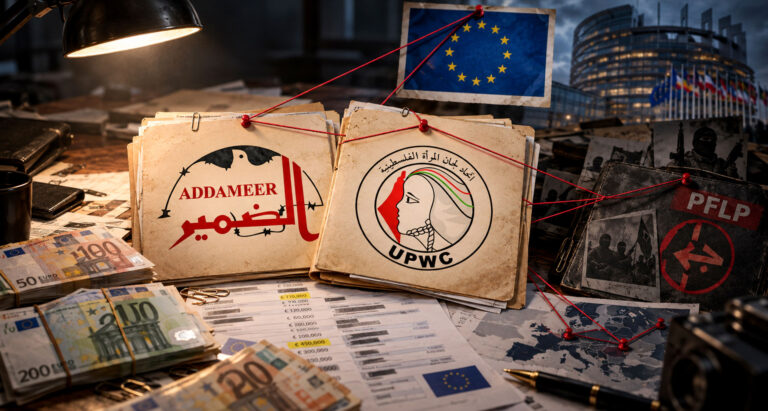
PCHR founder Raji Sourani previously served a prison sentence after he was convicted for membership of US-designated terrorist organization Popular Front for the Liberation of Palestine (PFLP) and later reportedly spoke at a PFLP-organized event about having been “in the ranks of the Popular Front.”
Euro-Med chairman Ramy Abdu was meanwhile subject to an Israeli anti-terror restriction order over his role within an organization Israel designated as belonging to and acting on behalf of Hamas.
Euro-Med’s record raises broader credibility questions too. HonestReporting has previously documented its promotion of sensational allegations involving organ harvesting, executions inside hospitals and even supposed weapons capable of making Palestinian bodies “melt or evaporate.”
Kristof’s defense at Harvard was that he did not get his anonymous journalist from Euro-Med. But he still cited Euro-Med as supporting evidence in the original column, which leaves an obvious question: why was it considered credible enough to corroborate anything?
More Dubious Testimonies
After recounting his anonymous journalist’s alleged dog rape in his original column, Kristof wrote that other prisoners and human-rights monitors had also reported dogs being “coached to rape prisoners.”
One of Kristof’s links went to Anadolu, which published an allegation from a pseudonymous 50-year-old West Bank detainee it called “Nihad.” He claimed that guards at Ofer Prison carried out a pre-dawn raid involving stun grenades before allegedly sexually assaulting him with a dog and leaving him outside on freezing concrete.
Another linked account, published by Middle East Eye, came from “Halim Salem,” also a pseudonymous West Bank detainee held at Ofer. His story again featured an early-morning raid, stun grenades, an alleged sexual assault involving a dog and being left outside in freezing conditions.
What’s more, the ingredients of both stories were already circulating in Euro-Med’s reporting long before either account appeared.
In June 2024, Euro-Med had published allegations involving prison “suppression squads,” sound bombs, detainees being forced face-down and dogs being released on them. The same report contained its purported dog-rape account from Fadi Bakr. Earlier Euro-Med material had also alleged detainees being stripped or restrained in freezing conditions.
So by the time Kristof was linking to “Nihad” and “Halim Salem” as supporting evidence, virtually every distinctive element was already circulating in the same reporting ecosystem: raids, stun or sound grenades, detainees forced to the ground, dogs, alleged sexual assault and punishment in freezing conditions.
At Harvard, Kristof reached for one more piece of supposed corroboration: a UN document made public after his column that, he said, described “precisely that phenomenon.”
The reality is rather less impressive.
The communication from UN Special Rapporteur on Torture Alice Jill Edwards was actually dated March 18, 2026, nearly two months before Kristof’s May 11 column, although the UN decided to publish it a week after his column. It recorded allegations, including one person who reported witnessing a detainee being raped by a dog.
It did not say that allegation had been verified. And the pattern is becoming difficult to ignore.
Across supposedly separate testimonies, the same extraordinary details keep resurfacing: dogs allegedly used for rape, dogs mauling genitals, electrocution to the testicles, detainees stripped naked, suppression raids, stun grenades and freezing conditions.
These are not mundane allegations that might naturally recur in hundreds of detention accounts. They are lurid, highly specific claims, yet they repeatedly surface through the same small network of Palestinian advocacy organizations and media reports.
PCHR’s May 2025 report, for example, was based on 100 former detainees. The purported dog rape came from a single anonymous witness. Yet by the time the allegation reaches later reports, remarkably similar stories begin appearing under different identifiers and through different organizations.
The UN communication then records another allegation involving a purported dog rape, alongside other striking claims already present in PCHR material, including a dog allegedly mauling a detainee’s genitals and electrocution to the testicles.
At some point, the recurrence itself stops being persuasive evidence of corroboration and becomes the very thing that demands scrutiny.
The UN communication does not establish that its witness was new, independent or separate from testimony already circulating through PCHR, Euro-Med and other Palestinian organizations. Nor does it verify that any of these extraordinary allegations occurred.
Corroboration Requires More Than Repetition
The New York Times defended Kristof’s original column by insisting that his reporting had been rigorously checked and independently corroborated.
At Harvard, Kristof effectively showed us what that corroboration looks like.
He does not know how many alleged dog-rape victims there were. He concedes that the organizations reporting the allegations talk to one another. Some supposedly separate accounts are extraordinarily similar. One of his own links does not even allege dog rape. And the UN document he invokes as further support records an allegation rather than verifying it.
Kristof was challenged at Harvard over one of the most notorious claims in his May column. His defense ultimately demonstrated the very problem his critics had identified from the beginning.
Liked this article? Follow HonestReporting on Twitter, Facebook, Instagram and TikTok to see even more posts and videos debunking news bias and smears, as well as other content explaining what’s really going on in Israel and the region. Get updates direct to your phone. Join our WhatsApp and Telegram channels!
© Divuach Ne’eman R”A, 2025