Key Takeaways:
- Elements within the Democratic far left have moved past cutting aid to calling for Israel’s end as a Jewish state.
- This push for Israel’s end is getting a pass from the media and from some Jews.
- New media will spread this emboldened and escalated antizionism further, with no checks.
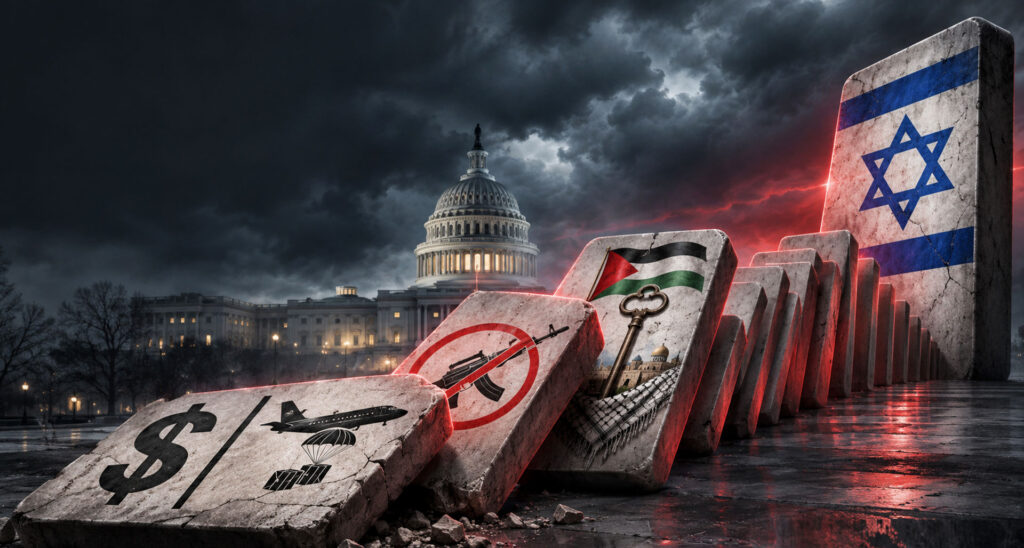
A quick look at a social media post from the newly-elected Democratic Rep.-elect Dariavila Aliza Chevalier is all it takes to understand what awaits Israel in the wake of Tuesday’s Democratic swing in America’s Midterm elections. Mere minutes after Pres. Donald Trump announced an end to American foreign aid to Israel, Chevalier posted on X: “Military aid is not enough. We need to end U.S. taxpayer funding for Israel’s war crimes, a full arms embargo, and the Palestinian right of return.”
Huh?
While there is nothing new about cutting American economic assistance, demanding an arms embargo, and weaponizing the term “war crimes,” Chevalier’s insertion of the phrase “Palestinian right of return” is a new form of escalation. Because while the majority of newly-elected Democrats may actually be centrists like Jon Ossoff of Georgia and Texan James Tallerico, Chevalier’s words still managed to lay bare the dramatic shift of antisemitism and antizionism across American culture and politics.
New Demands
What’s so telling about Chevalier’s rhetoric is both the timing and intent. Her message is chilling: Nothing but the coordinated dismantling of Zionism — in this case a “return” of Palestinians to their former homes presumably occupied by Jews — will satisfy incoming Democrats. Particularly those, like Chevalier, who are part of the party’s Israel-obsessed far-left fringe. Indeed, fellow Congressional newcomer Colorado Rep.-elect Melat Kiros spoke nearly the exact same words during an appearance on PBS this summer — she advocated for a “one-state” solution, an end to Israel as a Jewish “ethnostate” and that right of return for Palestinians. She even went one step further, provocatively suggesting Palestinians be awarded “reparations as a result of the [Israeli] genocide.”
Three months on, Chevalier was particularly clever to tether these “right of return” demands to Trump’s aid announcement. While the media was busy framing Trump’s move as a watershed moment in U.S.-Israeli history, Chevalier turned the ending of one era into the demand for a new one. It’s an era filled with anti-Zionist totems such as “war crimes,” a “one-state solution” and — most chillingly — an end to Israel’s Jewish majority. As she turns political performance into protest, Chevalier makes clear that nothing will ever satisfy protesters like herself except Zionism’s uncontested defeat.
Yes, extremists such as Kiros and Chevalier are still Democratic party outliers. But like so much of woke culture and identity politics, these extremists exert outsized power and influence by ensuring they’re the loudest voices in the room.
A Rising Ideological Movement
Chevalier is hardly alone in the deployment of such stark and violent antizionist rhetoric — which cleverly downplays Jews, laser-focuses on Israel, and then tethers that focus to the might of the U.S. government.
The Palestinian activist and academic Noura Erakat — currently promoting her new book “Confronting Zionism: Decolonizing Palestine and Building the World Anew” —spoke in a recent podcast of an unprecedented moment right now to correct historic “missed opportunities” that failed to bring about an end to Zionism. From Israel’s establishment in 1948 to the Oslo Accords nearly five decades, each time Israel could have been stopped, global powers failed to stop it. But with so many powers now aligned against Zionism, this is the time, Erakat insists, to break that cycle – and break Israel.
African-American author Ta-Nehisi Coates, meanwhile, recently highlighted what he called the “If But for Netanyahu Fantasy” at a Palestinian literature festival in London. This theory suggests that the popular belief that an end to the Prime Minister’s decades of rule will fundamentally alter Israeli government and society is a myth; what is really required, he believes, is an end to the Israeli “project” itself. Netanyahu may be on his way out, but Israel will still stand strong.
What’s most disturbing about ideologues such as Erakat, Chevalier, Kiros and Coates is how they’re been elevated by the media with such minimal confrontation or critique. As they blithely banter about ending Zionism and some great Palestinian “return,” their enablers never demand details about the fates of the Jewish Israelis impacted by such moves. The fact that their increasingly large and global audiences appear to also demand no such answers confirms the potency and power of antizionism right now — and the accompanying erasure of Jews.
The Impact of the Elections
There is little doubt that such erasure will rise sharply once America’s new Democratic-led Houses are seated in January — particularly if incoming Michigan senator Abdul el-Sayed secures a place on the powerful Senate Foreign Relations Committee, which directly influences American foreign policy. The fact that nearly 60 percent of Michigan’s Jews voted for an openly anti-Israel candidate like el-Sayed will only further normalize the delegitimization of Israel and Zionism by incoming radical leaders. True, that 60 percent figure represents a sizable decline in traditional Jewish support numbers; nearly 80 percent of Jews voted for the incoming Democratic Gov. Phil Weiser this week. But nothing legitimizes antizionism better than the political cover provided by sympathetic Jews such as those who cast ballots for el-Sayed.
The changing notion of media itself will also further post-Midterm antizionist rhetoric. Data from election night, for instance, reveals that Hasan Piker, the virulent anti-Israel streamer, rivaled NBC’s beloved election guru Steve Kornacki. Even though legacy media still led the evening, Piker operated with zero checks or balances — he reached nearly as large an audience without fact-checking (or perhaps even facts).
Now with his ideological comrades secure across nearly every level of U.S. government, Piker’s reach is certain to increase — along with the virulence of his already extreme views. And it will do so with scant government regulation or control. In fact, Piker’s $72.5 million defamation lawsuit against conservative commentator Scott Jennings reflects how media newcomers like streamers now possess the power to enact policy almost in real time and on their own terms.
With so much of streamer content focused against Israel, their highest-profile stars like Piker will assume even great influence over their young and impressionable followers (Piker alone has nearly 8 million across his myriad platforms). And with Piker suggesting that his legal campaign against Jennings may just be the beginning, non-traditional media stars — and their antizionist agendas — will become even more difficult to moderate.
It will be chaos across both America’s airwaves and its houses of government, just as the antizionists have always wanted.
Liked this article? Follow HonestReporting on Twitter, Facebook, Instagram and TikTok to see even more posts and videos debunking news bias and smears, as well as other content explaining what’s really going on in Israel and the region. Get updates direct to your phone. Join our WhatsApp and Telegram channels!
© Divuach Ne’eman R”A, 2025