Key Takeaways:
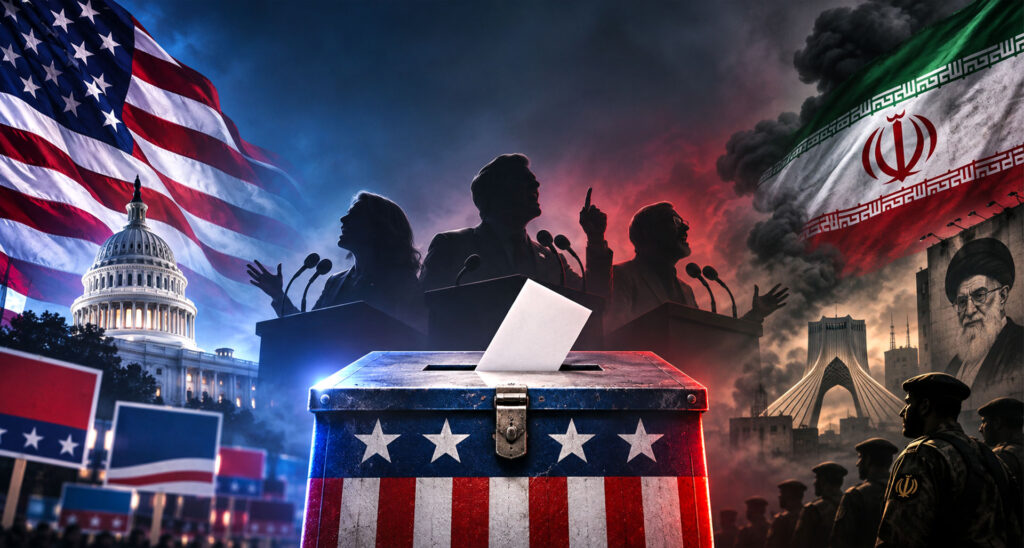
- From the Ayatollah to sympathetic academics, the Iranian regime and its allies have been celebrating the Republican losses in the midterm elections as a referendum against the war in Iran.
- Analysis of the midterms shows that most voters focused on government corruption and the cost of living, with only about a third citing the war in Iran as a crucial factor in their vote.
- It is unclear that Democratic gains in the U.S. Congress will immediately change how President Donald Trump’s White House handles the Middle East over the next couple of months.
What do the Iranian Speaker of Parliament, the Ayatollah, and an Iranian-American think tank scholar all have in common?
They’ve all been vocal in celebrating the results of the United States’ midterm elections.
The Speaker of Iran’s parliament posted on X (formerly Twitter) that Americans had said “NO TO WAR” and that “we endorse this message” (the “message” being the ouster of Republican politicians in favor of Democratic ones) while the parliament’s Deputy Speaker claimed that the losses incurred by President Donald Trump’s Republican Party were a consequence of his “defeat against the Iranian people.”
At the same time, the Deputy Head of Communications and Information at the Iranian President’s Office appeared to delight in the Republicans’ loss of Congressional seats, linking it to the United States’ support for Israel’s wars in Gaza and Iran, while the Ayatollah gloated on social media that “the process of the US’s collapse has accelerated.”
In the United States, Iranian-American scholar Trita Parsi (who is suspected of sympathetic ties to the Islamic Republic) posted on X that, instead of the Democrats having won the midterms, “Iran did.” Back in Iran, Mohammad Marandi, an Iranian-American academic / mouthpiece for the Iranian regime, could not contain his joy at the “blue wave” that washed across the United States, posting that the Republican defeat was due to Netanyahu, Trump, and “the Zionists,” and later claiming that Iran had won the election.
So, why such jubilation by the Islamic Republic over midterm election results in the United States? After all, according to Iran’s theocratic regime, the U.S. is the “Great Satan,” regardless of who is in power on Capitol Hill.
The Iranian regime’s gloating seems to boil down to its belief that this turn in the political climate will be beneficial to the Islamic Republic in its current fight against the U.S.
It is clear that the Iranian regime has taken this election to be a referendum on the popularity (or, rather, unpopularity) of the war with Iran. It is also clear that the Iranian regime views the wave of Democratic victories as proof that the American people have overwhelmingly turned against the war with Iran and its domestic consequences (e.g. higher gas prices).
Of course, Iranian regime officials are not the only ones making this case.
Various political analysts from the U.S. and around the world, as well as Vice President JD Vance and even President Trump, all pointed to the war and its consequences as affecting the election results.
However, while the mullahs in Tehran might be cheerful in believing that the war with Iran was seemingly the deciding factor in this year’s elections, analysis shows that this is not exactly the case. While roughly a third of voters viewed the war in Iran as a crucial factor in deciding their vote, most were more focused on government corruption and the cost of living (which is only tangentially related to the war, as other factors, such as tariffs and inflation, have also contributed to a higher cost of living).
Aside from viewing the midterm elections as a referendum on the unpopularity of the war with Iran, it appears that the Islamic Republic is also content with the election results due to the fact that they believe this gives them the upper hand in negotiating with the Trump administration.
On this, the regime in Tehran might be right in celebrating, as several of the midterm Democratic victors (such as Joshua Turek, Sherrod Brown, and James Talarico) as well as top Democratic politicians (such as Hakeem Jeffries and Chuck Schumer) have all made statements since the election results came in claiming that their top priority is to end the war with Iran.
Yet, while this may point to increased pressure on the Trump administration to end the war no matter the cost, it is unclear whether this shift in control of the U.S. Congress will have an immediate effect on how the White House proceeds in the Middle East over the next couple of months.
Regardless of how much the Iran war had an effect on the midterm election results or whether the wave of Democratic wins will mean an abrupt end to the conflict in the Middle East, it is clear that the theocratic regime in Iran, which has been responsible for the killing of tens of thousands of its own citizens as well as hundreds of American citizens over the past 45 years, is celebrating this recent change in the color of the American political map. And that should frighten everyone, no matter what their political leanings.
Liked this article? Follow HonestReporting on Twitter, Facebook, Instagram and TikTok to see even more posts and videos debunking news bias and smears, as well as other content explaining what’s really going on in Israel and the region. Get updates direct to your phone. Join our WhatsApp and Telegram channels!
© Divuach Ne’eman R”A, 2025