Turkey’s Hypocrisy Exposed by Israeli Recognition of Armenian Genocide
Israel's recognition of the Armenian Genocide is an important step toward historical truth and exposes the profound hypocrisy of Turkey's genocide accusations against Israel while it continues to deny its own history.
Israel’s recognition of the Armenian Genocide affirms an essential historical truth. Acknowledging one of the twentieth century’s first genocides reinforces the principle that mass atrocities must be remembered honestly, regardless of political convenience.
Turkey’s genocide accusations against Israel are undermined by its own century-long denial of the Armenian Genocide. While insisting the destruction of over 1.5 million Armenians was merely a wartime tragedy without genocidal intent, Ankara simultaneously labels Israel’s war against Hamas a genocide.
History demonstrates that genocide denial carries consequences. Hitler’s infamous question, “Who, after all, speaks today of the annihilation of the Armenians?” serves as a reminder that erasing past atrocities can embolden future perpetrators.
Yesterday, the Israeli cabinet voted unanimously to recognize the Armenian Genocide. Announcing the decision in Hebrew, Foreign Minister Gideon Sa’ar declared: “It is never too late to do the right thing.”
While the matter will be passed to the Knesset for legislation, the cabinet decision carries particular significance because few countries have faced more sustained accusations of genocide from Turkey than Israel itself. Turkish President Erdoğan recently claimed:
“The genocidal, occupying, expansionist ideology called Zionism threatens not only me, not only our party, not only our alliance, it threatens everyone. When we struggle against Zionism, we are not waging this struggle for ourselves or for personal reasons. We are doing it for our own survival and for the survival of our nation.”
Turkish President Recep Tayyip #Erdoğan with another Anti Semitic speech: "The genocidal, occupying, expansionist ideology called Zionism threatens not only me, not only our party, not only our alliance—it threatens everyone. When we struggle against Zionism, we are not waging… pic.twitter.com/iADAuAQpxD
Yesterday, in response to the Israeli cabinet’s recognition of the Armenian Genocide, Erdoğan doubled down on his accusations. In a speech yesterday, Erdogan alleged that “Israeli aggression has led to the deaths of countless innocent Palestinians,” they “intentionally murdered innocent children” and that “a genocide was carried out in Gaza.”
He also – ironically, given Turkey’s current policies and their own dark past – claimed that his party, the Justice and Development Party (AK Party)“will always stand with the oppressed.”
Presidential Communications head Burhanettin Duran asserted on social media on Sunday that the Israeli government was being hypocritical, supposedly having “perpetrated the most brutal massacre of the 21st century,” and was now ostensibly using “historical events as a political weapon.”
“It is the greatest irony in human history that those who speak of moral and historical responsibility are today relentlessly bombing hospitals, schools, places of worship and refugee camps while flagrantly violating international law,” said Duran.
Yet with the remarks by Erdogan and Duran, it is Turkey that displays outrageous hypocrisy. While 31 countries, and now Israel, recognise the Armenian Genocide, Turkey continues to deny that it ever happened. Instead, it argues that Armenians collaborated with invading Russian forces, that deportations were a legitimate wartime security measure, and that although vast numbers of Armenians died, there was never any intention to destroy the Armenian people.
The contradiction is impossible to ignore. Turkey insists that the destruction of over 1.5 million Armenians, amounting to the annihilation of some 60 to 65 percent of the Armenian population, was not genocide but rather a tragic consequence of war. It argues that the deaths occurred in the context of a legitimate security campaign against a population it accused of collaborating with an invading enemy, and that there was no intent to destroy the Armenian people.
This is, in essence, part of the reality Turkey rejects when it comes to Israel. Ankara dismisses the fact that civilian deaths in Gaza are the tragic consequences of a war against Hamas, fought in response to the October 7 Massacre and against an enemy that deliberately embeds itself among civilians.
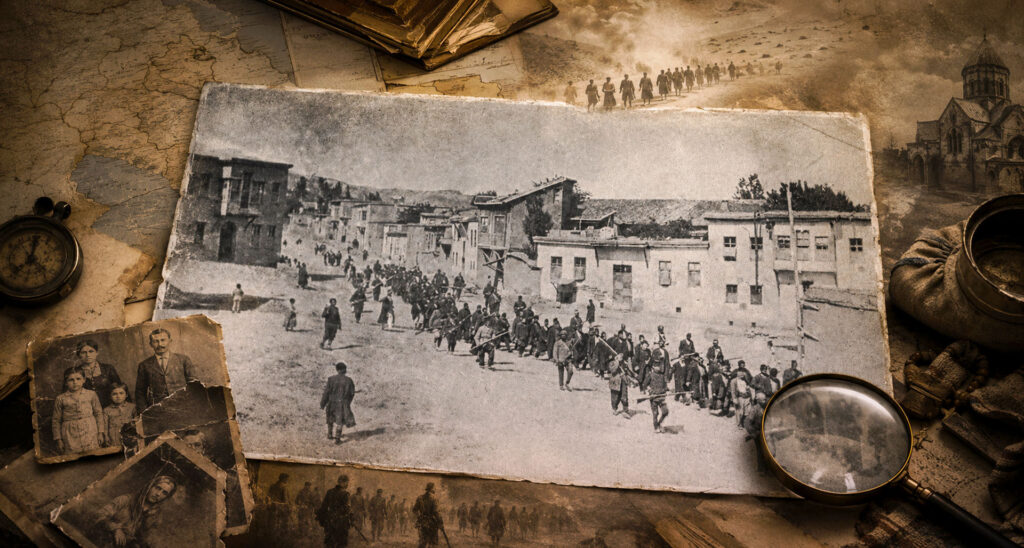
The Destruction of the Armenian People
Despite Turkey’s denial, the historical record tells a very different story. The destruction of the Armenian people did not begin as a wartime necessity but as a project conceived years before the First World War. The ruling Committee of Union and Progress (CUP), the Young Turk movement that seized power in 1913, embraced an ultranationalist vision of remaking the Ottoman Empire into an ethnically homogeneous Turkish state. Historian Hans-Lukas Kieser has described the CUP as pioneering“a modern, right-wing revolution” rooted in conspiracy theories, ethnic nationalism, demographic engineering, and anti-liberal politics. Armenians, an ancient Christian people who had prospered economically and culturally despite centuries of discrimination, came to be viewed as an obstacle to this vision. Plans to eliminate that obstacle were already taking shape by 1911-1912. The outbreak of war merely provided the opportunity to implement them.
On 21 February 1914, the CUP organised a boycott of Armenian businesses, foreshadowing the anti-Jewish boycotts launched by the Nazis nearly two decades later. CUP founder Selanikli Mehmed Nâzım Bey travelled throughout the empire to enforce the boycott. By August, violence had already erupted: more than a thousand Armenian-owned shops were burned in Diyarbekir, while Armenian and Greek property was systematically looted under the guise of collecting “war contributions.” As a result, many Armenians faced starvation. Months before Russia declared war on the Ottoman Empire, Armenians were already being dispossessed, impoverished, and targeted because of their identity and background.
After the Ottoman Empire entered the First World War, persecution escalated into extermination. Armenian soldiers serving loyally in the Ottoman army were disarmed, transferred into labour battalions, and murdered. The government expanded the Special Organization, a paramilitary force that became one of the principal instruments of mass killing. On 12 November 1914, Ottoman authorities publicly accused Armenians of conspiring with Russia and preparing to revolt, despite the fact that anti-Armenian violence had begun long before these accusations were made. The following day, mass killings commenced in the village of Otsni in Erzerum Province. Again, shadowing the Holocaust, economic persecution had become organised murder.
The genocide reached its defining phase in the spring of 1915. On 24 April, hundreds of Armenian intellectuals, clergy, politicians, doctors, and community leaders were arrested in Constantinople, effectively decapitating Armenian society. Armenian men were systematically separated from their families and executed. Women, children, and the elderly were forced from their homes and driven toward the deserts of Syria on what were presented as deportations but were, in reality, death marches. Along the way, families were robbed, raped, abducted, and massacred. Those who survived the violence often died from starvation, thirst, disease, or exhaustion. Entire communities that had existed for centuries vanished within weeks.
By late 1915 and throughout 1916, the objective was no longer simply expulsion but annihilation. Concentration camps around Deir ez-Zor became places of slow death where starvation, exposure, disease, and repeated massacres claimed countless lives. Children were torn from their parents and forcibly absorbed into Muslim households. Women endured widespread sexual violence and forced conversion. Churches, schools, businesses, and homes were confiscated or destroyed. Diplomats, missionaries, and relief workers consistently reported that what they were witnessing was not the chaos of war but the deliberate destruction of an entire people directed by the Ottoman government.
By 1917, Armenian civilization across eastern Anatolia had been shattered. Ancient towns and villages that had sustained Armenian life for millennia had been emptied. What had begun with boycotts, propaganda, accusations of disloyalty, and the arrest of community leaders culminated in the near annihilation of one of the world’s oldest Christian peoples through coordinated murder, starvation, forced displacement, and cultural destruction.
Recognition and Historical Truth
Israel’s decision to recognise the Armenian Genocide is therefore significant not only because it acknowledges one of history’s greatest crimes, but because it rejects the politics of denial. As Nazi leader Adolf Hitler asked before the invasion of Poland, “Who, after all, speaks today of the annihilation of the Armenians?”
Recognition cannot undo the past, but it helps ensure that genocide cannot simply be erased from history.
Despite this, for more than a century, Turkey has sought to deny this reality. Yet denial cannot erase history. Israel’s recognition is therefore more than a diplomatic decision. It is an affirmation that historical truth matters, that genocide must be recognised regardless of political convenience, and that justice begins by calling crimes by their proper name.
Founder of the modern Jewish Pride movement, Ben M. Freeman is the author of Jewish Pride: Rebuilding a People (2021) Reclaiming our Story: The Pursuit of Jewish Pride (2022) and The Jews: An Indigenous People (2025). Educating, inspiring and empowering, his work focuses on Jewish identity and historical and contemporary Jew-hatred. A Holocaust scholar for over fifteen years, Ben came to prominence during the Corbyn Labour Jew-hate crisis in the UK and quickly became one of his generation’s leading Jewish thinkers and voices against Jew-hate.