Key Takeaways
- Indigeneity is anthropological, not political. It concerns where a people’s civilization originated and developed, not whether they currently hold power or have experienced oppression.
- The Jewish people meet every substantive criterion for indigeneity. History, archaeology, language, law, culture, collective memory and an enduring connection to the Land of Israel all point to the same conclusion.
- Recognizing Jewish indigeneity restores historical accuracy. It places the Jewish people within the same anthropological framework applied to every other indigenous people and provides the proper context for understanding Jewish identity and Zionism.
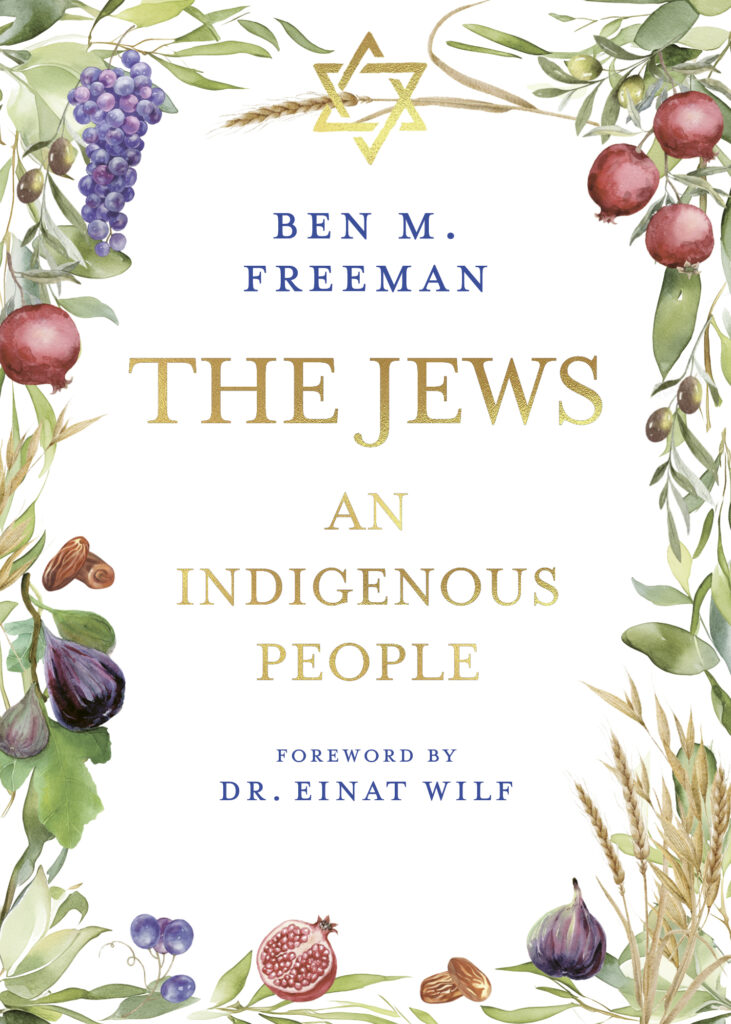
The question of Jewish indigeneity in the Land of Israel has become one of the defining controversies of the modern Jewish experience. For some, the answer is so self-evident that it scarcely requires explanation. When I published my third book, The Jews: An Indigenous People, some even questioned why I had spent two years researching something they regarded as so obvious. For others, however, acknowledging Jewish indigeneity is seen as legitimizing Jewish self-determination, and is therefore rejected.
This is unfortunate because indigeneity is, first and foremost, an anthropological concept. Yet over the past half-century it has been increasingly politicized. During the decolonization movements of the 1960s and 1970s, indigeneity became associated with a wider ideological framework dividing the world into colonizers and the colonized. While many indigenous peoples have undoubtedly experienced oppression, submission to another nation is not what makes a people indigenous. These are historical circumstances that many indigenous peoples share, not the characteristics that define them.
The distinction matters. If indigeneity is understood through the lens of oppression, it becomes possible to argue that a people somehow ceases to be indigenous if it regains sovereignty or exercises political power within its homeland. Such a proposition is absurd. Political realities change across centuries. The connections which bind a people to a land do not.
A second misconception is that indigeneity is determined simply by who arrived somewhere first. The idea appears intuitive until one examines actual indigenous communities. As anthropologist Manvir Singh observed in his 2023 essay It’s Time to Rethink the Idea of the Indigenous, chronology cannot explain who is or is not considered indigenous. The earliest permanent settlers of Iceland were Gaelic monks followed by Vikings, yet neither group is generally described as indigenous. However, the Maasai are widely recognized as indigenous despite their own oral traditions describing migration into present-day Kenya and Tanzania only a few centuries ago. Being first, while sometimes relevant, is neither a necessary nor sufficient condition for indigeneity.
What, then, distinguishes an indigenous people?
The answer lies not in chronology but in the formation of collective identity. It is for this reason that I define an indigenous people as:
“A group whose collective identity began in one specific land, and it is in that land they remained rooted (either physically, spiritually or culturally). This is their home and is where they originated, developed, and continued to be fixed through a connection to the environment and natural resources, living systems, culture and practices as a people, irrespective of their sovereignty in the land.”
Several elements of this definition deserve emphasis. First, it recognizes that indigeneity survives displacement. History is replete with examples of indigenous peoples who experienced conquest, exile or forced migration while maintaining enduring ties to their ancestral lands. Finally, it separates indigeneity from contemporary political arrangements. Sovereignty can be won, lost and restored. Indigeneity concerns the formation of a people, not the nature of the state that governs them.
This understanding also avoids reducing indigenous identity to genetics alone. Questions of ancestry matter, but they do not define a people. Modern genetic studies consistently demonstrate substantial shared Levantine ancestry among geographically dispersed Jewish communities. These findings do not define Jewishness. Rather, they corroborate what archaeology, history, language and Jewish tradition have maintained for millennia: that the Jewish people originated in the Land of Israel.
Nor is conversion incompatible with indigeneity. Indigenous communities around the world have long possessed mechanisms through which outsiders become members of the collective. The United Nations explicitly recognizes that indigenous peoples have the right to determine their own membership. The Jewish people are no different. Throughout history, Jewish law has determined membership, while conversion has enabled those who choose to join the Jewish people to become full participants in Jewish civilization. Ruth’s declaration, “Your people shall be my people, and your God my God,” places peoplehood before God, reflecting the longstanding Jewish understanding that conversion is entry into a people, a civilization, and a shared ancestral story.
The United Nations Framework and the Jewish Case
Alongside the definition I have proposed, the United Nations provides a useful framework for understanding indigeneity. Rather than offering a rigid definition, it identifies seven broad criterion which help assess claims to indigenous status. Although one of these characteristics is problematic, the framework remains a valuable means of evaluating indigeneity and will serve as a useful point of reference throughout this discussion.
Measured against these characteristics, the Jewish people do not present an ambiguous case. They represent one of the clearest examples of indigeneity anywhere in the world. This exposes an outrageous irony at the heart of the United Nations. The organization has developed a framework that affirms the Jewish people as indigenous to the Land of Israel, yet they continue to erases that very truth. Its own criteria demonstrate the legitimacy of Jewish indigeneity even as many within the institution refuse to acknowledge it.
Self- identification as indigenous peoples at the individual level and accepted by the community as their member
Historically, Jews have not described themselves as indigenous. This has sometimes been presented as evidence against Jewish indigeneity, but the opposite is true. The language of indigeneity is modern; Jewish civilization is ancient. Long before anthropology or international law existed, Jews already possessed our own vocabulary to describe the relationship between ourselves and our homeland. We spoke of Am Yisrael, the People of Israel; Eretz Yisrael, the Land of Israel; Zion; Jerusalem; and Aliyah. These concepts express precisely the relationship that the modern language of indigeneity seeks to describe.
That relationship remains central to Jewish identity today. While some Jews reject the connection between the Jewish people and the Land of Israel, they represent a minority view. Surveys consistently demonstrate that Israel occupies a central place in Jewish identity across the Diaspora. Research by the Institute for Jewish Policy Research found that 93% of British Jews say Israel forms part of their Jewish identity, while more recent polling found that 97% feel personally connected to events there. This should not be confused with the antisemitic canard of dual loyalty. Identity is not a zero-sum proposition. Jews can feel deep attachment to the countries in which they live while also recognizing Israel as the homeland of the Jewish people.
The second part of this criterion concerns community recognition. Like many indigenous peoples, Jews determine membership according to our own laws and traditions. Jewish law establishes who belongs to the Jewish people, whether by birth or conversion, while recognized conversion processes ensure that newcomers join the Jewish collective through its own institutions. Like other indigenous peoples, these mechanisms exist not to exclude but to preserve the continuity of the community across generations.
Historical continuity with pre-colonial and/or pre-settler societies
Historical continuity lies at the heart of indigeneity. While many indigenous peoples, including the Jews, have experienced conquest and colonization, these are historical circumstances rather than defining characteristics. What matters is continuity: an enduring connection to the civilization that first emerged in the ancestral homeland.
The Jewish case is exceptionally strong. Despite the Roman destruction of Jerusalem and the suppression of the Bar Kokhba Revolt, Jewish civilization did not disappear from the Land of Israel. Galilee became the principal center of Jewish life, where the Mishnah was compiled around 200 CE and the Jerusalem Talmud completed in the fifth century. Jewish communities continued to exist in Tiberias, Safed, Hebron, Caesarea, Acre and Jerusalem itself under successive empires. The claim that the Land of Israel was emptied of Jews until the rise of modern Zionism is a historical myth.
Nor did the Jewish return begin with modern Zionism. Jews made Aliyah throughout the centuries, including the migration of hundreds of French and English rabbis in 1211, the return of Sephardi Jews following their expulsion from Spain and Portugal, and later migrations from Yemen and Ethiopia. Modern Zionism transformed the Jewish return into a national movement; it did not invent it.
Jerusalem itself best illustrates this continuity. It was the capital of the ancient Jewish kingdoms, remained the focal point of Jewish prayer throughout exile, and became the capital of the restored Jewish state. Synagogues throughout the world face Jerusalem, and every Pesach Seder concludes with the words, “Next year in Jerusalem.” For more than two thousand years, exile stretched but never severed the bond between the Jewish people and their homeland. The land remained central to Jewish civilization, and Jerusalem remained its spiritual heart.
Strong relationship with ancestral territories and natural resources
Perhaps no criterion better captures the meaning of indigeneity than a people’s relationship with its ancestral land. As the United Nations recognises, indigenous peoples maintain a distinctive spiritual, cultural and practical relationship with the territories from which they emerged. Few peoples demonstrate this more clearly than the Jews. The connection between Jewish civilization and the Land of Israel is woven into almost every aspect of Jewish life.
The Jewish calendar itself reflects that relationship. Pesach, Shavuot and Sukkot all began as agricultural festivals rooted in the seasons and harvests of the Land of Israel before becoming pilgrimage festivals centered on Jerusalem. Tu BiShvat marks the agricultural cycle of the land, while Shmita, the Sabbatical year, commands that the land itself rest every seventh year. These are not simply religious observances. They reflect a civilization whose rhythms developed in direct relationship with a particular landscape.
The Land of Israel likewise remains central to Jewish prayer and collective memory. Jews pray facing Jerusalem, continue to pray for rain according to Israel’s rainy season regardless of where they live, and many choose to be buried in Israel or with soil from the Land of Israel placed in their graves. From the covenant with Abraham to the modern Declaration of Independence, the Land of Israel has remained the physical and spiritual centre of Jewish civilisation for more than three millennia.
Distinct social, economic or political systems
The Jewish case is equally compelling when it comes to distinct social, economic and political institutions. Like every civilization, the Jewish people developed systems that governed society, the economy and political life in the Land of Israel. Although these evolved over time and adapted to exile, their foundations remained recognizably Jewish and continue to shape Jewish life today.
Socially, Jewish civilisation has long been organised around the concepts of Kehilla (community) and Kol Yisrael arevim zeh ba’zeh—all Jews are responsible for one another. This sense of mutual responsibility gave rise to enduring communal institutions, including synagogues, schools, burial societies and welfare organisations, enabling Jewish communities to sustain themselves wherever they lived while preserving ancient ideas of communal responsibility.
Economically, Jewish civilization developed a distinctive ethic centered on tzedakah. Although often translated as “charity,” its roots lie in tzedek—justice. Biblical laws such as pe’ah and gleanings required farmers to leave part of their harvest for those in need, establishing an understanding that supporting the vulnerable was not voluntary generosity but a communal obligation grounded in justice. That principle continues to shape Jewish communal life today.
Politically, the Torah functioned as the law of the Jewish people. It was not simply a collection of religious teachings but the legal framework through which Jewish society was organized. As the scholar Yonatan Adler observes, the earliest Greek translation rendered Torah as nomos, law. It regulated political authority, established courts, governed property, agriculture and commerce, and prescribed the obligations binding Jewish society together. In modern terms, it functioned as the constitution of an indigenous civilization. These laws were implemented through institutions such as the beit din, while the public reading of the Torah ensured that they remained central to Jewish communal life. Even after sovereignty was lost, Jewish communities throughout the Diaspora continued to organize themselves around this legal tradition, preserving a remarkable continuity with ancient Jewish society.
Distinct language, culture and beliefs
The Jewish case is equally strong with respect to language, culture and beliefs. All three developed together in the Land of Israel as part of a single civilisation. Modern readers often separate religion, culture and nationality into distinct categories. Ancient Jewish civilisation did not.
Hebrew is the clearest example. Although Jews later developed important Diaspora languages such as Yiddish, Ladino and Judeo-Arabic, our indigenous language has always been Hebrew. It is the language of the Torah, Jewish prayer and Jewish learning. Even after it ceased to be spoken in everyday life, Hebrew remained central to Jewish civilization before being revived as the spoken language of the modern Jewish state. Few indigenous peoples have restored an ancestral language so successfully after centuries of dispersion. Today, whether spoken daily in Israel or read from a Torah scroll anywhere in the world, Hebrew continues to bind Jews to one another and to the Land of Israel.
Jewish culture demonstrates the same continuity. Customs such as brit milah, first commanded in the Torah and practiced by the ancient Israelites, remain among the most universal expressions of Jewish identity. Likewise, the mikveh, prescribed in the Torah and evidenced by more than a thousand archaeological discoveries across ancient Judea, Galilee and Perea, continues to play an important role in Jewish life today. Together with Shabbat and the festivals, these practices demonstrate that Jewish culture is not merely remembered but continuously lived.
Jewish beliefs likewise reflect this continuity. For thousands of years Jews have declared the words of the Shema: “Hear, O Israel: the Lord is our God, the Lord is One.” Yet Jewish belief cannot be separated from the Land of Israel. YHWH is the God of Israel, the national God of the Jewish people, and according to Jewish tradition it was this God who promised the Land of Israel to Abraham and his descendants. Whether understood literally, spiritually or culturally, that belief has helped sustain the Jewish people’s attachment to the Land of Israel throughout nearly two thousand years of exile. Judaism emerged as the indigenous civilisation of the Jewish people in the Land of Israel. Its language, customs and beliefs continue to express that reality today.
Form non-dominant groups of society
The only characteristic that should be rejected is the suggestion that indigenous peoples must constitute a non-dominant sector of society. This is not because it fails to fit the Jewish experience, but because it misunderstands indigeneity itself. Whether an indigenous people currently exercises political power says nothing about where that people originated or where its civilisation emerged. Sovereignty can be lost and regained. Indigeneity cannot.
More fundamentally, defining indigenous peoples by their political marginalisation strips them of their agency. It reduces indigeneity to a permanent condition of victimhood rather than recognising indigenous peoples as living civilisations capable of exercising self-determination and, where possible, decolonising themselves. If an indigenous people ceases to be indigenous the moment it regains sovereignty in its ancestral homeland, then indigeneity becomes a status from which there can be no escape.
The Jewish experience illustrates the flaw in this criterion. Like many indigenous peoples, Jews were conquered, dispossessed and dispersed. Unlike most, they eventually succeeded in re-establishing sovereignty in part of their ancestral homeland. That achievement did not make the Jewish people any less indigenous. It demonstrated that decolonisation is possible.
Resolve to maintain and reproduce their ancestral environments and systems as distinctive peoples and communities
Few peoples demonstrate this more clearly than the Jews. Across nearly two thousand years of exile, Jewish civilization continued to reproduce the systems that first emerged in the Land of Israel, maintaining a continuous connection to our homeland, our law and one another.
The Hebrew calendar is perhaps the clearest example. More than simply a means of marking time, it reproduces Jewish civilization across generations. Rooted in the agricultural rhythms of the Land of Israel, it continues to determine the Jewish festivals, Bar and Bat Mitzvot, yahrzeits and, today, even Israel’s national commemorations. It remains, quite literally, Jewish time.
The synagogue provides another remarkable example. Originally established as the beit knesset, the house of assembly, its principal purpose was the public reading and teaching of Torah, ensuring that every generation inherited the law of the Jewish people. Today, Jews throughout the world still read the same weekly parsha, completing the Torah each year in a cycle that has endured for centuries.
This continuity extended beyond institutions. Jews continued to celebrate the ancient festivals rooted in the Land of Israel, circumcise their sons, observe practices such as mikveh and preserve customs that reflected their origins. Even during the Holocaust, survivors recalled events according to the Hebrew calendar, and some continued to observe Yom Kippur despite unimaginable conditions. The survival of Jewish civilisation was not accidental. It was the result of a sustained determination to reproduce the ancestral systems first developed in the Land of Israel.
Applied consistently, the United Nations’ own framework recognises the Jewish people as indigenous to the Land of Israel. The difficulty lies not in the evidence, but in the unwillingness of many within the international community to accept where that evidence leads.
Taken together, these characteristics reveal why the Jewish case is so compelling. It rests not on a single piece of evidence but on the convergence of archaeology, history, language, law, ritual, collective memory and continuous attachment to one particular land. Measured against the United Nations’ own framework, the Jewish people satisfy every criterion associated with indigeneity. The only disputed criterion concerns contemporary political circumstances rather than historical origins, and that criterion is fundamentally flawed. The conclusion, therefore, is not ideological. It emerges from the historical and anthropological record itself.
Why Jewish Indigeneity Matters
The purpose of recognising Jewish indigeneity is not to win a political argument. It is to describe the Jewish people accurately. For too long, Jewish identity has been understood primarily through religion, persecution or the modern Arab-Israeli conflict. Each forms part of the Jewish story, but none explains where the Jewish people came from or what we are. Indigeneity does.
Understanding ourselves as an indigenous people restores the Jewish story to its proper foundations. Jewish Pride begins with Jews reclaiming the right to define ourselves rather than accepting definitions imposed from outside. Indigeneity provides a framework through which we can tell our own story using the same anthropological concepts applied to every other people. It reminds us that we are not merely adherents of a religion, but a people whose civilization emerged in a specific homeland, whose language, law, culture and collective identity were all shaped by that land.
Recognizing Jewish indigeneity also places the Jewish story back within the wider human story. Too often Jews are treated as though we exist outside the concepts used to understand every other people. We do not. Like other indigenous peoples, we have an ancestral homeland, an indigenous language, a shared civilization and an enduring collective identity. Understanding Jewish indigeneity therefore does not make the Jewish experience exceptional; it allows it to be understood through the same anthropological framework applied to every other people.
It also transforms how Zionism is understood. Rather than viewing it solely through the framework of nineteenth-century European nationalism or contemporary geopolitics, Jewish indigeneity reveals Zionism for what it fundamentally is: the movement through which an indigenous people restored self-determination in its ancestral homeland after centuries of conquest, exile and dispersion. In the language of today, it represents one of history’s most successful examples of indigenous decolonization.
As Charles Krauthammer observed:
“Israel is the very embodiment of Jewish continuity: It is the only nation on earth that inhabits the same land, bears the same name, speaks the same language, and worships the same God that it did 3,000 years ago. You dig the soil and you find pottery from Davidic times, coins from Bar Kokhba, and 2,000-year-old scrolls written in a script remarkably like the one that today advertises ice cream at the corner candy store.”
His observation captures something extraordinary. Beneath the streets of modern Israel lie the physical remains of ancient Jewish civilization. Above them lives that same civilization, transformed by history yet unmistakably continuous with its origins. The language has evolved, but it remains Hebrew. The capital remains Jerusalem. The festivals remain tied to the same landscape. Across more than three millennia of history, the thread connecting the Jewish people to their homeland has never been broken.
Recognizing that continuity does not politicize Jewish history. It depoliticizes it by returning the discussion to the historical and anthropological foundations on which the story has always rested. The Jewish story is an indigenous story. And it always has been.
© Divuach Ne’eman R”A, 2025