Key Takeaways:
- Personality cults turn political loyalty into devotion, making the leader more important than the ideology.
- From fascist propaganda to today’s algorithms, media can build and amplify loyalty to charismatic political figures.
- The press risks fueling extremism when it focuses on charisma while treating Jew-hate as a secondary detail.
The phrase “cult of personality” entered political language on 25 February 1956, in a closed session of the Twentieth Congress of the Soviet Communist Party. Nikita Khrushchev stood up and spoke for hours about the man who had ruled the country for a quarter of a century, and the title the speech has carried ever since is On the Cult of Personality and Its Consequences. Stalin, he told the delegates, had used “all conceivable methods” to support the glorification of his own person.
Khrushchev was describing a communist. That is the first thing to understand about the cult of personality. It does not belong to one ideology. It is a technique, available to any movement built around a single man, and it has been used by regimes that would have shot each other on sight. Fascism did not invent it. Fascism depended on it.
We tend to think of fascism as a set of ideas: a program you could read, disagree with, and defeat by argument. Fascism has never rested on a coherent philosophical system. Robert Paxton, whose 2004 study The Anatomy of Fascism remains the standard work in English, insisted that it must be judged by what it does rather than what it claims, and that it runs not on doctrine but on mobilizing passions: a community in decline, a sense of victimhood, a humiliation demanding vengeance, and a chief who alone can embody the destiny of the group.
Everything follows from that last item. The leader is not the salesman for the ideology. The leader is the ideology. Policy can be reversed overnight, alliances abandoned, promises broken, and the movement will not fracture, because what holds it together was never a set of positions. It was the person. This is why the cult of personality is not decoration. It is fundamental to these regimes. And the press has always played a central role in building it.
The Factory of the Duce
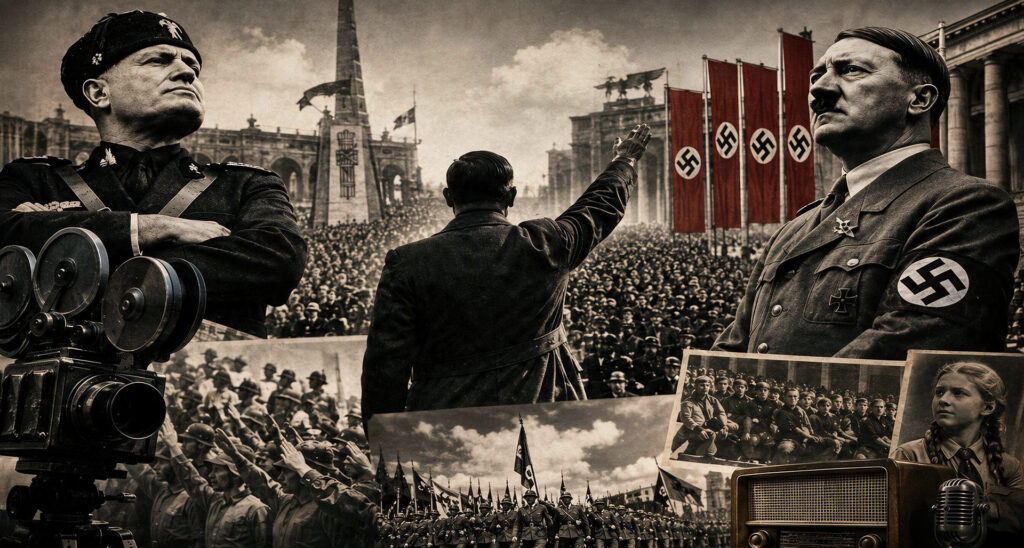
Benito Mussolini did not become il Duce by accident. He was manufactured. Historians of Italian fascism describe what they call the factory of the Duce: a coordinated apparatus of party organizations, state photographers, film units, and printing presses whose job was the production of a single image. Achille Starace, party secretary through the 1930s, was in the historian Richard Bosworth’s phrase personally responsible for the choreography of the regime. Emilio Gentile, the leading Italian scholar of the subject, has written of the glorification of the figure of Mussolini as the making of a prototype for a new kind of Italian. As the Warwick research project on the cult puts it, Mussolini was the first political leader “to harness systematically the techniques of theatre, the visual arts, and the mass media to a personalized system of rule.”
Mussolini understood the tool he was using. “Cinematography,” he declared at the opening of the Istituto Luce headquarters in November 1937, “is the strongest weapon.” Luce had been founded in 1924 and was producing a national newsreel from 1927, in a country where more than a third of the population could not read. Mussolini checked the films and photographs himself before they were released.
The output was constant. Newsreels of the Duce shirtless in the harvest fields. Postcards of him that circulated in Italian homes alongside images of saints and film stars. Schoolroom decalogues instructing children that Mussolini is always right. What is being produced there is not argument, but feeling. A kind of devotion that argument cannot touch, because to challenge it is to insult the person who feels it.
The Myth and the Man
Germany went further. Ian Kershaw, writing on the Hitler myth in History Today in November 1985, put it precisely. Concentrating on Hitler’s own character and personality, he wrote, “can nevertheless do little to explain the magnetism of his popular appeal.” The magnetism was not really in the man himself. It was in what Germans had come to want a man to be, and in the machinery that supplied him on demand.
Kershaw developed the argument in his 1987 book The ‘Hitler Myth’: Image and Reality in the Third Reich. The Führer cult, he showed, was the bond that held an otherwise chaotic regime together, and it was built as much by the enthusiasm of ordinary Germans as by Goebbels’ ministry. His hold over the German people, Kershaw wrote, lay in the hopes and perceptions of the millions who adored him. People wanted a redeemer. The propaganda supplied one, and then the wanting did the rest.
For Jews, this is the part that matters most. A leader who embodies a wounded nation must explain who inflicted the wound. For two millennia, the answer has been prepared in advance. Jew-hate is not simply a policy fascism adopts. It turns grievance into a target. Devotion upward requires hatred outward. The two are manufactured together.
A Radio in Every Home
We usually discuss Nazi propaganda as though it were mostly focused on posters and slogans. In reality it was a media policy, executed at national scale, within months of taking power.
The Reich Ministry for Public Enlightenment and Propaganda was created by decree on 13 March 1933, six weeks after Hitler became chancellor. Goebbels was thirty-five and the youngest man in the cabinet. His description of the job was not modest. “The national education of the German people,” he said, “will be placed in my hands.”
The press went first. The Editors Law of 4 October 1933 required every journalist in Germany to register with the Reich Press Chamber in order to work at all, obliged them to follow the ministry’s daily directives, and instructed them to keep out of print anything “calculated to weaken the strength of the Reich abroad or at home.” The same law purged the profession of Jews, and of anyone married to a Jew. Within a single year, journalism became a licensed trade, the license depended on obedience, and being Jewish disqualified you from telling Germans what was happening to Germany. The people who might have described the cult accurately were removed before it was finished.
Then came the part that reached into the home. On 18 August 1933, Goebbels opened the Berlin radio exhibition with a speech about what he understood the new medium to be. “The radio,” he said, “will be for the twentieth century what the press was for the nineteenth century.” That exhibition launched the Volksempfänger, the People’s Receiver, a cheap set produced with state encouragement and sold at seventy-six Reichsmarks, a fraction of the cost of a commercial radio. It was built with a short range, so that what it picked up easily was German.
The uptake was extraordinary. By 1941, according to figures cited by the film historian Eric Rentschler, some sixty-five percent of German households owned a People’s Receiver. Germany became the most radio-saturated country in Europe, and the voice coming out of those millions of sets, in the kitchen, in the evening, was the Führer’s.
The combination was total. A licensed press that could not contradict him. A cheap radio in two thirds of the nation’s homes carrying him directly to them. Leni Riefenstahl’s cameras, in Triumph of the Will in 1935, opening with his plane emerging from the clouds above Nuremberg. A German could not go a week without encountering a single account of his own country that the ministry had not shaped.
The image was engineered. The love was real. Those two facts have never been in tension. The propaganda did not implant the longing. It found it and shaped it. The postcard and the newsreel in Italy, the licensed press and the radio set in Germany. In each case the state understood that its survival depended less on persuading people of anything than on making them love somebody.
The Press as Partner
And here is the uncomfortable part. Dictatorships build these cults deliberately. Free presses have built them by accident, and with startling reliability.
American newspapers of the 1920s did not present Mussolini as a danger. They presented him as a personality, and often an admirable one. The Saturday Evening Post serialized his autobiography in 1928. As the historian John Broich has documented, major American papers credited fascism with rescuing Italy from the left and restoring its economy, while the New York Times described the outcome as a return to normalcy. John Gunther of Harper’s watched Mussolini’s masterful handling of an American press that, in his words, could not resist him.
Hitler was then introduced to American readers as “the German Mussolini,” which was then a compliment. When the glamour wore off, the ridicule began. Newsweek noted that his appearance suggested Charlie Chaplin. The New York Times predicted that office would simply expose his futility to the German public.
Dorothy Thompson is the clearest case, because she recorded her own error. She met Hitler at the Kaiserhof hotel in Berlin in late 1931 and wrote it up for Cosmopolitan the following March. It took about fifty seconds, she told her readers, to take the measure of the “startling insignificance” of the man who had set the world agog. Within a year he was chancellor. Thompson spent the rest of the decade correcting herself in print, was expelled from Germany in 1934 as the first foreign correspondent Hitler threw out, and in a New York Herald Tribune column in February 1937 wrote the sentence that should hang in every newsroom: “No people ever recognize their dictator in advance.”
The American Precedent
Father Charles Coughlin reached tens of millions of American radio listeners in the 1930s. He received some eighty thousand letters a week, so many that the post office in Royal Oak, Michigan had to be rebuilt to hold them. He commanded no army and held no office. What he had was a new medium, a warm voice, an audience that felt unheard, and nobody standing between him and them. On 20 November 1938, ten days after Kristallnacht, he told America over the airwaves that the Jews had brought it on themselves.
No ministry organized that. A democracy produced it, out of the ordinary working of a new technology and the ordinary human appetite for somebody to listen to. What eventually slowed him was not the state but the broadcasters, several of whom refused to carry him unless they could approve his scripts in advance.
Who Decides Now?
Every case so far had someone in charge of distribution. A ministry decided what the press could print and what the radio carried. A party decided which newsreel ran before the film. Even Coughlin needed a network willing to sell him the airtime, which is why the networks could eventually take it away.
That is the part that has gone. Amplification no longer requires a central authority or a political intention. It does not require anyone at all deciding that a particular man should be heard by millions. An algorithm does it, by learning what holds attention and supplying more of the same. The result looks like the old machinery and works without any of its politics.
Nobody orders a nineteen-year-old to watch six hours of a candidate a day. The system learns that he will and supplies more. It transmits presence, confidence, grievance and warmth at extraordinary fidelity. It transmits argument poorly and context not at all. It is close to a perfect instrument for building attachments to people, and close to useless for examining what those people believe.
We can measure the result. The Yale Youth Poll found this spring that ten percent of Americans aged 18 to 34 endorsed all three of the antisemitic statements it tested, against two percent of those over 65, and that agreement ran highest among those who take their news from social media. A quarter of all voters surveyed agreed that Jews maintain organized international networks placing their own interests above those of the countries they live in.
That is Coughlin’s audience, rebuilt at scale, and it is being served from both directions at once. Nick Fuentes, who has said that “Jews have no place in Western civilization,” has over a million followers on X alone. Hasan Piker, at the opposite pole of American politics, streams to an audience that has heard him call Hamas “a thousand times better than Israel,” describe ultra-Orthodox Jews as “inbred,” and dismiss the documented sexual violence of October 7th as “rape fantasies.”
Neither man holds office. Neither needs to. Both have assembled followings larger than anything Coughlin managed. Both are trusted by those followings as a primary source about the world. Both feed them hostility to Jews. Both sit entirely beyond the reach of any editor. The personality cult carrying Jew-hate is no longer something a movement has to build. It already exists, at both ends of American politics, and any candidate who wants one can plug into it.
The Phenomenon Beat
The press has responded by inventing a genre. Call it the phenomenon profile: the long profile of a magnetic figure and the following he has assembled, in which what the figure actually believes is treated as background texture.
Politico published an example on 18 August, the day before Florida’s Republican primary, about the gubernatorial candidate James Fishback. He lost, taking just over ten percent. The piece runs to some two thousand words. The word “antisemitic” appears once, inside a quotation from the Florida Republican chair, introduced as “what they say are Fishback’s ‘antisemitic and racist attacks.'” The issue is relegated to just what others say, with no objective determination. Israel appears once, in a list of supporter grievances between data centers and foreign wars. Fuentes is introduced as a “far-right streamer” and a voice of the “budding America First movement.” Budding, a word best reserved for discussing gardens fails to capture Fuentes’ vitriol.
A reader would not learn that Fishback told a cheering crowd in February that if you wanted children to fail you would feed them “the absolute goyslop in our cafeterias.” Goyslop is a 4chan term for food that Jews supposedly push on non-Jews to keep them weak. It is the blood libel with a nutrition label. The costume changes. The accusation does not.
The piece does report that the state party pulled his debate invitation, and it hands the reason to the party chair to say, at arm’s length, midway down. No serious profile would handle a candidate’s racial slurs about Black Americans that way, quarantined inside somebody else’s quotation and prefaced with what they say. That is how this one handled Jews.
And what did the magazine give its readers instead? The cult, reported admiringly as strategy. Hundreds of young men in a gas station parking lot. Supporters thrilled to be in his presence. A college chapter whose straw poll flipped from eighty-twenty against him to eighty-twenty for him in one semester. A twenty-one-year-old who had never voted saying, of the candidate, “Wherever James goes, I’ll follow.” The magazine calls him a “political pied-piper,” his campaign an “electoral blitzkrieg” and a “kamikaze run,” with a “dark energy” surging that somebody will eventually direct. The vocabulary of the 1930s has come back as admiring metaphor.
The genre is not confined to one wing, and the comparison that follows is not between two men. It is between two sets of coverage.
Politico itself makes the link, noting that Fishback takes inspiration from New York City Mayor Zohran Mamdani and adding that “they are ideological opposites, to be sure, but the campaign creativity seems to be analogous.” Their politics have almost nothing in common. The reporting reflex does. Mamdani won New York on what the same magazine calls a “charming online offensive,” and that gift is where his coverage tends to begin and where a great deal of it ends. He also supports BDS, holds that Israel should not exist as a Jewish state, and, asked in June 2025 to condemn the call to globalize the intifada, replied, “I don’t believe that the role of the mayor is to police speech.” He later said it was not language he uses. He did not say it was wrong.
Those positions belong near the top of any serious account of the man now governing a city of nearly a million Jews. They arrive late, when they arrive, and they arrive hedged. Different politics, same reflex. The charisma organizes the story, and what the man believes about Jews is demoted to a subplot.
What the Press Owes
None of this makes Fishback into Mussolini, or Mamdani into Hitler. Ten percent in a Florida primary is a defeat, and nothing here predicts dictatorship in America.
Someone will say that a candidate who finished third does not warrant the company of Mussolini and Goebbels, and that reaching for the 1930s is hysteria. The archives say otherwise. Every figure named above was, at the point where the coverage went wrong, a curiosity rather than a threat, and the coverage went wrong precisely because he was interesting before he was dangerous.
The claim is narrower and harder to dismiss. The cult of personality is the mechanism by which extreme movements have historically become governments. Jew-hate has ridden inside that mechanism every time, because a leader loved as the answer to a wound must name who inflicted it. And no press in the last hundred years has worked out how to describe a magnetic figure without adding to the magnetism.
Journalists are not obliged to denounce anyone. They are obliged to describe accurately, and accuracy includes proportion. When a candidate borrows a 4chan term to suggest that Jews poison children’s food, that is not a detail in a story about the attention economy. When a mayor will not say that a call to globalize the intifada is wrong, that is not a wrinkle in an otherwise charming campaign. These are facts about power, and about how safe Jews are meant to feel in the cities where they live.
Dorothy Thompson’s line was not written as consolation. She had gotten it wrong herself, and she wrote it so that we would not. We have the archives now. We have no excuse.
Liked this article? Follow HonestReporting on Twitter, Facebook, Instagram and TikTok to see even more posts and videos debunking news bias and smears, as well as other content explaining what’s really going on in Israel and the region. Get updates direct to your phone. Join our WhatsApp and Telegram channels!
© Divuach Ne’eman R”A, 2025