Key Takeaways:
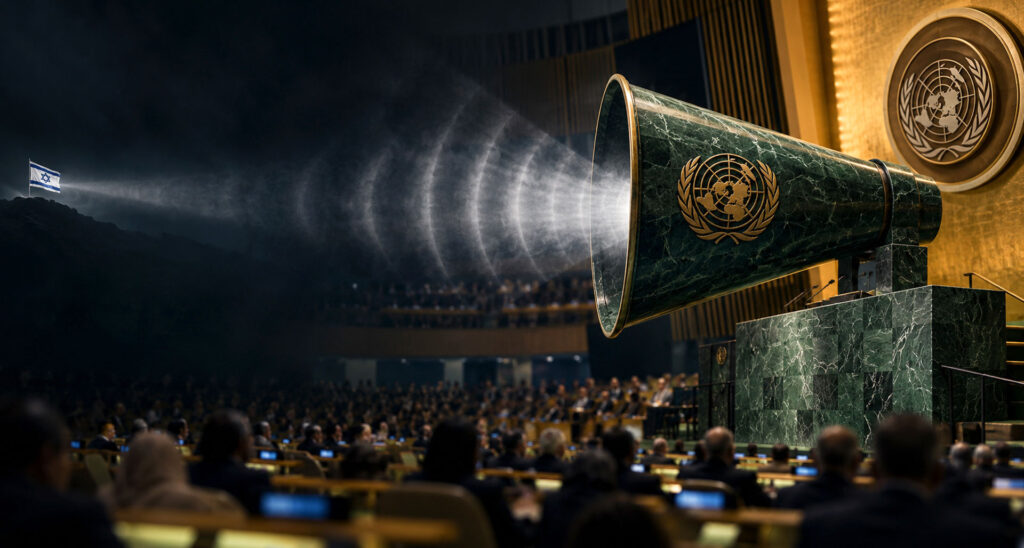
- Leader after leader turned the General Assembly into a platform for sweeping accusations against Israel, from genocide to apartheid and ethnic cleansing.
- Erdogan compared Gaza to a “concentration camp,” while others presented contested legal accusations against Israel as established fact.
- Across multiple addresses, Hamas, October 7 and Palestinian terrorism received markedly less attention than condemnations of Israel – context crucial to understanding the conflict.
It’s that time of the year again: UN General Assembly time.
And if there’s anything that unites many world leaders (especially those of nations with some of the worst human rights records on the planet), it is that the world body’s most prestigious diplomatic platform is a great opportunity to delegitimize the Middle East’s only democracy.
This year’s 81st session of the UN General Assembly has been no exception, with several leaders taking the opportunity not to advance peace, or foster genuine debate or condemn human rights abuses by authoritarian regimes and terror proxy networks, but to recycle inflammatory accusations, erase context and portray Israel as uniquely criminal.
Here is a look at the most egregious rhetoric from the UNGA podium over the past few days.
Turkish President Erdogan
Turkish President Recep Tayyip Erdoğan took his long-standing hostility toward Israel to dangerous new heights during his address, delivering perhaps the most inflammatory speech of the opening sessions.
Erdoğan accused Israel of possessing a “genocidal mindset,” described Gaza as “the most inhumane and shameful concentration camp of our time,” and called it “the world’s largest graveyard for children.” He also condemned Israel for alleged “state terrorism”, with precious little room in this portrayal for Hamas, the terrorist organization whose October 7 massacre sparked the Gaza war and whose embedding of military infrastructure within civilian areas has been central to the conflict. Needless to say, he also failed to meaningfully confront Turkey’s own close relationship with Hamas or the group’s role in initiating the current war. His speech presented Israel’s military campaign as the beginning of the story rather than a response to Hamas’ October 7 invasion, massacre and hostage-taking.
Israel’s delegation understandably walked out during the speech.
President Erdoğan once again used the UN podium to attack Israel and spread lies.
— Danny Danon 🇮🇱 דני דנון (@dannydanon) September 22, 2026
A leader who hosts Hamas leaders, supports terrorist organizations, and occupies Syrian territory has no justification to lecture Israel on morality.
Erdoğan, your hypocrisy will not hide the… pic.twitter.com/6IOaA88enz
Qatar’s Emir Sheikh Tamim bin Hamad Al Thani
Not to be outdone, Qatar’s Emir Sheikh Tamim bin Hamad Al Thani was scarcely more restrained.
“What has happened in Gaza is genocide in every sense of the word,” he declared, describing it as “a stain of shame on the conscience of humanity as a whole.”
He also accused Israel of “persecution, apartheid, and settler terrorism” in the West Bank and took aim at Israel’s response to international criticism:
Instead of looking in the mirror, they resort to hurling accusations indiscriminately in all directions – at times invoking accusations of antisemitism.
Missing: Hamas’ decision to launch the war, its continued armed activity and its embedding among Gaza’s civilian population.
Qatar presents itself as a mediator, and it has played a role in negotiations over hostages and ceasefires. So much for preserving a degree of credibility with all sides.
Jordan’s King Abdullah II
Jordan’s King Abdullah II – leader of a country at peace with Israel since 1994 – delivered an address accusing Israel of operating as a “state without restraint” and claiming that Israel’s policies are aimed at “erasing Palestinian life” and compelling Palestinians to leave their land. He described the alleged objective as “forced displacement” and called it a war crime. He also argued that the international community has spent decades managing the conflict rather than resolving it, blaming Israel entirely for the collapse of two-state prospects.
That sweeping formulation leaves rather a lot of history on the cutting-room floor, including Palestinian rejection of previous peace proposals, waves of terrorism against Israelis and, most obviously, Hamas’ October 7 massacre.
Iranian President Masoud Pezeshkian
Not surprisingly, Iranian President Masoud Pezeshkian used his appearance to invert accusations of terrorism directed at the Islamic Republic.
“The U.S. president described us as terrorists,” Pezeshkian told the General Assembly. “We have been the victims of terrorism.”
Pezeshkian claimed Iran had not targeted civilian populations, a claim contradicted by documented civilian deaths resulting from Iranian attacks during the regional conflict.
Holding up photographs of Iranian children and the late Supreme Leader Ayatollah Ali Khamenei, Pezeshkian portrayed Iran as the victim of American and Israeli aggression.
He also accused Israel and the United States of terrorism and contrasted international scrutiny of Iran’s nuclear program with Israel:
The atomic bomb is in Israel, but the inspectors are in Iran.
And:
Israel kills, but Iran is sanctioned.
He also described Gaza as “an open wound on the conscience of the international community.” This from the head of a state that has openly armed Hezbollah, funded Hamas, and fired ballistic missiles directly at Israeli territory.
Even the U.S. delegation walked out during the address.
🔥 The US delegation walked out of the UN General Assembly while Iranian Terror Regime President Masoud Pezeshkian was speaking. pic.twitter.com/kwJVu3RZGI
— Israel War Room (@IsraelWarRoom) September 23, 2026
Brazilian President Luiz Inácio Lula da Silva
Brazilian President Luiz Inácio Lula da Silva also returned to one of his favorite themes: accusing Israel of genocide.
But one portion of his speech was particularly notable.
Lula used the UN podium to defend UN Special Rapporteur Francesca Albanese, saying she must not “be silenced for telling the truth.”
That would be the same Francesca Albanese whose record includes repeated controversies over rhetoric concerning Israel and Jews and whose mandate and public statements have themselves become part of the debate over anti-Israel bias within the UN system.
Spanish Prime Minister Pedro Sánchez
Spanish Prime Minister Pedro Sánchez was even more explicit.
Speaking Wednesday night, Sánchez told the General Assembly that Spain “condemns without qualification the genocide that Netanyahu continues to perpetrate in Gaza.”
French President Emmanuel Macron
French President Emmanuel Macron used his final UN General Assembly address to deliver a broadside against Israel over both Gaza and the West Bank.
“What is our credibility worth if we remain inactive on Gaza?” Macron asked, describing the situation there as “a spectacle that should shame us all.”
But it was what came next that was particularly extraordinary.
Turning to the West Bank, Macron declared:
Look at what is happening in the West Bank, where every day violations are committed. In whose name? Hamas has never operated in the West Bank.
This is factually wrong, with the claim drawing immediate pushback from Israeli UN Ambassador Danny Danon.
הנשיא מקרון, @EmmanuelMacron, אתה טוען שאין חמאס ביהודה ושומרון?
— Danny Danon 🇮🇱 דני דנון (@dannydanon) September 23, 2026
תבדוק שוב pic.twitter.com/0DIUTLHE9c
Israeli officials cited more than 80 lethal Hamas-linked attacks from or directed out of the West Bank since 1990.
UN Secretary-General António Guterres
The rhetoric was not confined to national leaders.
In his opening address, outgoing UN Secretary-General António Guterres did condemn the “abhorrent terror attacks by Hamas on 7 October.”
But he then characterized what followed as an “onslaught on Palestinians in Gaza,” saying the scale of killing and destruction was unlike anything he had witnessed during his tenure.
As UN Watch pointed out, under Guterres’s watch since 2017:
- Syria: 120,000+ killed
- Sudan: 150,000+ killed
- Ethiopia: 162,000+ killed
- Yemen: 200,000+ killed
Guterres also used his opening remarks to accuse Israel of actions raising the “specter of ethnic cleansing” in the West Bank.
“Ethnic cleansing” is a grave term with a specific legal definition, not a rhetorical tool to be tossed around loosely.
The UN’s Israel Problem, on Full Display
For Israel, none of this is particularly new. What is striking is how comfortably the UN’s most prominent stage accommodates the most incendiary accusations against the Jewish state – genocide, apartheid, ethnic cleansing, even comparisons to concentration camps – while inconvenient facts about Hamas, Palestinian terrorism and Israel’s security reality are so easily minimized, distorted or erased.
If the United Nations wants to be taken seriously as an honest broker in this conflict, the General Assembly has once again demonstrated just how far it has to go.
Liked this article? Follow HonestReporting on Twitter, Facebook, Instagram and TikTok to see even more posts and videos debunking news bias and smears, as well as other content explaining what’s really going on in Israel and the region. Get updates direct to your phone. Join our WhatsApp and Telegram channels!
© Divuach Ne’eman R”A, 2025