I thought we had probably exhausted the sporting equipment. Apparently not: the skateboard has arrived.
On Friday, The Guardian published the latest installment in its “Gaza: a week in the life” series, following Rajab al-Reefi, 30, who has spent years teaching children in Gaza to skateboard. The series, according to the newspaper, follows five ordinary Palestinians through their daily lives.
Let’s start with Rajab himself.
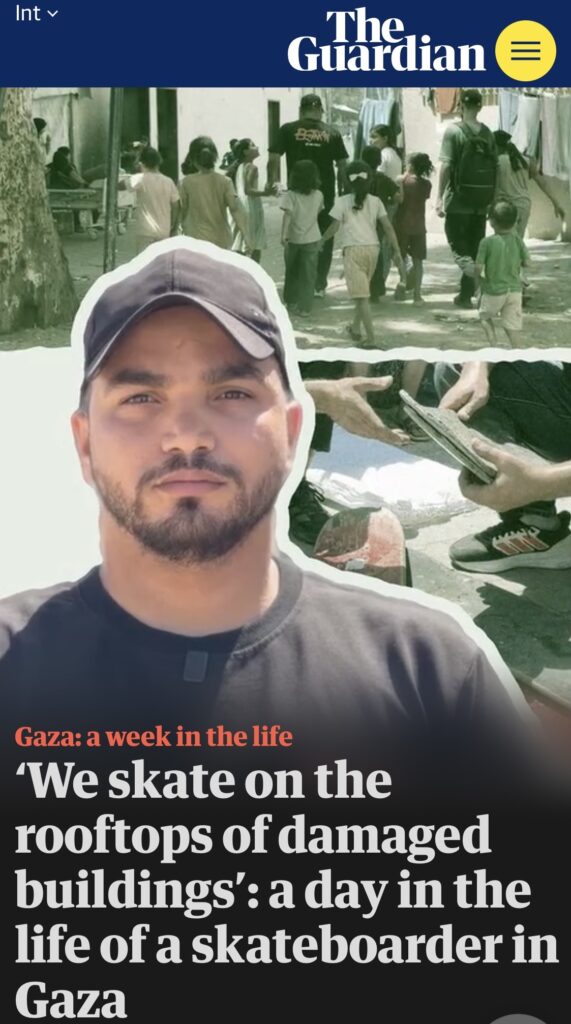
I rather like him. He clearly loves the sport, he is good with the children, and he has continued trying to give them something enjoyable to do through an awful war. There is something genuinely admirable about that.
The problem begins when the cameras get involved.
The footage was supplied by Tantesh Media Services, with The Guardian crediting Seham Tantesh in Gaza alongside its own reporters, editors, producers and art directors. In other words, this is not Rajab uploading a phone video of his skate club. It is a professionally assembled Guardian visual package.
At first, the video is exactly what you might expect. Rajab and the children skate. There are lessons, smiles and the inevitable falls; Rajab even comes off his board himself.
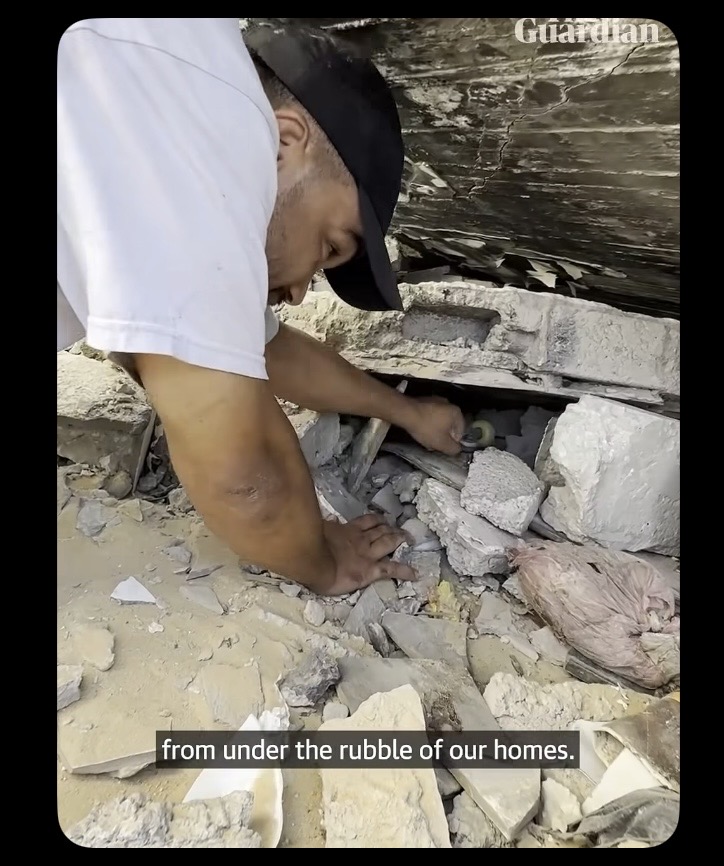
But before long, we are back among damaged buildings, rubble and tents. The skateboard becomes the thread carrying the viewer through a familiar visual landscape of Gaza.
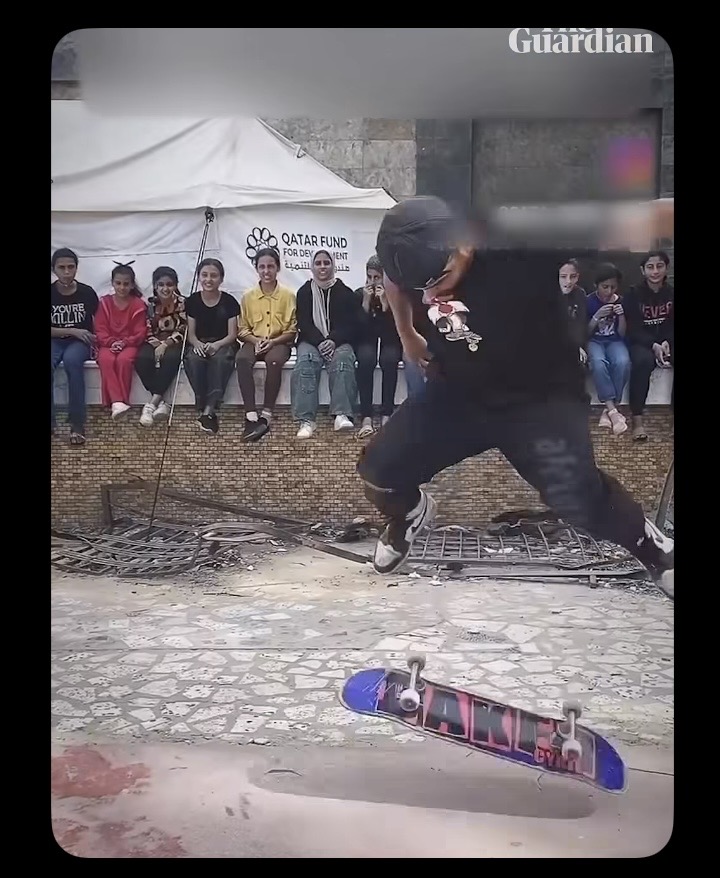
Apparently, Skateboards Are Banned
Then The Guardian makes a very specific claim:
“One of the banned items is a skateboard.”
That caught my attention because it is presented as a statement of fact, not simply as Rajab saying that he has been unable to obtain skateboards.
So I went looking for the Israeli regulation.
I haven’t found it.
The publicly available Israeli material I checked deals extensively with weapons, war materiel and controlled or dual-use goods. I could not find an ordinary wooden skateboard specifically identified as a banned item. That does not establish that a skateboard could not be held up under some other customs rule, wartime procedure or crossing restriction. It simply means I have not found the regulation that supports The Guardian’s categorical wording. Israel’s published policy has historically distinguished between ordinary civilian goods and weapons or problematic dual-use items requiring controls.
Perhaps The Guardian has documentation that I haven’t found. If so, it would be useful to see it.
Because there is a meaningful difference between saying, “Rajab cannot get skateboards into Gaza,” and declaring that “one of the banned items is a skateboard.” The latter leaves rather less room for ambiguity.
There is also some relevant history missing from the picture.
Rajab’s difficulties obtaining skateboards did not suddenly begin with this Guardian feature, and the history he describes stretches back long before the current war.
SkatePal interviewed him in 2024 and asked where he had obtained his first board. Rajab said he had built it himself because there weren’t any in Gaza. His second came from a friend in Italy, and he said boards continued to be available only through support from friends.
SkatePal says Rajab began skating in 2015 after the Italian organization Gaza Freestyle visited Gaza City and that he founded the Gaza Skate Team in 2017.
None of this means that the war has not made obtaining equipment considerably more difficult. Clearly, Rajab says that it has. But when a shortage of skateboards is presented primarily through the prism of the current siege, there is some useful history sitting just outside the frame.
From Famine to Kickflips
There is something increasingly striking about the scale of the claims surrounding Gaza and some of the objects repeatedly chosen to illustrate them.
The wider international debate includes allegations of famine and genocide. Meanwhile, The Guardian has chosen to devote one of its five portraits of ordinary life in Gaza to a man trying to keep a children’s skateboard club going.
To state the obvious, children skateboarding does not disprove famine. A skateboard cannot answer an allegation of genocide either. That would be an absurd argument.
But editorial choices are not meaningless.
If you select five people to show readers what ordinary life in Gaza looks like, the choice of those five people matters. One of The Guardian’s choices was Rajab, and once you stop watching his film simply as a viewer and start looking at how it has been edited, a familiar pattern emerges.
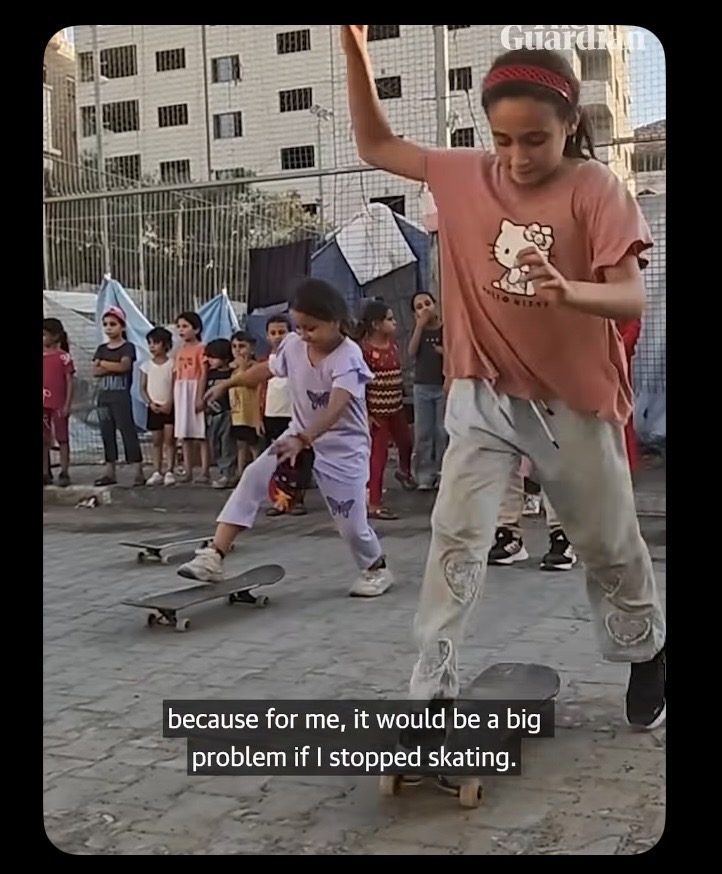
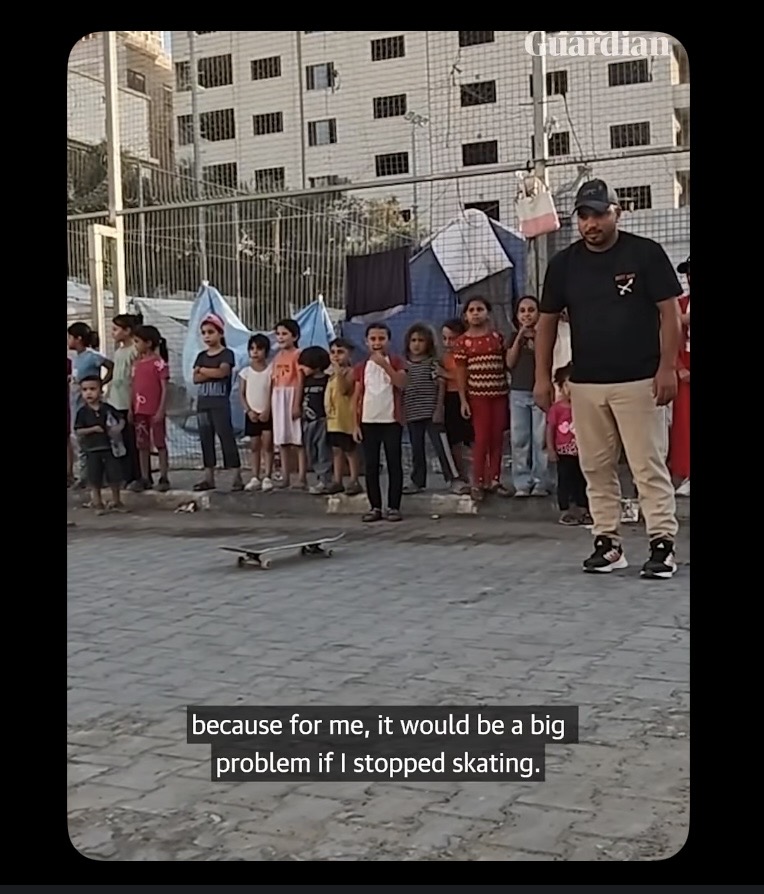
The children skate, and the film cuts back to rubble. They practice, and damaged buildings return to the frame. Rajab retrieves equipment from destroyed homes. He skates again, and once more the camera takes us through the ruins.
The board provides the continuity. The destruction provides the visual setting.
This is not accidental in the sense that the images simply happened to appear in front of the camera. Someone chose the shots, arranged them, and edited them into a 97-second film. The result is a story ostensibly about skateboarding in which the skateboard becomes a vehicle for moving the viewer through the broader visual narrative of Gaza.
Keep Your Eye on the Camera
None of this is a criticism of Rajab for wanting children to skateboard. Quite the opposite.
Nor is there anything remotely ridiculous about children finding moments of enjoyment during a war. If anything, that is the most human part of the entire story.
My issue is with the people holding the other camera.
The Guardian had an interesting subject in Rajab: a man who has spent years building a skateboarding community in a place where the sport was once virtually unknown, who made his first board himself and who is still trying to keep children skating in extraordinarily difficult circumstances.
That is already a story.
Yet given a skateboard, a group of children and 97 seconds, The Guardian still found its way back to the rubble.
The skateboard may be new.
The framing is considerably more familiar.
Liked this article? Follow HonestReporting on Twitter, Facebook, Instagram and TikTok to see even more posts and videos debunking news bias and smears, as well as other content explaining what’s really going on in Israel and the region. Get updates direct to your phone. Join our WhatsApp and Telegram channels!
© Divuach Ne’eman R”A, 2025