Key Takeaways:
- Travelers face criminal penalties for carrying prohibited Israeli products, even unknowingly.
- The law could fuel a broader boycott as retailers and travelers avoid Israeli goods altogether.
- Israel is being singled out, while Jewish ties to Israel are increasingly treated with suspicion.
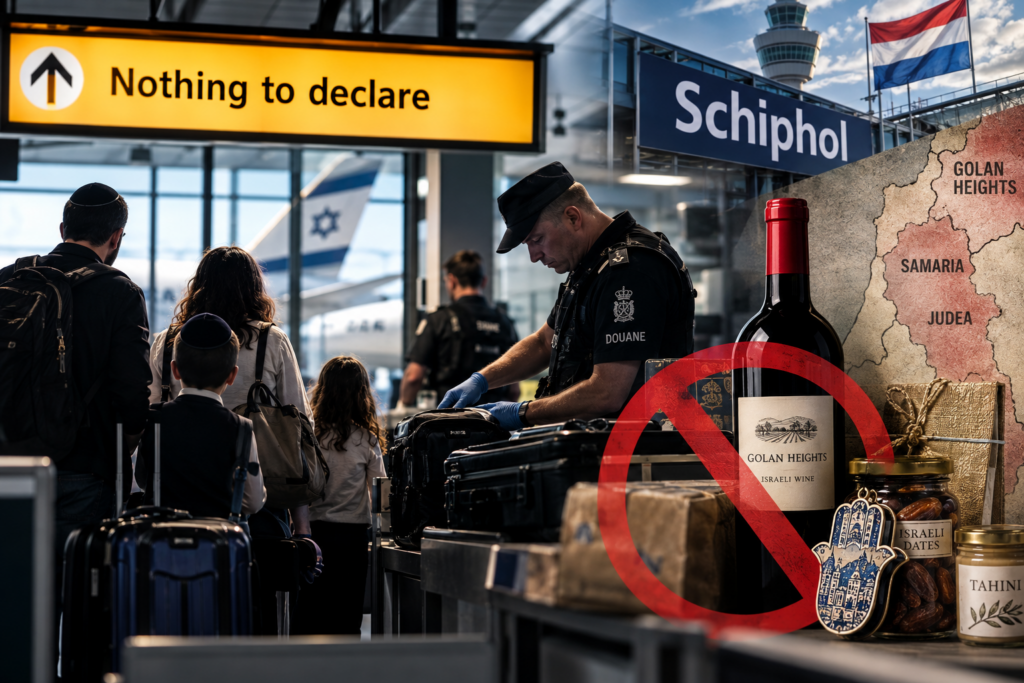
Last week, an El Al flight from Tel Aviv landed at Amsterdam’s Schiphol Airport. On board was a mother with her children who had come to the Netherlands during the Jewish festival of Sukkot. They collected their bags and walked towards the “Nothing to declare” lane.
They did not get far, because according to the Dutch news site NieuwRechts, a customs officer stopped them with a question and an order: “Are you coming from Tel Aviv? Yes? Everyone from Israel, come over here!”
Every passenger on that flight was reportedly made to put their luggage through a scanner. When one asked why, the officer claimed this was routine for intercontinental flights. The writer Sivan Behr, who was on board, has flown that route many times. She had never seen it before. NieuwRechts also reports that a unit of the Royal Netherlands Marechaussee, the country’s military police, has been assigned to carry out additional checks on flights from Israel.
This is Europe in 2026. Jewish families arriving for a festival had their suitcases searched by the state because they had come from the Jewish state.
A Criminal Souvenir
The searches follow a Dutch law that came into force on September 22. It bans the import, purchase and sale of any goods wholly or partly produced in Israeli communities in the territories Israel has held since 1967, including the Golan Heights. It also bans brokering those goods and any attempt to get around the rules. It applies to individuals as well as businesses, and to personal luggage, souvenirs and gifts, as well as commercial shipments. Goods ordered online and posted to the Netherlands are covered too.
The penalties are not a slap on the wrist, although that itself would still be outrageous. Violations are treated as criminal economic offenses. A deliberate violation can result in up to six years‘ imprisonment or a fine of up to €103,000. Even an unintentional violation can carry up to a year behind bars.
In practice, if someone buys a bottle of wine in a Tel Aviv shop and brings it to Amsterdam, they may have committed a criminal offense. Some of Israel’s best-known wines are made in the Golan Heights and sold in every Israeli supermarket and at the airport duty-free. It does not even matter where they bought the bottle. It matters where the grapes were grown.
The burden of proof rests entirely on the traveler. Keep the label, the packaging or documents showing where the product came from, the Dutch authorities advise. Customs can inspect your luggage and question you about where your gifts came from, and prohibited items can be seized. In the Netherlands, an innocent person now has to prove the innocence of their shopping.
The Netherlands has taken behavior that is entirely ordinary for travelers and criminalized it. Buying a gift is not a crime. Bringing home a souvenir is not a crime. Pouring a glass of wine on Friday night is not a crime. Nor is visiting family. Unless, it seems, it is Israeli.
Whose Rights?
The Dutch state presents this law as a defense of human rights. The rights it tramples tell a different story.
The very first article of the Dutch Constitution reads: “All persons in the Netherlands shall be treated equally in equal circumstances.” A family returning from Tel Aviv is in exactly the same circumstances as a family returning from Toronto or Bangkok. One is waved through. The other is told to line up. That is not equal treatment. It is selection by route, and on a flight from Israel the route is a proxy for who is on board.
The presumption of innocence has been quietly reversed. Every traveler from Israel now arrives as a potential offender who is obliged to carry the evidence of their own innocence in their suitcase. Freedom of religion is squeezed too, because the wine on a Jewish table on Friday night is now a matter for the criminal code.
Criminalising Israel
The Dutch government insists this law targets settlements, not Israel. Goods produced within Israel’s pre-1967 lines, it says, are not covered.
But even that description disguises how sweeping the ban is. The EU postcode list used by Dutch Customs includes Majdal Shams, the Druze town in the Golan Heights. It also includes a separate category of “borderline localities”, where importers are told to consult customs authorities to establish the precise location of production. Among them is Modi’in-Maccabim-Re’ut, an Israeli city of more than 100,000 people between Jerusalem and Tel Aviv. So this is not simply a boycott of what most people picture when they hear the word “settlement”. A product from a Druze town in the Golan is caught, while even goods from parts of Modi’in can require a customs determination.
This is a fiction. The one-ingredient rule turns every Israeli product into a suspect. A customs officer cannot tell from a label whether a Tel Aviv factory sourced its olive oil from the Galilee or from Samaria. Neither can the traveler or the supermarket buyer. Who knows where the sesame in the tahini was grown, or the dates in the silan, or the grapes in the brandy? No one at a till in Utrecht does.
Dutch retailers already understand this. Jumbo now relies on an independent party to verify that its Israeli dates, mangos and herbs come from inside the lines. Lidl says it sells virtually no products from Israel at all. When the penalty for getting it wrong is a criminal record, any sensible retailer knows what the safest course is. They stop stocking Israeli products altogether.
That is not an unfortunate side effect. It is how the law works. A ban on part of Israel becomes, in practice, a ban of all of it. A total boycott, achieved not by the letter of the law but by the fear it creates, and aimed at strangling the Israeli economy one cautious shop and one nervous tourist at a time.
A Selective Conscience
The double standard is plain. The EU maintains sanctions against Russia that go far beyond anything imposed on Israel. We have seen no reports of Dutch customs pulling aside entire planeloads of travelers to hunt for sanctioned Russian goods. Turkey has occupied northern Cyprus since 1974 and settled its own citizens there. We are unaware of any Dutch tourist facing prison for bringing home a souvenir from Kyrenia. Only one country’s disputed territory is treated as a source of contraband. It is the Jewish one.
Erasive Jew-hate
This law is not an isolated policy. It is a clear example of what we call erasive Jew-hate: the Jew-hate that denies Jews belonging. It works in two directions at once.
First, it erases Jewish belonging in the Diaspora. Most Jews in Europe have family, friends and history in Israel. For most of us, Israel is not a foreign cause. It is part of who we are. The Dutch state has now told its Jewish citizens that this connection makes them suspects. A Dutch Jew flying home after visiting her parents in Tel Aviv returns as someone to be sorted and searched. Behr has described growing concern among Dutch Jews who travel between the two countries. They are right to be concerned. The message is unmistakable: you may belong here, but only if you leave Israel behind.
Second, it erases Israel from the community of nations. Israel is not treated as a country with a government whose policies can be opposed. It is treated as uniquely contaminating, a state whose products and people must be kept out. This year the Dutch public broadcaster boycotted the Eurovision Song Contest rather than share a stage with Israel. It was the first time the Netherlands had stayed away for political reasons. Now it is the turn of the airport. Israel’s culture is shut out first, then its produce, and now, in effect, its travelers. Every other nation is judged by its conduct. Israel alone is treated as though its existence were the offense.
Jew-hate has always adapted to the moral language of its age. Once it spoke the language of the Church. Today it speaks the language of human rights and international law. The vocabulary is new. The target is not.
Who Will Still Come?
This law does not only reach Israelis landing at Schiphol. It reaches every European who has ever thought of visiting Israel: Dutch Christians on pilgrimage, students on exchange programs, Jewish families visiting relatives, couples who have always wanted to see Jerusalem. Every one of them now returns home carrying legal risk in their suitcase. Flying home through Paris or Frankfurt changes nothing, because the rules apply whether you travel directly or through another EU country.
Someone will tell us that no one is really going to prison over a jar of honey, and that prosecutors will focus on systematic, deliberate violations. Perhaps. But a law that relies on the prosecutors’ goodwill offers no reassurance to someone deciding whether to book a flight. The simplest way to avoid the risk is to bring nothing home. The simpler way still is not to go.
That is how this kind of boycott works. It does not need to ban anyone from traveling. It only needs to make the trip feel dangerous. People will not stop going because a law forbids it. They will stop going because they are afraid, afraid of the scanner and of a jar of honey whose ingredients no one can trace. The result will be fewer pilgrims and fewer Europeans who have walked Jerusalem’s streets and met the people who live there. Every canceled trip is an empty hotel room, an unpaid guide, an unfilled restaurant table and an unvisited vineyard. The Jewish state becomes a place respectable Europeans quietly avoid. Its people become travelers to be searched.
What Should Happen?
The Dutch government must answer plainly. Dutch Customs now says that a traveler’s origin, nationality, religion or appearance were not grounds for inspection. Then it should show it. Who ordered the checks on flights from Tel Aviv? If the check really is routine for intercontinental flights, the government should be able to show that passengers from New York, Dubai and Singapore receive exactly the same treatment. A statement is not evidence.
Then it should repeal this law. It cannot be made fair, because the idea at its heart is not fair. No amount of customs guidance can fix a law that treats a Jewish connection to Israel as grounds for suspicion.
An 82-year-old Dutch Jew named Dudi, who was born during the war and spent it in hiding, is due to make that same journey. Hearing what was happening at Schiphol, he said: “Jews were marked and discriminated against then too. Now it is happening again. They are marking us.” In a country where three in four Jews were murdered during the Holocaust, that sentence should stop every Dutch official in their tracks. It will not.
Liked this article? Follow HonestReporting on Twitter, Facebook, Instagram and TikTok to see even more posts and videos debunking news bias and smears, as well as other content explaining what’s really going on in Israel and the region. Get updates direct to your phone. Join our WhatsApp and Telegram channels!
© Divuach Ne’eman R”A, 2025