Key Takeaways:
- What began as student protests over France’s education system quickly escalated into mass rioting, looting, and the destruction of buildings and property.
- The appearance of Palestinian flags and symbolism at protests across Europe highlights how the pro-Palestinian movement has become a vehicle for causes unrelated to Israel.
- The pro-Palestinian movement has turned into a vehicle for broader anti-Israel and anti-Western activism, normalizing the glorification of violence and destruction.
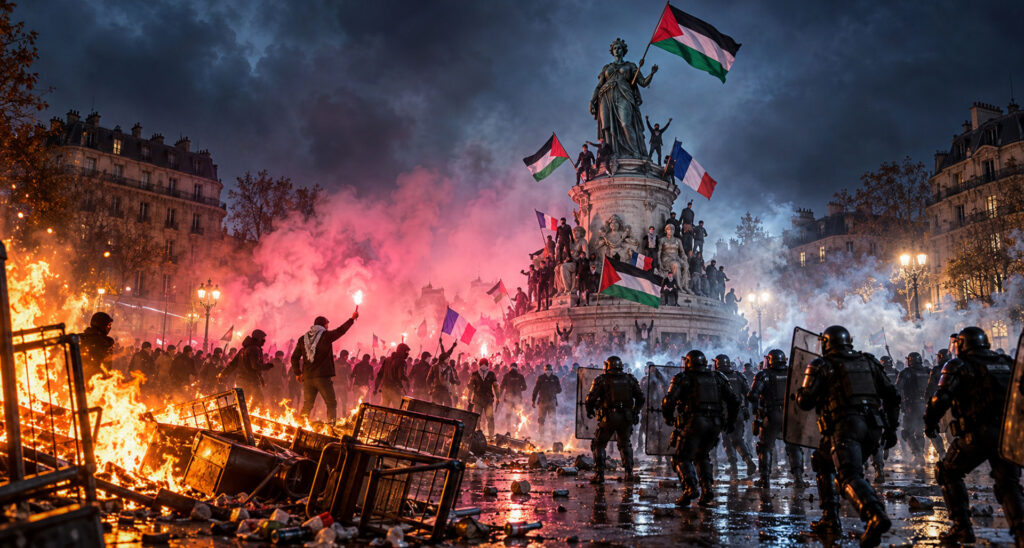
French demonstrations that began as a response to teacher shortages, overcrowded classrooms, and deteriorating schools quickly spiraled into some of the most destructive protests the country has seen.
Buildings have been set on fire, including the town hall in Limoges, while luxury stores and supermarkets have been looted and police vehicles attacked.
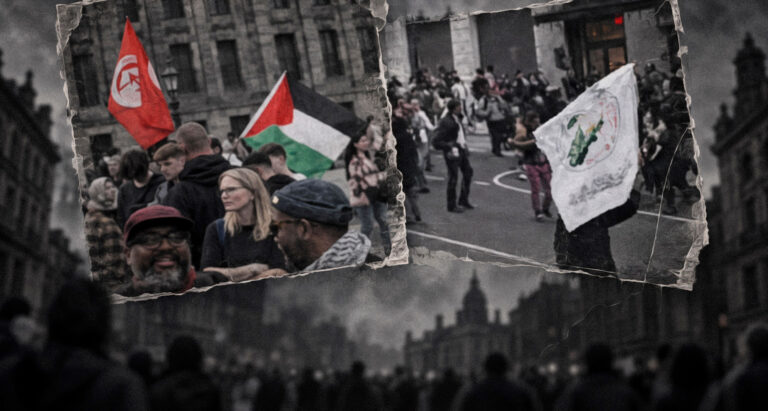
In nearly every video and photo from the protest, there is one item that, at first glance, appears out of place – the Palestinian flag.
Yet these protests, which were originally led by students, have nothing to do with Israel. Or at least not in their original purpose.
Unlike the protests that broke out following the terrorist attacks on October 7, 2023, which claimed to be in “support” of Gaza and merely protesting IDF actions, these demonstrations did not begin as a response to Israel or Gaza. They began with distinctly French grievances over the state of the country’s education system, before violence and unrest spread across France and to other parts of Europe, including Spain.
Why, then, in nearly every video and photograph that has emerged from the unrest, is there a distinct effort to relate the protest back to Israel?
The answer reveals a dark phenomenon that has swept across the world in mass protests, accumulating more legitimacy over the past several years. This is the desire to “globalize the intifada.”
Israel has seen the devastation and destruction of intifadas firsthand, with buses and cafes attacked by suicide bombers that left countless people dead, injured, and traumatized. The call to globalize such a catastrophe reveals the dark desire to spread that same violence beyond Israel’s borders.
This is especially true in France, where despite the Jewish population representing less than one percent, antisemitic incidents account for 53 percent of all anti-religious acts. And as the protests spread, Jewish institutions are likely to continue to be a target. It is for that reason that in the midst of the protests in Paris, a synagogue was vandalized. In another incident in Marseille, a journalist noted that only Jewish businesses were attacked and set ablaze.
But the trespassing, vandalism, and destruction of property do not stop at a synagogue. Those protesting in the streets of France have frequently found common ground in hostility toward Israel, the Jewish people, and the systems and framework of Western civilization, including the country they are protesting. As such, the Palestinian flag and slogans have been a primary marker at these initially anti-government protests in France and Europe more broadly. Whereas the Palestinian cause has been turned into a vehicle for the radical left to express deeper anti-Western and anti-Jewish grievances, the same protests provide Islamist movements an opportunity to bring the symbols and rhetoric of a far-away conflict closer to enemies at home.
The supposed interconnectivity of these previously unrelated causes led Greta Thunberg, who previously traded her climate activism for the publicity yacht that attempted to challenge Israel’s naval blockade of Gaza, to join the protestors in France. With a keffiyeh draped across her shoulders, Thunberg, who was “incredibly proud” of the protestors, insisted that all protest movements “need to be united” because they face the “same enemy,” which is an “extremely destructive system.”
Ultimately, the protests are a telling sign of how the pro-Palestinian movement is no longer confined to demonstrations explicitly concerned with Palestinians, Israel, or the war against Hamas. The Palestinian flag, symbols, and slogans being chanted have become attached to other social or political movements, regardless of relevance, making the cause a prop for broader anti-Israel or anti-Western activism.
The integration of such symbols has become so normalized that “globalizing the intifada” is no longer merely a slogan chanted without understanding its words, but a European reality. The result is the exportation and glorification of a campaign of violence onto the streets of France.
Liked this article? Follow HonestReporting on Twitter, Facebook, Instagram and TikTok to see even more posts and videos debunking news bias and smears, as well as other content explaining what’s really going on in Israel and the region. Get updates direct to your phone. Join our WhatsApp and Telegram channels!
© Divuach Ne’eman R”A, 2025