Key Takeaways:
- The standard Western explanation for terrorism — desperation, poverty, occupation — fails to describe the two people who murdered Malki Roth, and that failure is why negotiation doesn’t work. What they had, Roth argues, was theology: “You cannot negotiate with people who think that what they’re doing is what God wants.”
- Ahlam al-Tamimi’s freedom is not a limit on American power but a decision the United States keeps making and refuses to name. Jordan takes more American aid than nearly any country on earth and hosts American forces permanently. The U.S. could extradite her at any time, and instead chooses not to, without ever admitting it.
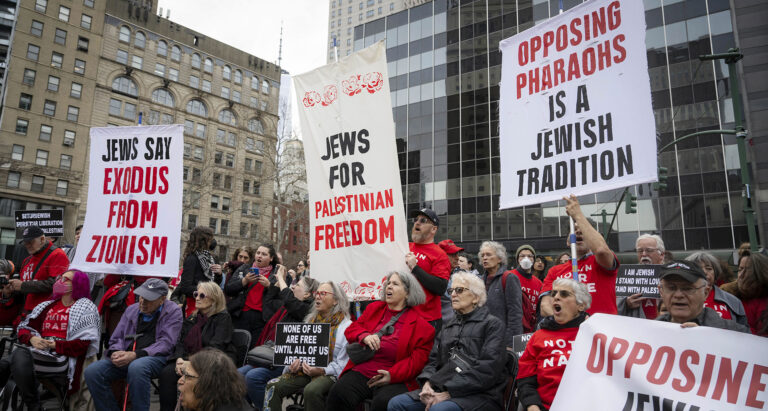
- The slogan being chanted on streets and campuses describes something that already happened. Roth draws a hard line between an intifada, “waging war via civilian forces, taking no prisoners, and being cruel and difficult,” and what he calls “the idiots’ intifada,” a crowd that wants a better world and has attached that wish to the exact method that killed his daughter.
The chant is three words long and it moves easily. It fits on a placard, in a chorus, on a campus lawn in New York. Globalize the intifada. Most of the people shouting it have never had to define it, and would probably say it means resistance, or liberation, or something else with a clean shape.
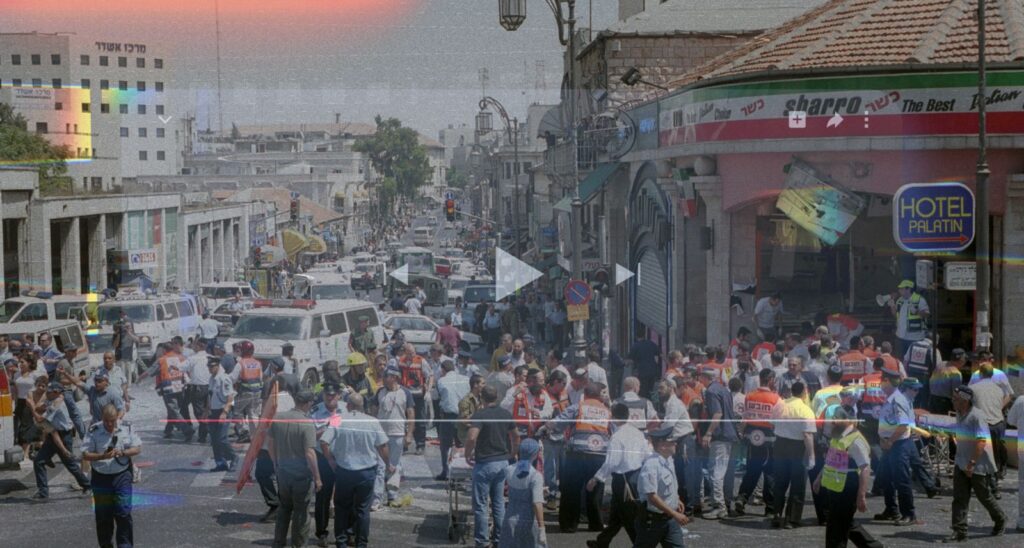
Arnold Roth can define it. He can define it down to the minute, because on a school holiday twenty-five years ago, the intifada walked into a pizzeria in the center of Jerusalem carrying a guitar case, and his daughter Malki was standing at the counter.
Roth is an Australian-born lawyer who was running a drug development company in Jerusalem in 2001. He has spent the quarter-century since that day campaigning to extradite the woman who organized the attack. He is not interested in being a symbol, and he is tired of the way his family has been used by the media.
When asked what he would say to a student at Columbia marching under that sign, that weariness comes forth: “I’d walk away, I wouldn’t do it.”
What he will do is explain, in detail and without flinching, what the word actually means when it stops being a slogan and becomes life-altering pain.
She Was a Bridge, Not a Cause
Roth resists talking about Malki as an issue. He has said the campaign is about justice, not revenge, and that people who only know the murder do not know his daughter at all.
She was fifteen. Born in Melbourne, an American, Australian and Israeli citizen, she had just finished tenth grade at the Horev Girls School in Jerusalem. She was a gifted classical flautist who played in the Jerusalem Youth Orchestra and wrote her own music. She was a madricha (youth leader) in Ezra, a religious youth movement, responsible for a group of nine-year-old girls.
Roth described her as a “fifteen-year-old girl who was sweet-natured, pretty talented, and had friends, and was something of an influencer in a very modest kind of way.”
The middle child in a family whose size the Roths have never disclosed. It is a deliberate family practice, and he mentions it in passing, almost apologetically, as a small locked door in an otherwise open account.
Malki’s youngest sister, Haya-Elisheva, was born healthy and then catastrophically damaged by an illness and then terrible mismanagement in hospital. She is thirty-one now and lives at home with her parents. “We’ve never heard her say a word,” Roth said. “She’s brain damaged and blind, and has a lot of really quite serious issues.”
Malki adored her. That is the thread that runs through everything else about her. She volunteered with disabled children because of her sister; the summer she was killed, she and a friend argued their way into a residential camp for severely disabled children that took only trained professionals, refused to accept the refusal, and spent a remarkable week there. Her parents only learned how hard she had pushed after she was dead.
“Malki was in no respect unusual,” Roth said, “but in every respect was an agent for change, and a bridge between different worlds.” A bridge between the mainstream kids in her class and the handful with special needs who were being mainstreamed. She was a bridge inside her own family as well. “She was never the sort of child that you would have looked at and said, this is a leader. This wasn’t a leader. This was a facilitator. This was a person who helped other people get along.”
Then, wrenchingly, adds: “And we miss her terribly.”
The Day That Changed Jerusalem Forever
August 9, 2001 was at the height of summer vacation and, in Roth’s memory, a frightfully hot Thursday. Malki had made a plan for the day with Michal Raziel, sixteen, her lifelong friend and neighbor. They were going to decorate the bedroom of a friend coming home from a vacation in the United States, as a surprise. In the early afternoon they were due at Ezra, where they were both counselors.
In between, they went for pizza. “It was no secret,” Roth said. “They used to love going to Sbarro.”
They were at the counter a few minutes before two o’clock. They probably did not notice the young man who walked in, dressed to look as Israeli as possible, carrying a guitar case across his shoulder.
Roth has thought about that guitar case for twenty-five years, and has built a small mercy out of it. Malki was a serious musician. “I sort of comfort myself in the thought that she may have glanced over at this guy and thought to herself, this is a good guy, he’s a musician like I am.” He does not leave the thought unguarded. “And maybe she didn’t. Maybe she was alarmed. I don’t know. We have no way to know.”
At almost exactly two o’clock the man pressed a button on his chest and the case exploded, releasing several kilograms of black nails. Roth kept some of them on his desk for years. “Black nails,” he said, “because they have fabulous flesh-shredding capabilities.”
The Roths did not learn Malki’s fate for twelve hours.
Frimet Roth called her husband’s office a few minutes after two. He was not surprised to see her number. “But as soon as I put it to my ear, she was screaming. She said, ‘there’s been a pigua [terror attack], I can’t find the children,’ and she hung up.”
He declines to narrate what came next in any great detail. “It’s enough if I say that it was a walk through Dante’s Inferno.” But he shares one moment he vividly remembers, walking from his office to the bus, the way he did every day, and doing deals with God, “offering him things so that this has a happy ending.” By then he knew the death toll was enormous. “All I wanted to do was just call in whatever favors I might possibly be able to call in so that we’re just not in this story. Just leave us out of this story.”
At around two in the morning, his two oldest sons, one of whom had started the army the day before, were driven by a social worker from Jerusalem to the national forensic laboratory in Jaffa. They phoned home.
“I could tell from the sound of their voices before they even said anything what was ahead,” Roth said. “But we found Malki, and that was the end.” He corrects himself immediately, because it wasn’t. “Of course it was also the beginning of the next stage of our lives, which was a stage that has had an altogether different character to it.”
On that hot Thursday, fifteen people were murdered on the spot. About 130 were injured. A sixteenth victim, a woman who was there with her toddler daughter, was brain-damaged in the blast and lingered unconscious for the next twenty-two years before she died; Roth knows her parents, who spent most days of those two decades at her bedside. “So in the end it was sixteen people who were murdered.”
There were no guards outside restaurants in Jerusalem in those days. Nobody had seen an attack on that scale. “Really, Jerusalem was never the same,” he said. “The next day there were funerals all day.”
The Intifada Was Not a Metaphor
The Sbarro bombing is the thing the slogan describes. Roth is willing to grant that the word has a real referent: “There is a thing that legitimately can be called intifada, and it has to do with waging war via civilian forces, taking no prisoners, and being cruel and difficult.”
And then there is the other thing. The one that lives on placards that get waved on the streets of New York, London, and Melbourne.
“Then there’s the idiots’ intifada. The globalize-the-intifada crowd, who actually don’t really have any idea of what they’re talking about.”
He is precise about the psychology, and notably unhostile toward the impulse underneath it. It arrives, he said, as a way of being different from the mainstream. “I really want to see the world better. I want to see the triumph of good people over the oppressors.” It rests on the premise that the conventional world — parents, teachers, the people on the street — has screwed things up.
“You can want these positive things,” he said. “But when you get it all mixed up by bringing in this concept of intifada, which is the kind of war that the woman who plotted the massacre at the Sbarro pizzeria talks about a great deal, when you mix that into your vision of a better world, you’ve created something which is devastatingly wrong.”
His conclusion is blunter than most people expect. Marching on a parliament or a corporate headquarters shouting globalize the intifada, he said, “you ought to be arrested. On any reasonable view, you are about to call for something that will result in the destruction of human lives, even if you yourself are incapable of seeing that.”
What sharpened this for him was a scene in Sydney. Roth is from Melbourne; Malki was born there, and four of his children are Australian-born. Several months ago, he said, a young woman with enormous charisma stood on the balcony of Sydney Town Hall screaming globalize the intifada, and the crowd loved it. He was referring to Grace Tame, named Australian of the Year in 2021 for her advocacy for survivors of sexual assault. An Australian television station asked him to comment, and as he assembled the thoughts, he found that he was more enraged than he had realized.
The failure he describes is not really the crowd’s. “It’s not treated as potent by the people who engage in it,” he said, “nor is it treated as potent by the people who are supposed to be enforcing orderliness in our society. We can call them police, we can call them ministers of religion, we can call them parents. And it’s failing.”
The Murderers Were Not Desperate. They Were Devout.
There is a standard Western interpretation of how a person arrives at the decision to bomb a pizzeria: oppression, then despair, then violence as the last available language. Roth has spent two decades reading the primary sources on the two people who murdered his daughter, and the account does not survive contact with them.
He starts by distinguishing between the two. “She was the bomber. She was not the bomb.”
The bomb was Izz al-Din al-Masri, the young man with the guitar case. People expect him to say al-Masri walked in knowing he would meet his death. “I don’t believe he thought about that for a second,” Roth said. “He knew that he was walking to a place where he’d be able to kill a lot of Jews.”
Ahlam al-Tamimi was twenty-one. She was born and raised in Jordan in a well-off family, and had moved to the West Bank roughly a year before the attack. She was, Roth said, “absolutely uninterested in giving up her life.”
He has collected her speeches: transcripts and videos accumulated over the years since she became a celebrity. What he says is missing from all of them is the thing everyone assumes must be there: Not desperation. Not displacement. “Not a sense of, we need those territories back, or we have to move that border.”
“What it reflects,” he said, “is a sense that this is what God wants. And you cannot negotiate with people who think that what they’re doing is what God wants.”
Tamimi did not begin from this place of fanaticism. She arrived in Ramallah as a hater of Israel and joined Fatah, the secular wing of Palestinian politics. It wasn’t enough. She converted to radical Islamism and joined Hamas, the first woman admitted to its ranks, and began looking for something spectacular to do.
She found it a week before Sbarro, and it failed. She carried a booby-trapped beer can into a supermarket about two hundred meters down the street from the pizzeria, in the center of town. It did not detonate the way she wanted.
“And she was heartbroken,” Roth said. “You can imagine, she was desperate. She really wanted to kill people. And she demanded a second chance.”
She got it a week later. She brought al-Masri from Ramallah into the center of Jerusalem, walked him to the entrance of the pizzeria, told him what to do, and asked him for a few minutes to get clear.
Roth finishes the sentence she left unfinished. “Which was, so that I can live and you can go ahead and die.”
Al-Masri stood beside the two girls, studying the menu board for a couple of minutes to fulfill her instruction, and then pressed the button.
Roth will not use the word suicide. “None of this is suicide, and I reject every use of the expression suicide bomb or suicide bomber. He didn’t have suicide on his mind. He had murder on his mind.” What he had, in addition, was total indifference to his own fate, “since it was God who sent him.”
And from there, Roth said, it is a short walk to a belief he refuses to wave away as propaganda. “These people perceive the act of murder as a way to be with their seventy-two virgins. It’s not an easy concept to just throw away. They really believe that their best days are coming next. And they have no commitment at all to ‘let’s make life for our own children and our own community, our villages and our towns, better.’ It’s got nothing to do with that.”
That is where the narrative of oppressed fighting the oppressor breaks down. “They don’t come with a grievance. They’ve learned to use the word desperate,” he said. “But I know from my own experience, I know from the lives of the two people I’ve mentioned, they weren’t desperate. They weren’t poor. They were successful people from wealthy families. In both cases, what they want is to satisfy their God.”
At trial, Tamimi pleaded guilty to every charge and was sentenced by a panel of three judges to sixteen consecutive life terms.
The Roths knew none of it while it happened. They didn’t know she’d been arrested, didn’t know there was a trial, didn’t know where or when it was, didn’t know she’d been convicted or was about to be sentenced. “All of this was done behind our backs.”
What Roth knows about that courtroom, he knows because someone he still cannot identify called him anonymously the day after the sentencing, arranged to meet him at a place they both knew, and handed him documents. “I could not have gotten that information otherwise.”
The documents told him that Tamimi had spent the proceedings grinning at the judges the entire time. And that the judges had taken the unusual step of putting a warning to the government on the record: if there are ever deals to release prisoners, she should not be part of one, and should receive no commutation.
“She really enraged them,” Roth said, “because in every possible way she was communicating the message of, ‘I’m not sorry.’”
She has been more explicit since. “She said, I would do this again if I had the opportunity. I want you to do it. My only regret is that I didn’t kill more of them.”
Roth adds one detail about her vocabulary that he has clearly turned over many times. “She’s never mentioned who she murdered. They’re all Zionists. She’s never used any other word. They’re all Zionists.”
A pause, and then: “Most were children.”
The Shalit Deal Was Not a Rescue. It Was a Down Payment.
In October 2011, after five years of Hamas captivity and years of grassroots campaigning inside Israel, the soldier Gilad Shalit came home. The country traded 1,027 convicted prisoners for him. It had more than ninety percent public support.
Roth was against it, and says so without softening. “I was and I continue to be totally opposed to doing deals with terrorists.”
He is quick to point out he is not alone on some fringe. The most rigorous case against such deals, he notes, was made by the man who ultimately presided over this one. Benjamin Netanyahu wrote a bestselling book on terrorism in the mid-1990s. “I always refer to it as the dummy’s guide to dealing with terrorists,” Roth said, conceding that isn’t the actual title. The argument stated that trading with terrorists only enlarges their appetite, “and you will never be done with them.”
Catastrophic is the word Roth and his wife used to define it. “It was a catastrophe. It continues to be a catastrophe.”
His central objection is about what the Israeli public was never told. By his own analysis of the list — and he is careful to mark it as his, not an official finding — more than half of the 1,027 had carried out murders. “It was a snow job. People were never really given an understanding of what are the moral dimensions here and what are the risks to Israeli society.”
In the months and years that followed, Israelis were murdered by people freed in the exchange.
Two names came out of that deal. One of them was Ahlam al-Tamimi, who went home to Jordan as a hero. “Tamimi was the top of the list,” Roth said, “and she has had a spectacular career whipping people up into a frenzy over doing more terrorism.”
The other, much less well known at the time, was Yahya Sinwar, the future mastermind of October 7. “He walked out free at that time as well.”
Roth expects another deal. He also expects the politics around it to look different. “I’m quite sure that the next deal, and I’m sure there will be one, will have much smaller support, because many Israelis — certainly the more thinking parts of Israeli society — recognize that you don’t really solve problems in this way. And actually you create huge problems that you don’t have a solution for.”
Jordan Is Not the Moderate Everyone Says It Is
Tamimi has lived openly in Jordan since 2011. She has been indicted in the United States since a sealed complaint was sworn out in Washington in July 2013 and unsealed in March 2017. She has been on the FBI’s Most Wanted Terrorists list since that unsealing, with a State Department reward of up to five million dollars attached to her. Jordan has not handed her over, and has argued that the 1995 extradition treaty with the United States is not enforceable in the first place.
Asked why Washington has not been able to apply enough leverage, Roth said the question contains a false premise, and that correcting it is the hardest part of any interview he gives.
“The answer to your question is of course they can,” he said. “The reason that it hasn’t happened is entirely self-imposed.”
He describes, then discards, the cynical version. “What I like to do is come across super cynical in talking about this and say, well, you know, the Jordanians have wrestled the Americans to the ground. They’ve warned the Americans not to push, and the Americans have stopped pushing.” He rejects it flatly: “But that’s nonsense.”
The actual balance of power isn’t close: The United States is by far Jordan’s most important ally. Jordan is among the largest recipients of American aid in the world. There is a treaty. There are American forces stationed permanently on Jordanian soil.
“There is every reason in the world why the Jordanians would do a quick mathematical calculation and say, ‘The Americans are asking us to hand this savage over, we’d better do it.’ But that’s not what’s happened.”
He allows that he cannot fully explain it. The real analysis, he suspects, will only be possible after she is arrested, extradited, and tried in Washington. But he is unwilling to leave the central point ambiguous.
“What is for certain not the case is that the United States can’t pull it off. Absolutely it can pull it off. Chooses not to pull it off, and never owns up to that.” Which means, he said, “there’s all kinds of moral contradictions and ethical breaches, and most of all, a total betrayal of US justice, all being done by the Americans.”
Even more exhausting for Roth is to hear Jordan constantly praised as “moderate.” Jordan sits near the bottom of global press-freedom rankings, and nobody, he said, gets access to the airwaves without the approval of the Royal Hashemite Court.
And who did get this approval? Ahlam al-Tamimi herself, who was given a weekly television program that ran for roughly four and a half years, until 2016. It aired on the Hamas-affiliated Al-Quds channel, from Jordanian soil, while she was already under American indictment.
Without this indirect approval from the leadership, Roth says, “there’s no way that this woman could have gotten to the point of being an icon and a celebrity and being able to get up on TV every week and say, ‘this is what I did, I don’t regret it, you should do the same. God is happy with me, he’ll be happy with you too.’”
The show ended, but her celebrity did not. She still gets publishing deals, still gets people speaking in her name, still has aggressive support across social media that Roth suspects is sometimes herself. “This is poison, this is toxin, this is going straight into the bloodstream of young, poorly educated Jordanians whose textbooks are replete with heavily bigoted antisemitic themes.”
Then he stops to make sure the point has landed. “And I just want to pause and remind people: yes, it’s Jordan I’m talking about. Everybody’s favorite moderate country, Jordan. Jordan has a shocking record. And we don’t know about it because it’s not talked about, because it serves multiple political interests to say, well, Jordan is really the human side, the nice face of Arab society.”
He would be willing to buy some of that, he said, “were it not for the fact that that claim is what keeps one of the world’s worst savages, America’s most wanted female fugitive, safe.”
“There’s a deal. But it’s a deal with the devil.”
He is candid about his own position in it. “Yes, of course, this is called special pleading. I’m talking about the woman who murdered my child. I’ve never hidden it. Of course I have an interest.”
“But there were sixteen people murdered there that day, and many others have been murdered in the name of the very toxic bigotry that she radiates, that she projects.”
Reporters Gave Her a Chair and Gave Him Leprosy
On the Sunday morning after they buried Malki, with the house full of people — thousands came through, most of them strangers — Arnold Roth was handed a telephone.
It was a talk show host calling from London for the BBC. Roth is emphatic that neither the woman nor her message is the point of the story. What matters is what she wanted.
She had already interviewed the father of the bomber. And she explained, to a man two days after burying his daughter, that “my audience will be very interested to hear the contrasting views.”
“I had the good sense to say to her, ‘I don’t think I can do that.’ And I hung up the phone.”
Very soon afterward came a second call, this one from someone he could relate to: an Australian, from the Australian Broadcasting Corporation, assuring him that the ABC was not at all like the British. He wanted the same thing: a double-headed interview with the bomber’s father. And he had, Roth said, the chutzpah to add a reassurance: “I’ve spoken to him. Really, what he wants is peace. He’s very disappointed by what his son did.”
Roth declined that too. The matter eventually went to court in Australia.
And shortly afterward, he said, that same peace-loving father was across the Arab media saying “our son has restored the honor of our family, I hope my other sons will do what he did.”
What Roth concluded from the episode was a pervasive naivete in the media. “These were not stupid journalists. They were really at the top of their profession. And they could not get their minds around the idea that this is not a conflict between two people who just want essentially the same thing and we can’t both get it.”
“What they’re not getting is what it means to be dealing with Hamas,” he said. “Hamas is a pretty good example of an absolutely inflexible enemy who doesn’t care what happens to his own people or even to himself, literally in every sense of the word, as long as he draws blood from our side.”
But that lack of imagination has been hard to make apparent to wider audiences. “It doesn’t sell well, and we’re paying the price for the fact that we’ve never really worked out a good way to convey to other people what it means to be at war with Hamas.”
The pattern did not end in 2001. Roth described the Associated Press sending a journalist to Tamimi’s home in Amman to interview her and her husband, footage he has kept. He has, he said, hundreds and possibly thousands of clips of legitimate outlets giving her the kind of coverage “that you would give to a town mayor who wants to have his views heard.”
His own phrase for the asymmetry is the one that sticks: with us, it’s as if we have leprosy.
He has taken it directly to the institutions — to the BBC’s managers, in a video conference he demanded and got; and he would say the same to Reuters and to Facebook, which have done the same thing. The obligation he describes is not neutrality but delineation: “There is a real obligation to make a clear delineation between voices that are acceptable and voices that should never, ever be allowed onto the airwaves.”
And this, for Roth, is where the media story and the campus story coincide. The slogan, he said, is “the slogan for the madness that allows people to think — smart people, good people, people in the West, people in the East — to think that the people who support the blowing up of synagogues, or even the blowing up of churches,” are simply angry, or badly treated, or desperate. “And it’s all wrong. They’ve missed the entire point of the story.”
He keeps referring back to Tamimi as the case study: “her freedom embodies everything that’s wrong.”
“Nobody has a better claim to getting out there and saying globalize the intifada than she does,” he said. “She doesn’t use those words, though. She says: God wanted what I did, I’m glad I did it, God was happy that I did it, and I only wish that I could do more of it.”
“That’s globalize the intifada.”
The Answer Is Education, and the Other Side Started First
Asked what he would say to a student at Columbia wearing a keffiyeh, holding that sign, Roth’s answer was that he wouldn’t say anything.
“I’d walk away.” Not out of contempt, rather out of an assessment he’s done over decades. “That kind of discourse, in the agora, the public space of a university, is never going to work. What’s needed is a process, and the process isn’t being handled well.”
His critique of the process starts with his own side. The Jewish world is facing more antisemitism, and more violent antisemitism, than at any point in his lifetime, and the solution on offer is that the organizations which have fought it for two or three generations should be given more support because they have the experience.
“And it’s obvious to me that this is getting it absolutely upside down. We’ve done it wrong.” He does not claim to know exactly where. “And whatever the wrong is, I don’t know it. I don’t have that kind of wisdom or insight.”
What he is certain of is the shape of the thing that would work, and the shape of the thing that won’t. “It surely is not going to be achieved in lecture halls or cafeterias or one-on-ones or standing on boycott lines and yelling at each other. It’s going to require something persistent, consistent, something that’s done over a long period of time — and that most likely we haven’t even thought of what it looks like today.”
It’s what the other side has been doing for years.
“The side that’s funded by Iran and Qatar — mostly Qatar — understands this a lot better, in a functional sense, than our side does,” he said. He describes them as “long-term investors in sowing fields of real influence, with people who come with packaged influence that they’re going to be sowing and harvesting and then reaping in years to come. That’s been going on for a long time.”
Which sets the honest expectation about the timeline. “Anything we do now to try to reverse the damage — the immense damage done by the Qataris, and there’s nothing wrong with saying that the Qataris are by far the most active in this field — is going to take years. It’s not going to happen quickly.”
And in the meantime, he is unsparing about the present. He would not go to Brooklyn, he said. Brooklyn scares him, as would any city where large numbers of people stand outside coffee shops shouting Free Palestine “as if that were some sort of an invitation to a dialogue.”
But asked what could actually be done to overcome the crowd shouting the slogan, he gave a one word answer: education.
“And education, by definition, is always slow and takes time and needs a steady hand. And above all, needs leadership that is actually committed to making that change. In most places I don’t think we have that kind of leadership.”
He is scathing about politicians generally, and then declines to be fatalistic about them. “We need a better kind of politician. But there’s no reason why we can’t get a better kind of politician.”
“I don’t have a good answer. All I can contribute to this discussion is: whatever we need to do, it needs to be done intelligently, fast, and on a systemic basis. In other words, everybody has to be involved in trying to figure out what’s wrong and helping make it right. I don’t see any society anywhere that’s doing it right.”
He also thinks the diagnosis most people reach for is backwards. “It’s a real mistake to think of it as, ‘well, Israel got us into all of this,’ or ‘this is all about hating the Jews.’ Hating the Jews and viewing Israel as the source of all problems is a symptom. It’s certainly not the cause.” It is, he said, “a very successful lever in the hands of the right kinds of bigots. It works really well.”
And then, on the phrase his generation was raised on: “If we thought that never again was the slogan for our generation, nobody should be in any doubt. Never again doesn’t work anymore. It’s going to be again. And there’s no reason to expect differently.”
Roth speaks from the particular vantage point of coming from Melbourne, which he said has more Holocaust survivors relative to its size than any community in the world. “Pretty much everything that turned me into the adult that I grew up to be was a function of being raised by parents who were Holocaust survivors.”
“None of my friends had grandparents. None of them, as far as I can remember. Almost none of us had aunts or uncles. Small families. Everybody came out of concentration camps.”
That upbringing is the source of his quarrel with the assumption he sees governing Western life. “We are what we were raised to be by our families. And families that have been raising people from the 1960s onwards are caught up in the essential assumption that everybody is good, we just have to find a common language.”
“But that kind of avoids the reality that not everybody is good. And sometimes we’re called upon to work out strategies for living in a world where not everybody is good.”
That is the whole case against the arrangement that keeps Ahlam al-Tamimi in Jordan, the reasoning that says the problems of a murderer living free in Jordanian society matter less than sending a message of brotherhood to the Jordanian people.
“Ahlam al-Tamimi is free for the worst possible reasons,” Roth said. “And when she is eventually arrested and handed over and put on trial, those reasons will become more obvious than they are today. But until they are openly discussed, there are going to be lots of bad decisions made.”
Finding Meaning and Comfort
The last question was how he keeps going.
He answered by going back to the shiva, the seven days Judaism prescribes for mourning, and the conversation he had with his children when they discussed what they wanted to build.
The result was the Malki Foundation, now in its twenty-fifth year. It exists for families with a child who is severely disabled, and who decide not to place that child in an institution. It lends equipment, funds therapies at home, and sends therapists to housebound children and out to Israel’s periphery. It has helped thousands of families on a strictly non-sectarian basis; roughly a third of them are Arab Israelis.
It is, in other words, Malki’s work. The thing she was doing the week she was killed, run at scale for a quarter of a century by her father. “What that does for me is all internal. I have the confidence and the satisfaction of knowing that in Malki’s memory, objectively good things are being done every single day.”
And then, without raising his voice:
“There is a difference between good and evil. There is a side that’s good and a side that’s evil. I know that I’m on the good side. They can scream as much as they want and call me and my children and my grandchildren people who are engaged in genocide. Good luck to them. It’s nonsense.”
Arnold Roth is an Australian-born, Jerusalem-based lawyer and co-founder of the Malki Foundation, established in memory of his daughter Malki Roth, murdered at fifteen in the 2001 Sbarro pizzeria bombing. Learn more about the organization’s work at https://kerenmalki.org. This interview was conducted by Ben Chertoff for The Honest Take. Listen and subscribe at podcast.honestreporting.com.
Liked this article? Follow HonestReporting on Twitter, Facebook, Instagram and TikTok to see even more posts and videos debunking news bias and smears, as well as other content explaining what’s really going on in Israel and the region. Get updates direct to your phone. Join our WhatsApp and Telegram channels!
© Divuach Ne’eman R”A, 2025