With Israel’s election almost upon us, the knives are out.
Much of the international media landscape is reverting to familiar tropes. A wave of news coverage and social media commentary paints Israeli society as monolithic, extreme, or warmongering – simply because security remains a paramount concern across the political spectrum.
There is no question that Israelis’ views on security have hardened since the October 7 atrocities. After the worst massacre of Jews since the Holocaust — and three years of war on multiple fronts — that should hardly come as a surprise.
But a population taking the threats against it more seriously does not make it “extreme.” Nor does believing Israel must ultimately be able to defend itself make Israelis warmongers.
Which is why it is refreshing to see a major mainstream media outlet focus on something else Israel’s election tells us.
The Australian, in an editorial published ahead of Tuesday’s vote, points to the election as evidence of the strength of Israeli democracy:
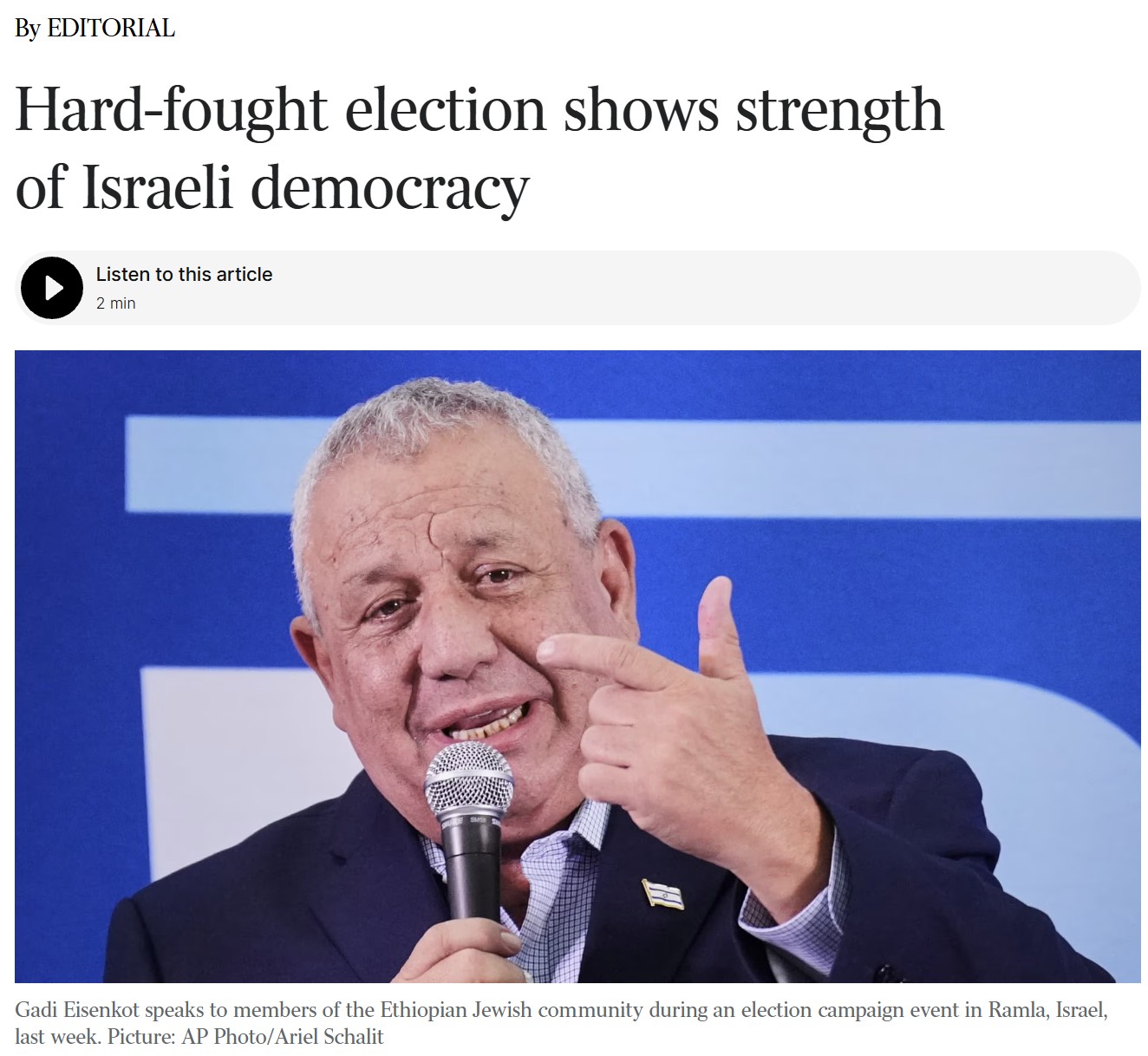
Final polls ahead of Tuesday’s fiercely contested Israeli election forecast deadlock, with neither Benjamin Netanyahu’s right-wing coalition nor former defence chief Gadi Eisenkot’s centre-right alternative getting the 61 Knesset seats needed to govern. That portends what is invariably the case after Israeli elections: protracted horse-trading or even a new election if it is impossible to agree on a new coalition. But that should not diminish perceptions of Israel as a strong democracy, the only one in the Middle East.
A little more than three years after the October 7, 2023, massacre of Jews by Hamas terrorists, the election is a reminder to Israel’s critics of the vast gap between the estimable determination of the Jewish state to uphold vibrant democracy and the record of other regimes, especially Iran’s theocracy. Israelis vote for a new government at least every four years. In contrast, the Palestinian Authority, whose “statehood” was recognised prematurely by the Albanese government, has not had an election since 2006. Leader Mahmoud Abbas, 90, won the last Palestinian presidential election in 2005. His term should have expired in 2009. He has ruled by decree ever since and postponed the election due now until September next year.
Read the entire thing.
Israel’s election will not produce a perfect government. It may not even produce a swift one. But it will produce something its critics too often refuse to acknowledge: a free people debating its future, voting for its leaders, and holding them accountable at the ballot box.
Robust debate, messy coalitions, and fierce political competition are not signs of weakness or extremism. They are the hallmarks of a resilient democracy surrounded by authoritarian regimes.
Liked this article? Follow HonestReporting on Twitter, Facebook, Instagram and TikTok to see even more posts and videos debunking news bias and smears, as well as other content explaining what’s really going on in Israel and the region. Get updates direct to your phone. Join our WhatsApp and Telegram channels!
© Divuach Ne’eman R”A, 2025