Key Takeaways:
- Protests sparked by frustration with France’s education system quickly became intertwined with pro-Palestinian activism, anti-Israel rhetoric, and broader anti-Western grievances.
- Motaz Azaiza’s presence at the French protests highlights how prominent activists have become part of a wider movement.
- An Italian citizen who supported October 7 and radical ideologies was arrested on suspicion of having organized the France-inspired protests in Italy.
As protests continue to spread in France and across Europe more broadly, it has become all the more apparent that the protests that once started with calls for better schooling have been hijacked by radicalism, exporting violence to the streets of Europe.
It is not a coincidence that the protests turned quickly to violence – a vast international network of pro-Palestinian organizations, including those linked to terrorist organizations, fueled the initial unrest in France on October 17. Urgence Palestine, an organization established in the wake of October 7, was proudly at the protests carrying Palestinian flags, while a branch of the Association France Palestine Solidarité announced its support for the protests, highlighting the signs associated with the pro-Palestinian movement.
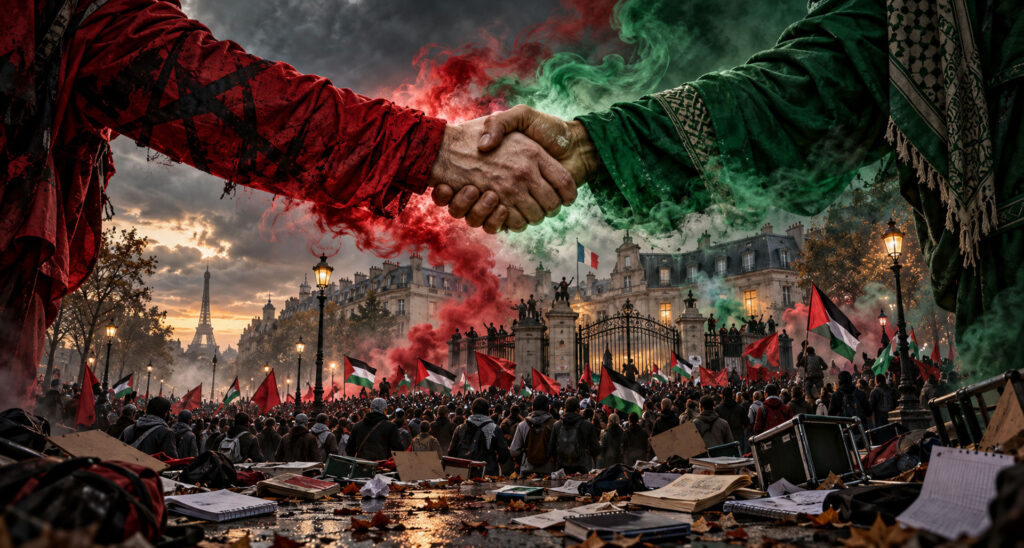
These coalitions and the connection of extreme left-wing organizations and ideology with radical Islamist ideology are manifestations of the red-green alliance that has been a moving force in these protests. The alliance bonds two extremes that would otherwise have nothing in common with each other, creating common ground through the mutual enemies of Western civilization and the state of Israel.
The red-green alliance brings together radical left activists and Islamist political movements, making use of historical Jew-hatred and antisemitic tropes, many of which originated in the Soviet Union, and brands the Jew as the source of the world’s problems. In the modern era, Israel is classified as the global Jew, becoming a scapegoat for unrelated issues.
The protests, which have drawn a spotlight to pro-Palestinian activism, give this alliance a ready-made political framework through which otherwise unrelated grievances can be reframed as part of a broader struggle against Israel and the West, while providing a shared public platform to mobilize supporters and advance these narratives. The result of such widespread hatred and targeting of Jews is not merely political rhetoric – some synagogues in France canceled prayers while Jews were warned to conceal their identity in public.
This convergence of radical ideologies appeared not only in pro-Palestinian organizations but also among individual activists.
Motaz Azaiza, a Gazan-born photographer, has largely been hailed by the international media as a credible voice regarding the war against Hamas in Gaza, despite his family being connected to terrorist organizations. Not only was he present with his camera at 6:30 am on October 7 when Hamas’ terrorist attacks began, but he later reinforced his support for the attacks on his X account, posting that “the Gazans have entered the settlements.” But rather than posting the photographs he took that morning of Israeli hostages being taken, he deliberately withheld the photos from being published in order to protect those committing the crimes.
Azaiza may be documenting the destruction, but it is not simply as a neutral observer. As a vocal activist, it is unsurprising that he also joined the protests in France, documenting how “from Gaza to Paris” he is witnessing the “streets, the struggles, and the voices demanding change.” In one of the photos, he stands smiling, with a large Palestinian flag waving behind him, subtly inviting his audience to draw a connection between two causes that would otherwise be unrelated.
The convergence of the two movements has not been limited to France. As the protests have spread to other cities across Europe, the same pro-Palestinian symbolism has been used, and similar forms of activism have emerged.
Yousef Sihar, an Italian citizen of Moroccan descent, was arrested by Italian police on suspicion of helping organize the protests in Italy in October, reportedly by writing the protest manifesto and creating a group chat for the October 17 Movement protests, which were inspired by the day the French protests spiraled into chaos and mass destruction.
Yet the protests were not Sihar’s first step into pro-Palestinian activism. He previously founded the organization Rising Dawn, which spread propaganda in line with Hamas and the Popular Front for the Liberation of Palestine (PFLP). while being branded as a pro-Palestinian organization. He celebrated the attacks of October 7 on his social media, writing that fighting would not stop until “we recover every inch of our land.”
Similarly in France, another protest leader was recorded claiming that the “French and Israeli police collaborate” by using the same techniques and “colonial mechanisms,” attempting to justify the violence of the protests by pinning the blame on the universal evil – Israel.
The pattern that first emerged in France and quickly spread to other cities is difficult to ignore. Where the initial protests were sparked by genuine frustration with schooling in France, they shifted into a vehicle used by the pro-Palestinian movement to express anti-Israel and more broadly, anti-Western grievances. By universalizing the Palestinian cause through anti-colonial rhetoric, the red-green alliance has found common ground between otherwise incompatible movements, united by hostility toward the very Western values of freedom and democracy that allow them to organize and protest openly.
Liked this article? Follow HonestReporting on Twitter, Facebook, Instagram and TikTok to see even more posts and videos debunking news bias and smears, as well as other content explaining what’s really going on in Israel and the region. Get updates direct to your phone. Join our WhatsApp and Telegram channels!
© Divuach Ne’eman R”A, 2025