Key Takeaways:
- Pro-Palestinian groups helped fuel France’s unrest. Urgence Palestine, EuroPalestine and UJFP supported student protests, bringing Palestinian flags and messaging into demonstrations as they erupted into violence and looting.
- Deep ties connect these groups to France’s radical left. Shared activists and coordinated campaigns linked pro-Palestinian organizations to revolutionary groups that mobilized protesters ahead of the October 17 demonstrations, which descended into widespread violence.
- The network extends beyond France. Anti-Israel groups have longstanding ties to international organizations, including CODEPINK and Samidoun, through campaigns predating the October 7 Hamas attacks.
France burned.
What began as ostensibly student-led protests over overcrowded classrooms, crumbling school infrastructure and teacher shortages descended into scenes that bore no resemblance to a campaign for better education.
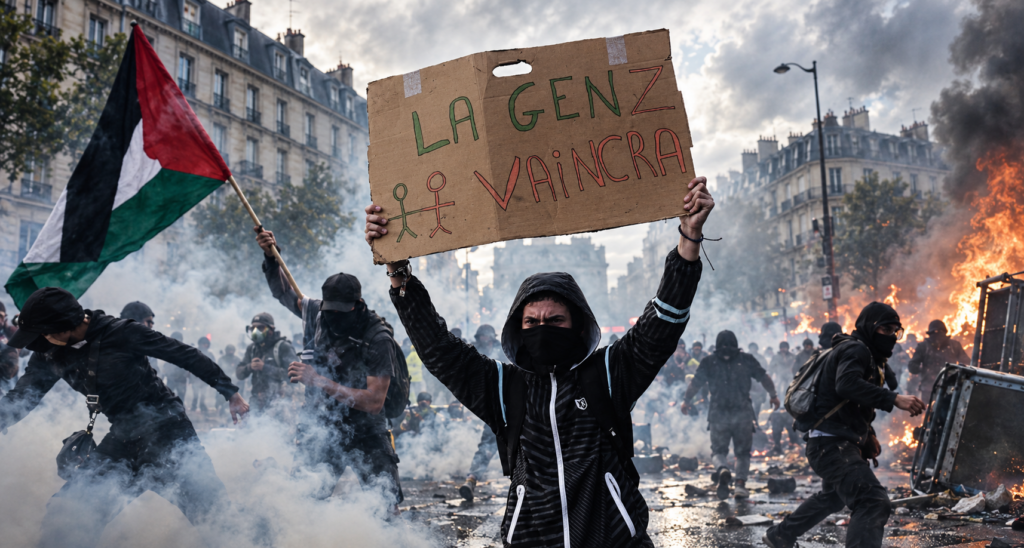
Masked rioters hurling projectiles at police officers. Cars and barricades set ablaze. Shops smashed open and stripped bare. Historic public buildings engulfed in flames.
From Paris and Marseille to Lyon, Bordeaux, Lille and Limoges, violence swept across France, leaving a trail of destruction as overwhelmed police forces struggled to restore order.
In Lyon, rioters set fire to the city’s historic tourist office on Place Bellecour, a nineteenth-century pavilion that had stood for more than 170 years. In Limoges, masked attackers torched the city’s magnificent nineteenth-century town hall, causing part of its roof to collapse. In Paris, the iconic Monument à la République, its stone pedestal defaced with graffiti as smoke billowed through the surrounding streets, became an almost fitting symbol of the wanton destruction.
By October 19, the government of President Emmanuel Macron had resorted to emergency measures, with localized curfews imposed in several cities. In parts of central Paris, including Place de la République and Les Halles, access was restricted between 11pm and 6am.
For now, the curfews appear to have brought a measure of calm to France’s streets. But further demonstrations are planned, with an expectation that the violence could erupt again.
For millions watching from abroad, the scenes have been almost incomprehensible.
Social media feeds filled with videos of masked mobs confronting baton-wielding police officers. Television news bulletins showing burning vehicles and looted shops. Newspaper photographs of historic buildings consumed by flames.
And, accompanying it all, headlines still discussing student protests.
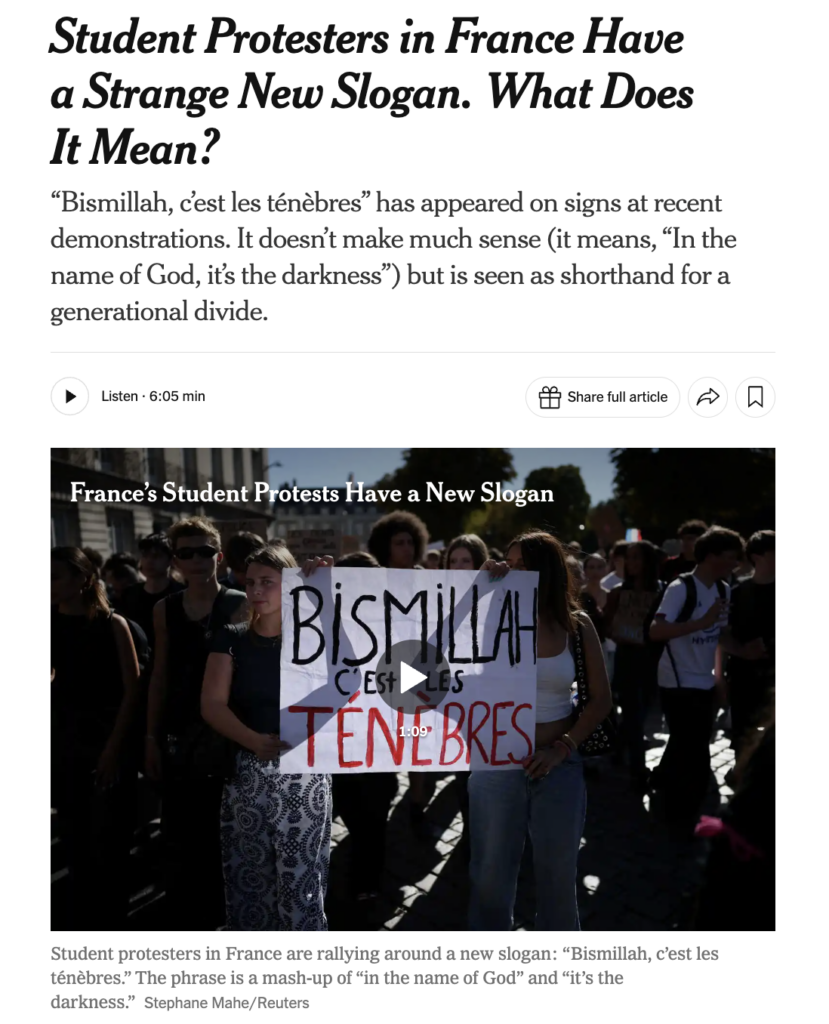
There may well be legitimate questions to ask about the state of France’s schools. But it stretches credulity to suggest that those smashing shop windows, setting buildings ablaze and attacking police officers were primarily concerned about overcrowded classrooms or a shortage of teachers.
The violence had become something far removed from the grievances that supposedly brought people onto the streets.
Who were the people behind the masks? Who encouraged them onto the streets? And what, exactly, were they hoping to achieve?
To begin answering those questions, we need to look beyond the broken glass, burning buildings and familiar explanations about disaffected students.
We need to examine the organizations that helped fuel France’s unrest, the political networks connecting them and the activists who continued calling people onto the streets even as the violence escalated.
Because behind the images of burning French cities lies another story: one involving pro-Palestinian activist networks, radical-left organizations, and international alliances that extend far beyond France’s borders.
And to understand what brought these networks together and galvanised them into action, we need to go back three years.
To October 7, 2023, when Hamas terrorists massacred some 1,200 people in Israel, and to the international pro-Palestinian activist movement that mobilized in the aftermath.
From October 7 to France’s Streets
The pro-Palestinian movement that emerged in France after October 7, 2023, was not built entirely from scratch.
Many of the organizations involved had spent decades campaigning against Israel, organizing boycotts, mobilizing demonstrators and cultivating alliances with far-left political movements. Others came into existence directly after Hamas’s massacre and Israel’s subsequent military campaign against the terrorist group in Gaza.
Over the next three years, these organizations built a sprawling anti-Israel protest infrastructure, bringing together political parties, trade unions, student activists, Palestinian solidarity groups and international campaigners.
And their activism has hardly remained confined to the Israeli-Palestinian conflict.
France’s latest unrest has provided another opportunity to push their agenda into the streets. Some have publicly called for further mobilization despite escalating violence. Others have promoted demonstrations or supported detained activists, while still others have helped turn Palestinian flags and slogans into conspicuous features of protests supposedly concerned with French schools.
Urgence Palestine: A Movement Born After October 7
Unlike some of France’s longstanding Palestinian solidarity organizations, Urgence Palestine was established in October 2023, in the immediate aftermath of Hamas’s attacks.
Founded by Palestinian activists in France and their allies, including Omar Alsoumi, the organization rapidly developed into a prominent force in French pro-Palestinian mobilization, organizing demonstrations across the country and building alliances with left-wing parties, unions and other activist movements.
Alsoumi is well-known extremist. In May 2025, the French government froze his assets. Six months later, police arrested him as part of an investigation into the alleged glorification of terrorism, including statements that justified Hamas’s October 7 attacks and called for the spread of the Al-Aqsa Flood, the name Hamas gave its October 7 massacre.
Prosecutors also accused him of refusing to provide a device decryption key. He was placed under judicial supervision and ordered to stand trial. The proceedings have since been postponed until December 2026.
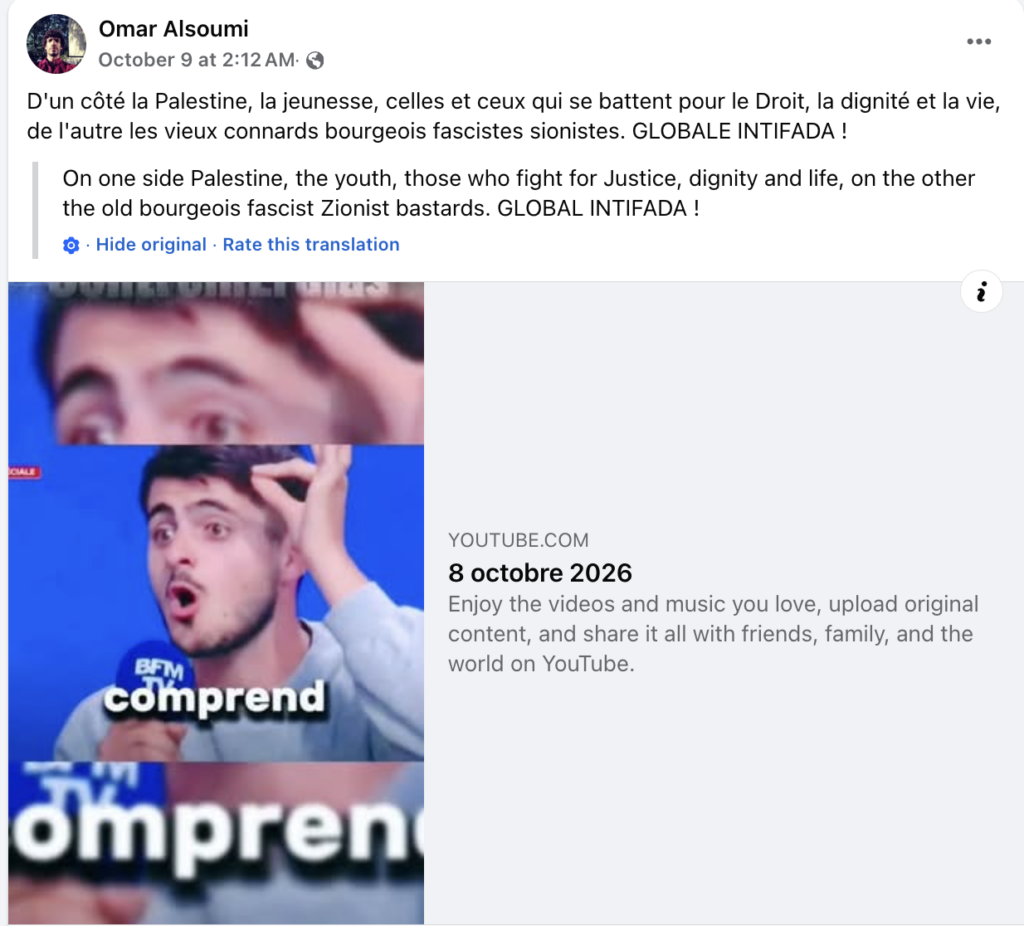
In a recent Facebook post, Alsoumi celebrated France’s unrest, declaring: “On one side Palestine, the youth, those who fight for Justice, dignity and life, on the other the old bourgeois fascist Zionist bastards. GLOBAL INTIFADA!”
Another Urgence Palestine spokesperson, Salah Hamouri, a researcher for the PFLP-affiliated Palestinian NGO Addameer, was convicted by an Israeli military court in 2008 over a plot to assassinate Rabbi Ovadia Yosef, the former Sephardic chief rabbi of Israel. Sentenced to seven years in prison under a plea agreement, Hamouri was released in the 2011 Gilad Shalit prisoner exchange.
On October 13, 2026, Israeli forces raided Addameer’s offices in Ramallah, seizing computers, documents and checkbooks. The organization is accused of receiving terrorist funds and providing legal assistance to imprisoned PFLP operatives.
By November 2024, Urgence Palestine was capable of drawing thousands onto the streets. That month, it organized a major demonstration in Paris against an event associated with Israeli Finance Minister Bezalel Smotrich.
In April 2025, then-Interior Minister Bruno Retailleau initiated proceedings to dissolve the organization. In a letter to Alsoumi, Retailleau accused Urgence Palestine of inciting violent acts, including against Jewish people, and promoting armed struggle.
Yet the organization remained active.
In August 2026, Urgence Palestine joined three other major pro-Palestinian organizations in calling for an entire month of demonstrations and direct action across France in October, coinciding with the third anniversary of the Hamas attacks.
And as France’s school protests escalated, Urgence Palestine successfully connected the student movement with Palestinian activism.
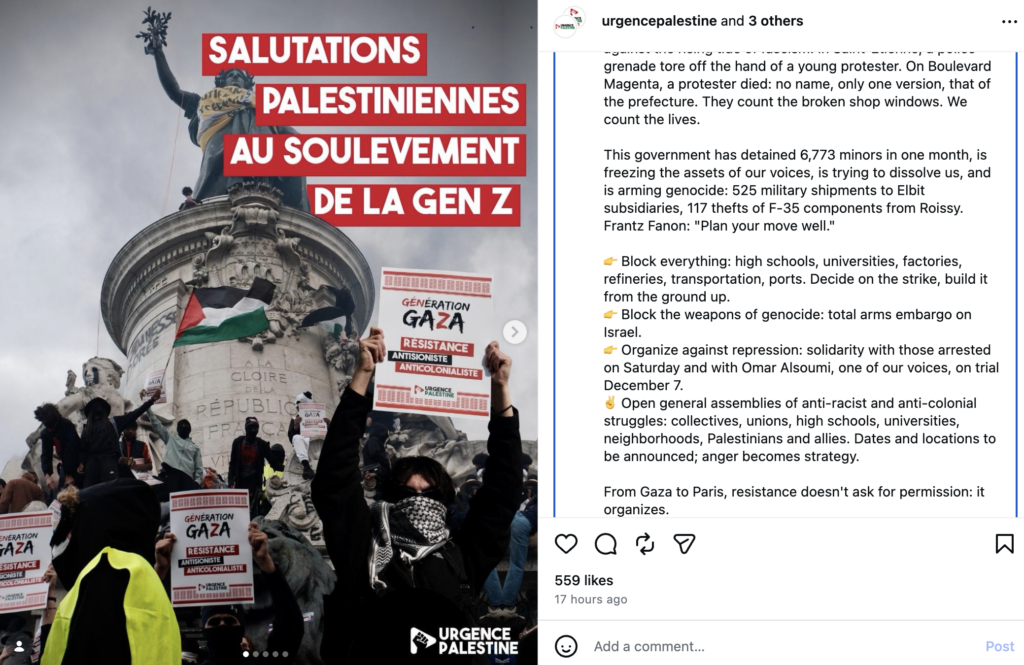
Its members have participated in the school demonstrations carrying Palestinian flags, while the organization has encouraged young people to turn the wider demonstrations into pro-Palestinian rallies.
CAPJPO–EuroPalestine: Promoting the Protests as France Burned
The Coordination des Appels pour une Paix Juste au Proche-Orient, also known as CAPJPO–EuroPalestine, traces its origins to the early 2000s and is closely associated with anti-Israel extremist Olivia Zémor.
It has spent more than two decades promoting anti-Israel boycotts, demonstrations and international solidarity campaigns, with connections extending to the American activist group CODEPINK, which was listed among the international supporters of a EuroPalestine-backed event in Paris in 2014.
Earlier this year, a Paris court convicted Zémor of glorifying terrorism over articles published on October 7 and 8, 2023, immediately following Hamas’s atrocities in Israel.
She received a two-year suspended prison sentence, five years of electoral ineligibility and registration on France’s judicial database of terrorist offenders.
Police also arrested her husband and EuroPalestine vice-president, Nicolas Shahshahani, in a separate investigation into alleged glorification of terrorism over remarks made at an October 2025 demonstration.
One of Zémor’s defense lawyers was Elsa Marcel, a prominent activist associated with the revolutionary socialist organization Révolution Permanente.
On October 15, Marcel appeared alongside Révolution Permanente’s Anasse Kazib and Le Poing Levé spokesperson Alexis Durey at an organizing meeting in Saint-Denis to discuss how the student demonstrations could develop into a much wider movement ahead of October 17.
Meanwhile, EuroPalestine itself was actively promoting the demonstrations.
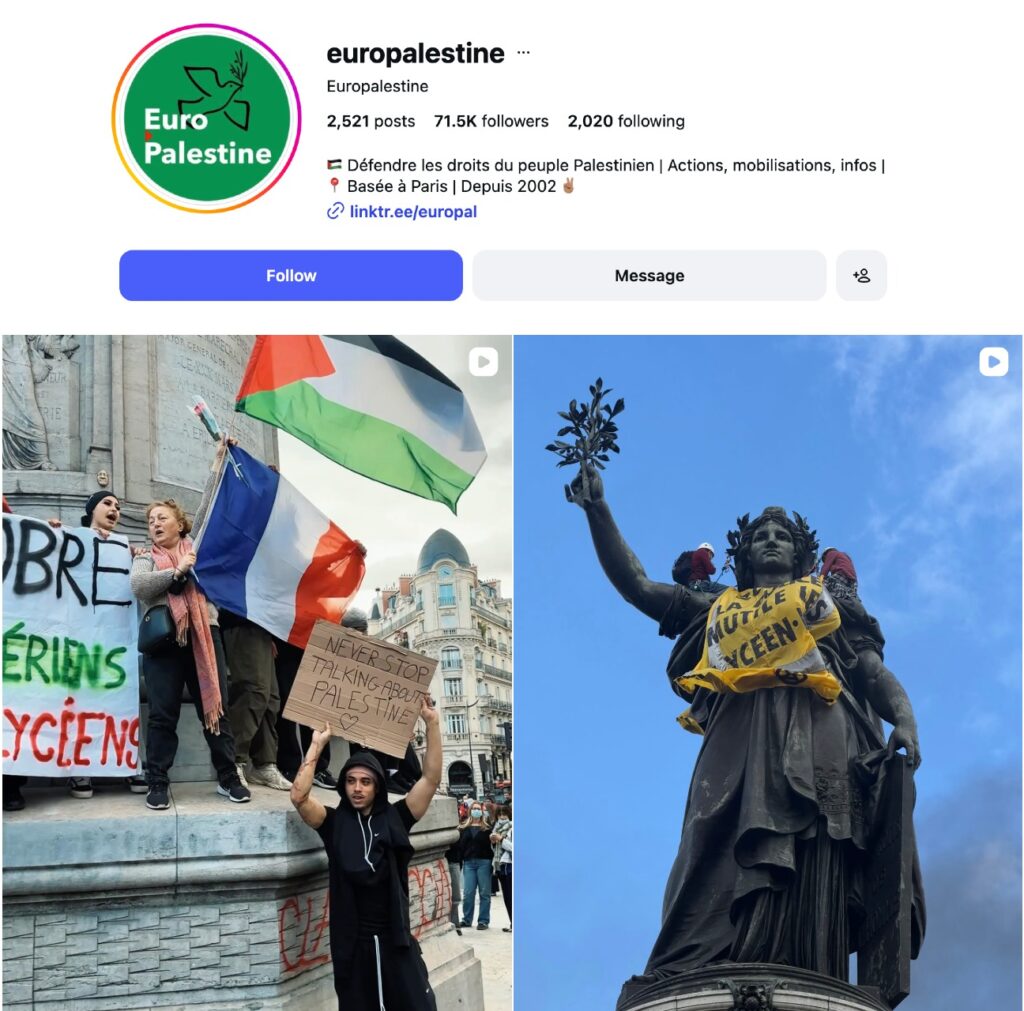
On October 14, it published an article titled “Bravo les lycéens!” (“Bravo, students!”), celebrating the student protests and publishing photographs highlighting Palestinian flags and placards.
The article invited more public demonstrations the following Saturday, which was the same day that France experienced its worst rioting in years.
EuroPalestine’s website publicized demonstration arrangements for that day, including a gathering at Paris’s Place de la République and another at Place Bellecour in Lyon.
Both cities subsequently witnessed widespread disorder.
Even as the scale of the destruction became clear, EuroPalestine continued celebrating. On October 18, it published photographs of Palestinian flags at demonstrations and an article emphasizing their prominence across the country.
Union Juive Française pour la Paix: From Gaza Campaigns to France’s Riots
Founded in Paris in 1994, the Union Juive Française pour la Paix (UJFP) is another veteran anti-Israel activist organization, with activities stretching back nearly three decades.
UJFP has been deeply involved in the Boycott, Divestment and Sanctions (BDS) movement, campaigning for economic, cultural, sporting and academic boycotts of Israel.
Its activists have participated in the wider “Nuit Debout” anti-government protest movement, demonstrating that its involvement in broader left-wing political mobilization predates the current unrest by a decade.
According to NGO Monitor, UJFP received €18,000 from a French government agency in 2016 for an anti-racism initiative involving educational materials and public meetings. According to NGO Monitor, UJFP used the grant to promote anti-Israel messaging, including comparisons between Zionism and Nazism.
In February 2018, the French government confirmed that it had initiated proceedings to recover the money, finding that the videos departed from the project’s approved purpose by promoting allegations of French state racism. It also ordered UJFP to remove references to government support.
Following October 7, 2023, its activities intensified.
According to minutes from UJFP’s own January 2024 general meeting, the organization experienced a surge in membership, including a large rise in donations as it made Gaza the central focus of its activities.
By October 2026, UJFP was further extending its activism into a domestic protest movement.
On October 5, its website advertised a demonstration scheduled for the following day at Place de la République in support of the protesting students.
The same day, it also publicized a solidarity gathering outside the Bobigny criminal court for Ritchy Thibault, co-founder of the radical activist collective Peuple Révolté and spokesperson for Pour une Écologie Populaire et Sociale (PEPS).
Thibault had been detained following a speech at a demonstration in Saint-Denis over alleged incitement to commit a criminal offense, specifically his calls to set fire to the Élysée Palace, make October 17 a thousand times worse than the Yellow Vest protests and launch a revolution.
Parti des Indigènes de la République: Gaza, Immigration and the “Student Revolt”
The Parti des Indigènes de la République (PIR) provides one of the clearest examples of an organization explicitly connecting Palestinian activism to France’s domestic unrest.
Its origins date to 2005, with its formal establishment as a political party in 2010. Long before October 7, PIR presented French domestic politics through an anti-colonial framework, linking issues of immigration, policing, racial discrimination and international conflicts, including the Israeli-Palestinian conflict.
During the 2014 Gaza conflict, PIR activists supported pro-Palestinian demonstrations in Paris, including the controversial July 19 march in Barbès that proceeded despite a police ban.
That approach has continued into the current unrest.
On September 29, 2026, as student demonstrations spread across France, PIR published a statement declaring unconditional support for protestors. It has continued publishing posts to its social media feed that encourage continued mobilization.
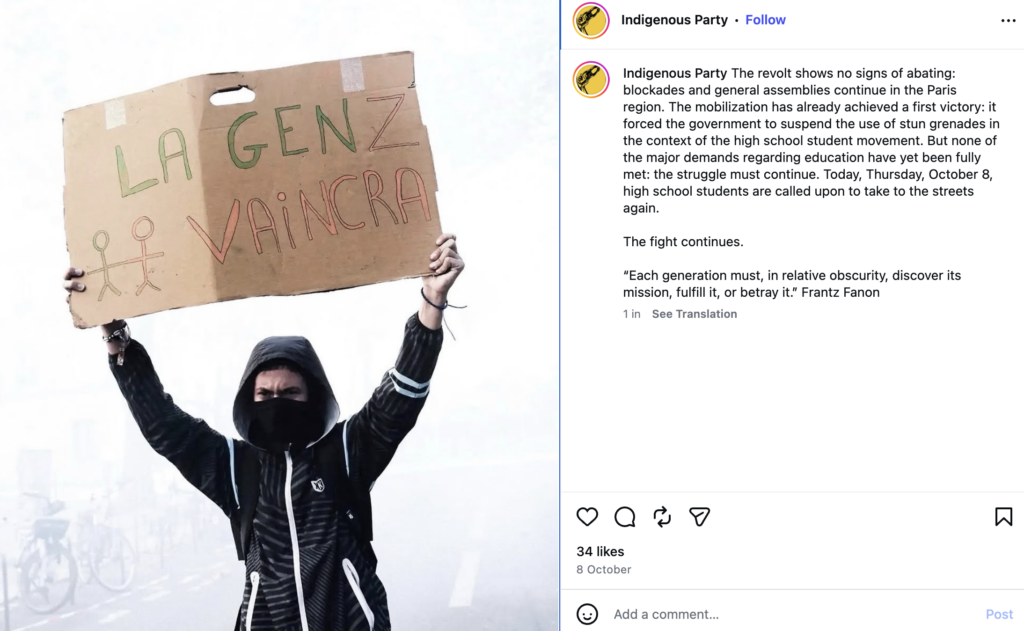
The organization said that three years of Gaza-related activism had made the Palestinian cause intertwined with French unrest, specifically citing Palestinian flags and Free Palestine posters at demonstrations.
An October 4 statement described the “students” taking part as belonging to a “generation Gaza,” and demanding the release of people arrested.
Association France Palestine Solidarité: Decades of Extremism, a New Protest Movement
The Association France Palestine Solidarité (AFPS) is one of France’s longstanding and established pro-Palestinian organizations.
Formed in 2001 through the merger of two older associations, AFPS has historically maintained a network of local branches engaged in demonstrations, lobbying, fundraising and anti-Israel campaigns.
Following October 7, AFPS was increasingly active in nationwide Palestine demonstrations and developed further joint campaigns with organizations that had emerged in response to the war.
This month, it helped organize a national month of action against arms transfers to Israel alongside Urgence Palestine, BDS France and Stop Arming Israel France.
On October 17, as demonstrations across France descended into serious disorder, its Blois branch published a statement explicitly supporting demonstrations and highlighting the appearance of Palestinian symbols at them.
BDS France: Turning Anti-Israel Into Organized Action
BDS France formally launched its national campaign in 2009, following Israel’s Operation Cast Lead in Gaza. Its early activities included organizing boycotts of Israeli products, protesting at retailers, and campaigning against Israeli participation in cultural and commercial events.
Its own archives describe a national organizing meeting in October 2009 involving approximately 150 activists from across France, including representatives of AFPS, UJFP and the New Anticapitalist Party.
After October 7, BDS France continued its campaigns against Israeli companies, cultural institutions and commercial relationships, emphasizing military trade and calls for sanctions.
In October 2026, it became one of the principal organizers of the nationwide month of action alongside AFPS, Urgence Palestine and Stop Arming Israel France.
A major launch meeting took place at the Bourse du Travail in Paris on October 1.
Speakers advertised for the event included BDS France organizer Imen Habib, AFPS president Anne Tuaillon and Urgence Palestine spokesperson and convicted PFLP terrorist Salah Hamouri, alongside trade unionists and politicians from the Communist Party, the Greens and La France Insoumise.
The campaign included coordinated demonstrations, the distribution of leaflets and actions directed at companies involved in military commerce with Israel.
Stop Arming Israel France: From October 7 to Nationwide Blockades
Established in November 2023, Stop Arming Israel France’s declared purpose was to respond to a call from Palestinian trade unions to halt the supply of arms to Israel.
Within a year, however, the organization had expanded its alliances well beyond the Palestinian cause, joining Guerre à la Guerre (“War on War”), a coalition bringing together radical-left, antiwar and anti-Israel groups.
Its published membership roster includes Urgence Palestine, Samidoun, Action Antifasciste Paris-Banlieue, Le Poing Levé, Contre Attaque and Palestine Action France, among others.
In August 2026, it joined AFPS, BDS France and Urgence Palestine in announcing October’s month of nationwide action, attracting support from more than 50 organizations.
As France’s school protests escalated, the group was pursuing a coordinated campaign of demonstrations and disruptive actions.
On October 8, its Telegram channel circulated an urgent appeal for activists to gather at Charles de Gaulle Airport to prevent a shipment of military components destined for Israel.
By mid-October, the organization was reporting more than 30 actions across France and urging supporters to organize further mobilizations, including events that were not publicly announced in advance.
Its activities reveal a network capable of organizing coordinated actions nationwide, sharing resources and mobilizing activists through alliances with some of the same radical-left organizations involved in France’s wider unrest.
The Red-Green Alliance In Action
The connections between France’s pro-Palestinian activist organizations and its revolutionary left run deep.
Together, they form an overlapping network of political parties, student unions, “antifascist” movements and radical-left organizations, many of which have spent years collaborating on campaigns against Israel, the French state and the wider Western political order.
Take Guerre à la Guerre (“War on War”), the radical antiwar coalition mentioned earlier.
Its published membership roster includes Stop Arming Israel France, Urgence Palestine, PFLP-linked Palestinian NGO Samidoun, the revolutionary student organization Le Poing Levé, Action Antifasciste Paris-Banlieue, Contre Attaque and Palestine Action France.
A June 2025 joint demonstration appeal reveals an even broader network. Alongside the coalition’s members were BDS France, UJFP, the Nouveau Parti Anticapitaliste (NPA), Révolution Permanente, La France Insoumise (LFI) and several other left-wing organizations.
These were not isolated groups occasionally appearing at the same protests. They were publicly coordinating campaigns and mobilizing supporters around common political objectives.
The relationships also extend to individual activists.
For example, Ritchy Thibault, the Peuple Révolté co-founder arrested this October, had previously received public support from LFI, the NPA, the Fédération Syndicale Étudiante (FSE), Peuple Révolté and PEPS while facing allegations of threatening President Emmanuel Macron and politician Jordan Bardella.
Among the individual signatories were Omar Alsoumi of Urgence Palestine, Révolution Permanente’s Anasse Kazib and Ariane Anemoyannis, a spokesperson for Le Poing Levé.
Then there is Elsa Marcel, the Révolution Permanente activist who defended EuroPalestine president Olivia Zémor in her terrorism-glorification case.
On October 15, Marcel appeared alongside Kazib and Le Poing Levé spokesperson Alexis Durey at an organizing meeting in Saint-Denis, with the stated aim of transforming the demonstrations into a much wider movement ahead of October 17.
In the days leading up to that date, Révolution Permanente and Le Poing Levé called for a “semaine rouge,” or “red week,” aimed at extending the unrest into workplaces across France.
Their activists visited transport depots and railway stations, including Paris’s Gare de Lyon, distributing leaflets and urging workers to join the mobilization.
Meanwhile, on October 14, the NPA published a statement titled “17 octobre: révolte générale” (“October 17: General Revolt”), accusing authorities of attempting to divide the movement by distinguishing casseurs, those engaged in destruction, from protesters carrying placards.
The NPA rejected any distinction between those engaging in destruction and other demonstrators, arguing that different forms of struggle were complementary, united against capitalism and the government.
The following day, LFI published a nationwide guide to the October 17 demonstrations, calling on supporters to participate and announcing that its parliamentary representatives would be joining them across France.
All this as previous demonstrations had already descended into violence, destruction and arrests.
Then came October 17.
According to an assessment by French intelligence officials, two overlapping movements played a significant role in the violence: the “ultragauche,” encompassing so-called antifascist, anarchist and anarchist-autonomist groups, and the “extrême gauche radicale,” which includes organizations such as the NPA and Révolution Permanente.
Even after the destruction, radical activists have continued to defend the political significance of the unrest.
On October 20, Révolution Permanente’s Anasse Kazib published an article discussing the looting and destruction, portraying the scenes as expressions of political anger against capitalism and calling for that anger to be channelled into a nationwide general strike.
And these networks extend well beyond France.
In January 2023, Samidoun coordinated an international campaign demanding the release of imprisoned PFLP leader Ahmad Sa’adat.
Its published organizational roster included CODEPINK alongside UJFP, CAPJPO–EuroPalestine, Révolution Permanente, several AFPS branches, NPA affiliates and French antifascist organizations.
The connections are undeniable: shared activists, coordinated campaigns, international alliances and revolutionary organizations openly seeking to transform unrest into a bigger and more coordinated attack on the French state.
The evidence establishes that organizations with longstanding anti-Israel connections helped broaden and mobilize the protest movement, even as France experienced serious disorder.
For the revolutionary activists involved, Palestine is not the only cause. It is part of a much wider struggle against Israel, capitalism and the West.
And for those seeking to overthrow the existing order, France’s burning streets are not the culmination of their revolutionary campaign. They’re just the beginning.
Liked this article? Follow HonestReporting on Twitter, Facebook, Instagram and TikTok to see even more posts and videos debunking news bias and smears, as well as other content explaining what’s really going on in Israel and the region. Get updates direct to your phone. Join our WhatsApp and Telegram channels!
© Divuach Ne’eman R”A, 2025