Key Takeaways
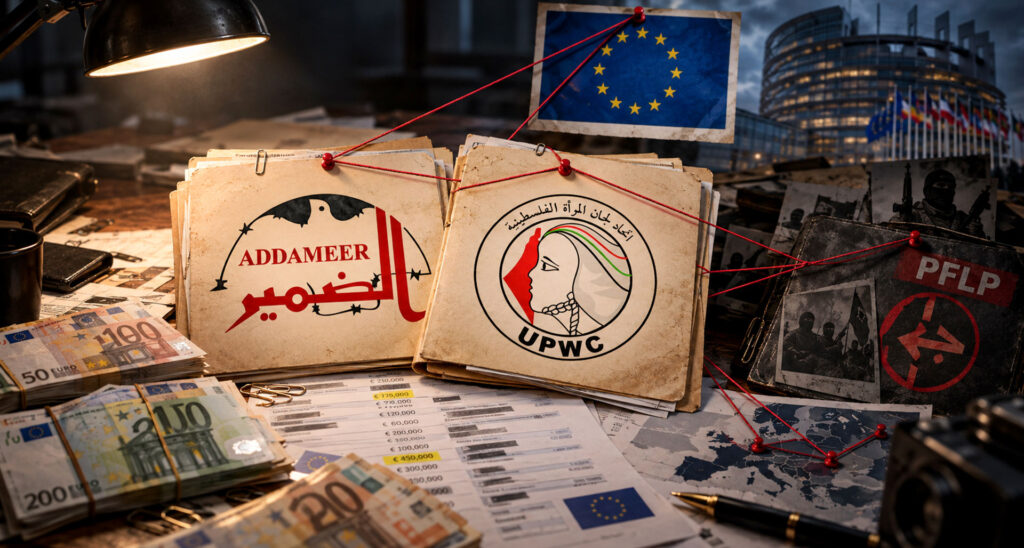
- Terror Ties: Israel raided two Palestinian NGOs with extensive documented connections to the PFLP terrorist organization through their leadership, staff, and activities.
- European Funding: European governments have provided millions in public funding to these organizations, including after Israel designated them as terrorist groups.
- US Sanctions: Washington sanctioned Addameer in 2025 over its PFLP ties, yet European funding continued and UPWC remains unsanctioned.
Israeli forces entered the center of Ramallah on Tuesday and searched the offices of two Palestinian organizations: the Addameer Prisoner Support and Human Rights Association, and the Union of Palestinian Women’s Committees (UPWC). According to AFP journalists at the scene, soldiers took documents and furniture from Addameer’s former headquarters. Israel had already shut that building in August 2022, and the soldiers put the closure order back up on its front door.
The IDF explained its actions by stating on X that Addameer is funded with terror money and provides legal assistance to PFLP terrorists in prison. It described the Ramallah raid as one of two operations against illegal “charities” that had served as offices for Hamas and the PFLP. Five operatives were arrested across the two operations.
Al Jazeera called the raid the latest act in an “Israeli campaign of aggression against Palestinian civil society organizations.” Human rights groups are expected to describe it as harassment and criminalization.
But the questions they should be asking are: Who are these organizations, and who is funding them?
The PFLP Connection
To understand these organizations, we must first examine their connections to terrorism. In October 2021, Israel’s Defense Ministry designated Addameer and the Union of Palestinian Women’s Committees (UPWC) as terrorist organizations. In August 2022, it ratified that decision, describing both as “branches of the Popular Front for the Liberation of Palestine.”
The Popular Front for the Liberation of Palestine (PFLP) is a Palestinian Marxist-Leninist terrorist organization founded by George Habash in 1967. It became notorious for its campaign of international aircraft hijackings during the late 1960s and 1970s. The United States, European Union, Canada, and Israel all designate it as a terrorist organization.
Its violence did not end with the hijackings. In 2001, PFLP operatives assassinated Rehavam Ze’evi, an Israeli cabinet minister, at a Jerusalem hotel. In 2019, a PFLP cell carried out the bombing near Dolev that murdered 17-year-old Rina Shnerb and wounded her father and brother.
The connections between the PFLP and the two organizations are not confined to Israel’s intelligence assessments. They can also be traced through their founders, leadership, employees, and public activities.
Addameer
Addameer, Arabic for “conscience,” was founded in 1991 and describes itself as a legal aid organization for Palestinian prisoners. Its connections to the PFLP stretch from its founding to its staff.
Its founder and former chairman, Abdul-Latif Ghaith, was barred from traveling abroad in 2017 and 2019. Israel’s interior minister said Ghaith was a PFLP activist with ties to the group’s operatives overseas.
Khalida Jarrar served as Addameer’s vice-chair until 2017. A senior PFLP figure, she was elected to the Palestinian Legislative Council on its list in 2006. In 2019, after the murder of Rina Shnerb, the Shin Bet named her as head of the PFLP in the West Bank, responsible for its activities, including terror attacks. She was sentenced to two years for her PFLP role, although prosecutors lacked evidence to convict her over its armed activity.
She was not the only board member with that history. Mahmoud Jiddah served 17 years in an Israeli prison for grenade attacks on Jerusalem civilians in 1968. Bashir al-Khairi, described by CNN as head of the PFLP’s political bureau, was convicted of terror offenses in 1969 and served 15 years. In 2021, Jarrar, al-Khairi, and another Addameer employee stood on the PFLP’s electoral slate.
The pattern continues among staff. NGO Monitor has documented the overlap between Addameer’s employees and the PFLP for more than a decade. Ayman Nasser, coordinator of its legal unit, admitted PFLP membership in military court in 2013. Former accountant Samer Arbid was indicted for commanding the cell that murdered Rina Shnerb. Salah Hamouri, an Addameer researcher and lawyer, had been convicted of plotting to assassinate Rabbi Ovadia Yosef. The PFLP called him “comrade.”
Addameer documentation officer Sumoud Sa’adat, daughter of imprisoned PFLP leader Ahmad Sa’adat, celebrated Ze’evi’s assassination as a heroic operation in 2016. On October 7, 2023, as Hamas was murdering Israelis, she posted that freedom was inevitable.
The question of the PFLP has been put to Addameer directly. In 2012, when it applied for consultative status at the UN Economic and Social Council, the United States asked it to clarify its affiliation with the group. The committee deferred the application four times. In 2013, the application was closed. Addameer never answered.
Union of Palestinian Women’s Committees
The Union of Palestinian Women’s Committees (UPWC) was founded in 1980. It says it empowers Palestinian women and runs kindergartens in poor West Bank communities. But its connections to the PFLP also begin with its founding.
The academic Simona Sharoni has written that UPWC was founded by women who favored the PFLP’s platform. One of them, Maha Nassar, helped found the PFLP’s organization at Birzeit University, served as UPWC’s president, and sat on the PFLP’s Central Committee. When UPWC eulogized her, it placed her alongside Dalal Mughrabi, who led the 1978 Coastal Road massacre in which 38 Israeli civilians, including 13 children, were murdered.
The leadership has not changed direction. In July 2017, Israel arrested Khalida Jarrar alongside Khitam Saafin, UPWC’s chairwoman, in an operation the Israeli army said targeted PFLP activity. Addameer itself reported both arrests. The PFLP’s own statement counted Saafin among its leaders and activists. She was arrested again in 2020 and indicted in 2021 for holding a position in an outlawed organization.
According to the PFLP, UPWC’s vice president, Suhair Khader, sits on its Central Committee. In 2018, Khader described UPWC as the PFLP’s “feminist framework.” UPWC’s coordinator in Rafah, Samira Abdel-Alim, is, according to the PFLP, its head of women’s affairs.
Others have reached the same conclusion. Fatah lists UPWC as a PFLP “affiliate.” An audit commissioned for USAID described it as the PFLP’s women’s organization.
The connections extend beyond its leadership. UPWC’s kindergartens are named after Ghassan Kanafani, a PFLP spokesman. When Israeli forces searched a UPWC office in 2012, they reportedly seized posters of George Habash and 60 children’s T-shirts bearing Kanafani’s name. At a 2017 graduation, preschoolers appeared in military uniforms holding PFLP signs. In 2018, UPWC marked the fortieth anniversary of Dalal Mughrabi’s “martyrdom.”
In 2017, the Israeli movement Women Wage Peace marched alongside Palestinian women. UPWC called for the march to be stopped and those responsible investigated and prosecuted, according to its statement quoted by NGO Monitor. A women’s organization sought the prosecution of women for taking part in a peace march.
Washington’s response
On June 10, 2025, the US Treasury sanctioned Addameer, stating that it “has long supported and is affiliated with the PFLP.” Treasury also said that in the spring of 2022, Khaled Barakat of Samidoun, who was already under US sanctions, worked with the PFLP to send money to Addameer. The sanctions followed a request made in February by the Zachor Legal Institute, co-signed by 44 other groups.
According to UN special rapporteurs, the sanctions froze Addameer’s bank accounts, shut its premises and digital platforms, and forced all of its staff to resign.
UPWC has not been sanctioned, however it carries the same Israeli designation and has the same PFLP ties. When the Treasury acted on Addameer, Zachor urged it to expand its focus to the other groups it had identified. The Treasury has not acted against UPWC, and it should.
The Money Behind the Organizations
Neither organization is transparent. According to NGO Monitor, Addameer has not published its income since 2014, and UPWC publishes no financial information at all. What we know comes from donors’ records, compiled by NGO Monitor in its backgrounder and profiles of Addameer, UPWC, and Spanish public funding. The money is overwhelmingly European.
Addameer’s donors include:
- Ireland: €75,000–€81,000 annually through Irish Aid from 2018 to 2022, then €100,000 in both 2023 and 2024, totaling €598,250.
- Switzerland: CHF 393,390 from 2018 to 2020, including CHF 135,763 in 2020.
- The Basque Government: €799,362 from 2019 to 2021 through Mundubat, with Addameer, UPWC and DCI-P as implementing partners. It also gave Addameer €150,000 directly in 2021 and €78,000 in 2024.
- Barcelona City Council: €120,000 annually from 2019 to 2022, then €160,000 in 2023, through Paz con Dignidad. Another €160,000 went to Paz con Dignidad in 2024 for prisoner protection.
- San Sebastián: €50,000 for a 2024–2026 project run by SODePAZ and Addameer.
- Valencia’s regional cooperation agency: an undisclosed grant through Mundubat for an Addameer project running from February 2025 to January 2026.
UPWC’s donors include:
- The European Union: €699,236 from 2017 to 2019, shared among five Palestinian organizations, four tied to the PFLP.
- The Basque development agency:€184,252 from 2018 to 2019 and €716,058 from 2023 to 2025 for a Gaza mental-health project, both through Mundubat.
- The Provincial Council of Gipuzkoa: €39,999 from 2021 to 2022, through Mundubat.
Earlier Addameer donors include Norway, Denmark, Sweden, the Netherlands and Germany’s Heinrich Böll Foundation. Israel’s Ministry of Strategic Affairs estimated that Addameer received nearly €2 million in European public funding between 2013 and 2019.
Two points stand out. First, Spain. Barcelona, San Sebastián, Navarre, Gipuzkoa and the Basque Government have funded these organizations through NGOs such as SODePAZ, Paz con Dignidad and Mundubat. Barcelona’s 2024 grant was titled “Protection of Palestinian political prisoners in a context of criminalization,” presenting the terror designation as grounds for further funding.
Second, the timing. Valencia’s grant ran from February 2025 to January 2026, and San Sebastián’s until 2026. Addameer was under US sanctions for more than seven months of the Valencian project. There is no public record that either grant was withdrawn.
When Evidence Isn’t Enough
In July 2022, nine EU countries, including Ireland and Spain, challenged Israel’s terrorist designations, saying the evidence was insufficient. The UN agreed. Both organizations deny PFLP links.
Ireland and Spain are also the two countries whose money features most heavily above.
Much of Israel’s intelligence is classified, but the case does not depend on it. The public record includes Jarrar’s PFLP role, Addameer’s report of Saafin’s arrest, Fatah’s description of UPWC and its campaign against the Women Wage Peace march. NGO Monitor has documented much of this. The US Treasury also sanctioned Addameer.
Spain offers a comparison. No Spanish municipality would fund a prisoner charity whose former vice-chair was a senior ETA leader, yet Spanish governments fund Addameer and defend its work as human rights advocacy.
The burden of proof also lies with the funders. Governments spending taxpayers’ money must show their grantees are clean. It is not Israel’s job to prove otherwise.
Tuesday’s raid has been reported as an attack on civil society. It was the enforcement of an Israeli designation. The question is why public bodies in Dublin, Vitoria-Gasteiz, San Sebastián and Valencia have kept funding these organizations.
Israel has designated both organizations, and Washington has sanctioned one. European governments have kept funding them.
Liked this article? Follow HonestReporting on Twitter, Facebook, Instagram and TikTok to see even more posts and videos debunking news bias and smears, as well as other content explaining what’s really going on in Israel and the region. Get updates direct to your phone. Join our WhatsApp and Telegram channels!
© Divuach Ne’eman R”A, 2025