Key Takeaways:
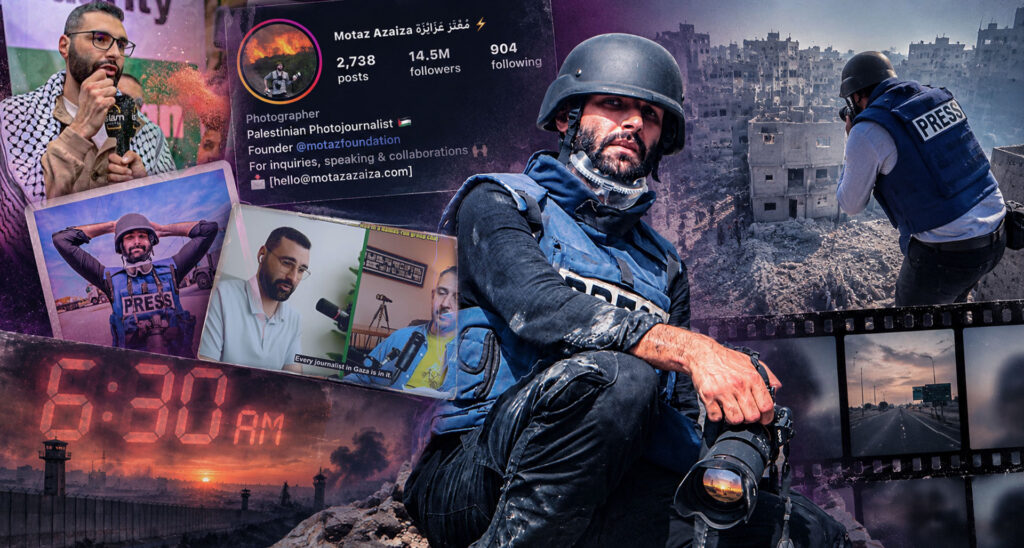
- Azaiza says he went out with his camera at 6:30 AM on October 7 and intended to head toward Erez. The initial Hamas rocket attack began at 6:29. His interview does not explain why, at almost exactly the moment the attack began, he chose the Gaza-Israel crossing as his destination.
- He says he followed a Qassam vehicle, photographed Israeli captives and deliberately withheld some of what he recorded.
- He says Gaza journalists lowered their cameras or deleted material when Palestinians criticized Hamas, while acknowledging that his own camera initially concentrated on Israel rather than anger toward Hamas.
As a veteran professional photojournalist, I have spent much of the past three years looking at photographs from Gaza — Who took them, where they stood, what they put in the foreground, what appeared behind the subject, what was cropped out, what the caption told us, where the picture went next.
With his remarks in a September 3 Arabic-language podcast interview, Motaz Azaiza has now added another question: What never left the camera?
Azaiza became one of the world’s most recognizable photographers of the Gaza war. His photographs and videos reached millions. World Press Photo describes him as an award-winning Palestinian photojournalist whose images achieved global recognition. TIME included him among its 100 most influential people of 2024.
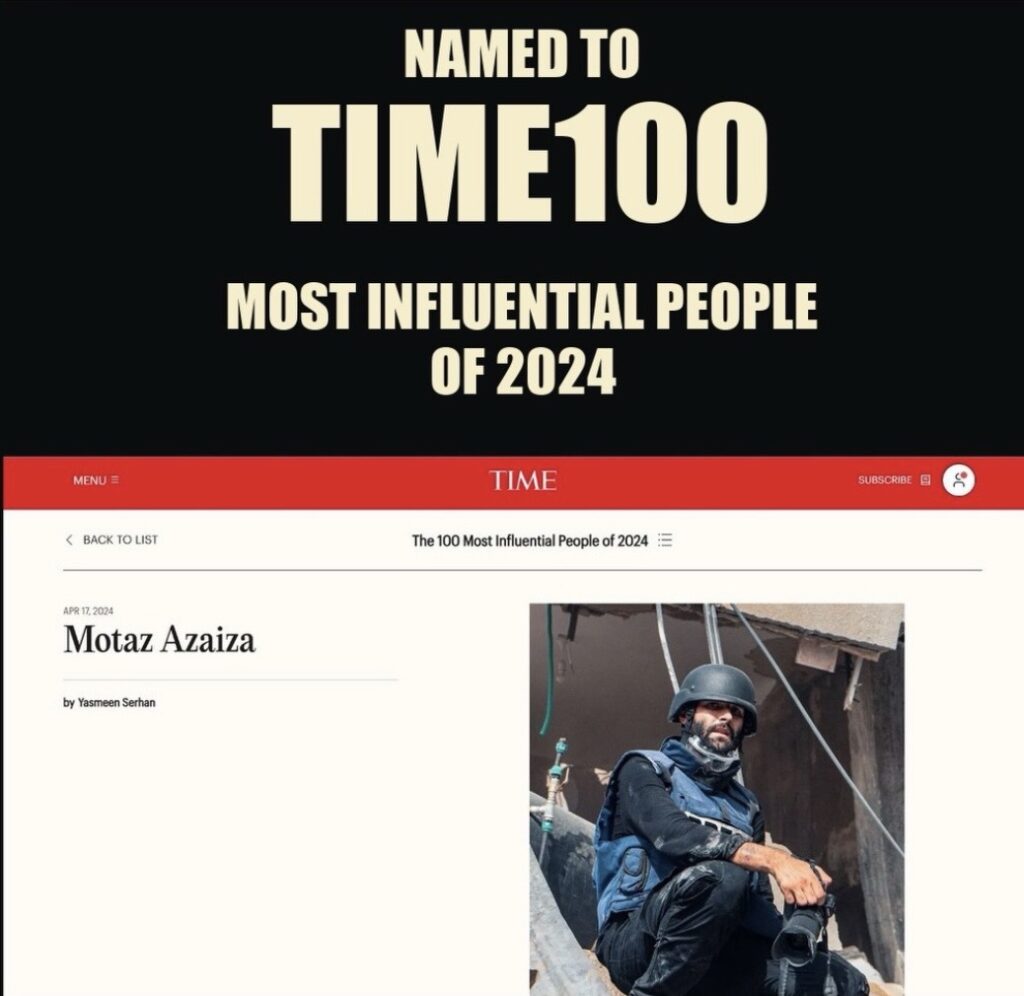
Azaiza’s prominence makes recent admissions about Gazan photojournalists’ conduct all the more important to analyze. During his September 3 interview with Ahmad Biqawi on the Taqarob podcast, Azaiza reveals the practices and conduct of his colleagues, and raises as many questions as it answers about the trustworthiness of Gazan media sources.
October 7, 6:30 AM
During the interview, Biqawi asked Azaiza when he went out with his camera on October 7. His answer is precise: “October 7th, 6:30 AM.”
The initial Hamas rocket attack began at approximately 6:29 AM. The time has subsequently been used to mark the beginning of the October 7 attack in anniversary commemorations. Reuters reported from the first anniversary commemorations at 6:29 AM.
Azaiza says he went out with his camera at 6:30. Then he tells Biqawi where he intended to go: Erez Border Crossing. According to Azaiza, he took his neighbor’s son with him after offering him 50 shekels. On Salah al-Din Street, he says he encountered an Israeli vehicle and then an al-Qassam Brigades vehicle. The al-Qassam vehicle changed his plan. He followed it with his camera.
Several elements of the story deserve scrutiny. Azaiza puts himself outside with his camera at 6:30 and says his intended destination was Erez, but he doesn’t explain why he was already in the field a minute after the October 7 Massacre began, or why he was headed toward the crossing.
His recollection of 6:30 could be approximate. Nothing he says establishes that he had advance knowledge of the attack. But after nearly three years examining what Gaza photographers were doing on the morning of October 7, that combination of time, camera and destination cannot simply be passed over. A photographer has told us where he intended to take his camera at almost exactly the moment the attack began.
I want to know why, and international news outlets should be similarly curious.
The Pictures We Didn’t See
Azaiza’s conduct later in the day was also instructive about the broader decisions he and his Gazan peers made, and the implications for the information coming out of the Gaza Strip. The photojournalist continued his story, relating that he encountered Israeli captives in Hamas vehicles. He followed behind and filmed. Biqawi eventually asks him where he published those scenes. Azaiza answers: “I didn’t publish them.”
The Gazan journalist explained that people visible in his images could potentially be identified by Israel. He did not want his pictures to result in harm to them. Later in the exchange, he returns to the point. He had filmed people around the captives. He withheld the photographs.
Every photographer edits. We edit when we choose a lens. We edit when we move five meters to the left. We edit when we press the shutter. We edit again when we decide which frame to transmit. Sometimes there are perfectly legitimate reasons for withholding an image. Protecting a vulnerable source is an obvious example.
Azaiza described photographs from one of the most consequential news events of this century. The camera recorded something. The photographer decided the audience would not see it. That decision is part of the photographic record too.
I’ve spent most of my working life in photojournalism, and I know how much of the story is decided before a picture ever reaches an editor. Put the camera down, delete the frame or simply don’t send it, and the picture desk never gets to make that choice. You’ve made it for them. Azaiza knows this as well as I do.
When the Camera Goes Down
The decision not to publish photographs of the hostages and their captors was not an isolated incident, but based on Azaiza’s descriptions, part of a broader practice for protecting Hamas and other malicious actors in Gaza. In the interview, Azaiza talks about filming Palestinians who criticized Hamas. At approximately 1:56:56, he describes an instance where a civilian criticized Hamas while news cameras were rolling. According to Azaiza, the reaction among other journalists was to stop filming.
“I’ve never seen a journalist from Gaza publish something like this,” said Azaiza.
Then he describes what happened when somebody said something critical of Hamas: The cameras went down. Material might be filmed and subsequently deleted. Azaiza includes himself in this story. He acknowledges that he too was initially hesitant about publishing criticism of Hamas. He describes fear of confrontation and the consequences that could follow.
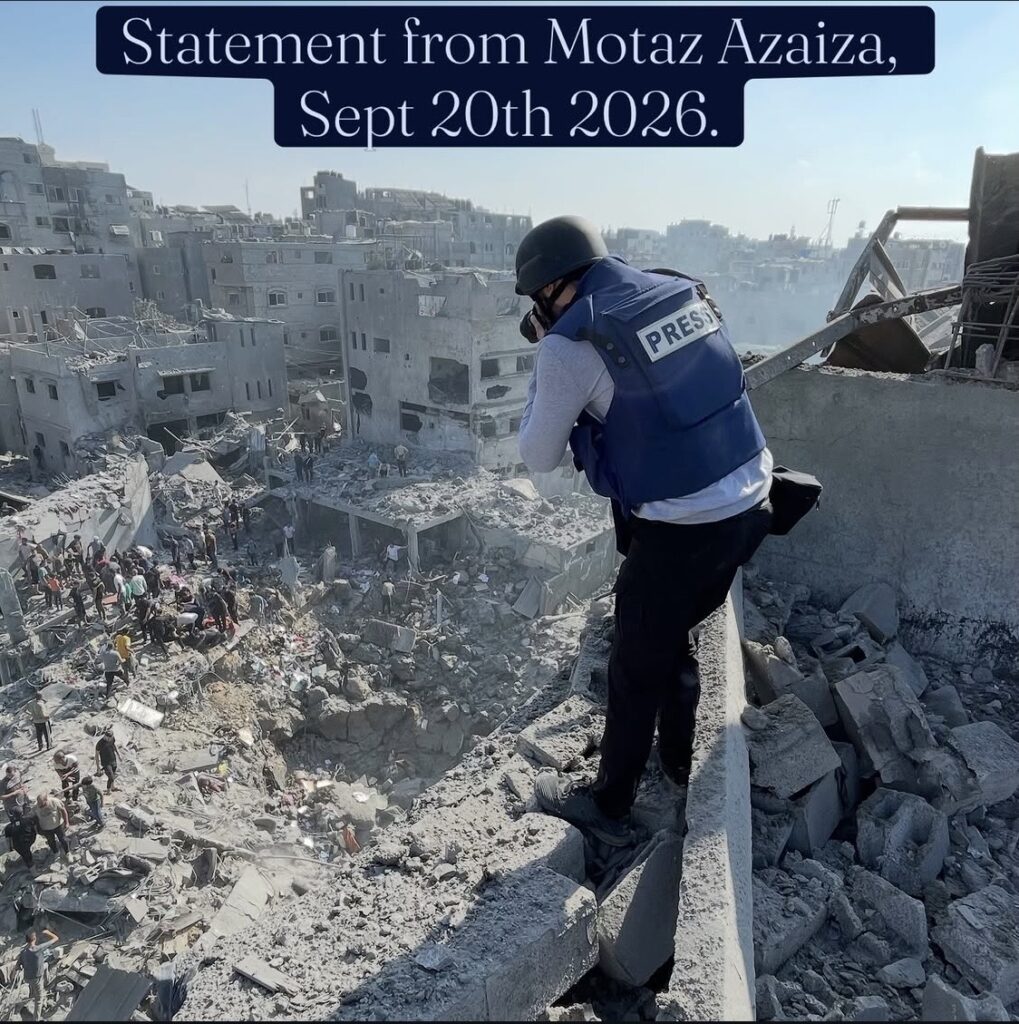
That deserves some care. Journalists operating under Hamas rule in Gaza faced pressures that editors sitting thousands of miles away did not. The photographic consequence is what interests me: The camera came down. An international audience consuming photographs from Gaza had no way of knowing what happened after it did.
Where He Pointed His Own Camera
Where Azaiza chose not to point his camera is as interesting as where he chose to point it. Azaiza talked about what interested him photographically during the early period of the war — He says he wasn’t concentrating on anger toward Hamas and its government, but on Israel. That is an extraordinary admission from a photographer whose imagery became part of the world’s visual understanding of Gaza.
The admission of focus on Israel doesn’t make Azaiza’s photographs false, but it does tell us what he was looking for. Every photographer does this to some degree. You walk into a situation and make decisions immediately. Turn left. Turn right. Wide lens. Long lens. Get closer. Wait for somebody to enter the frame. And sometimes you simply don’t point the camera at something.
The problem arises when the resulting body of photographs is consumed internationally as though it represents everything that was there to be seen. Azaiza is telling us something else was there: Anger at Hamas. And initially, his camera wasn’t particularly interested in it.
“Lift The Bird”
One tiny moment in the interview caught my attention, probably only because I’ve spent my life around photographers. Azaiza recounted in the interview that he once encountered a displaced Palestinian carrying a bird. He sees the potential picture.
“Lift the bird so I can photograph it,” he tells the man.
The man complies. While Azaiza is photographing him, something unexpected happens. The man criticized Hamas. Azaiza said he published the material and was subsequently contacted by people demanding that he remove it.
I have tried to locate the original bird photograph or video and have not yet found material I can independently establish is the incident Azaiza describes. So for now, his interview is the evidence. The instruction itself should not be exaggerated. Photographers interact with subjects. Asking someone to lift an object does not automatically turn a photograph into a fake. But the photograph didn’t simply happen. Azaiza saw the ingredients of an image and arranged them. Any experienced photographer understands exactly what that means.
The more interesting part came from the subject. That wasn’t arranged, and according to Azaiza, that was the part that caused trouble.
In the same way Azaiza chose to shape his pictures, he also detailed that Hamas was involved in shaping narratives beyond individual videos and photographs.
SMART
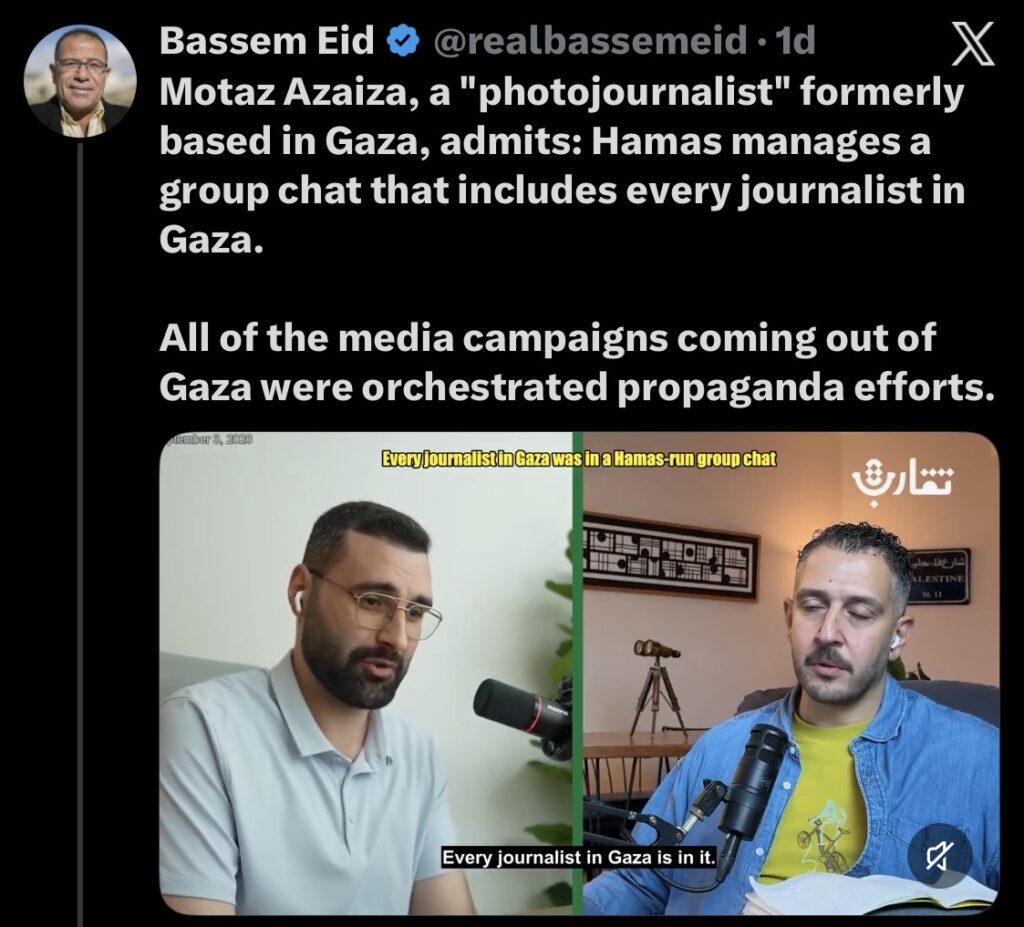
Azaiza provides one more glimpse into the environment in which Gaza’s journalists operated. When Biqawi asked whether media campaigns against Azaiza were spontaneous, Azaiza said they were not. He described SMART as affiliated with Hamas and said that “All the journalists in Gaza are there.”
Hamas media were represented and connected the group’s administration with the Rafah Crossing media operation. Azaiza said he himself had been added to SMART. His claim that every Gaza journalist belonged to SMART is his own and has not been independently established.
SMART itself is real. Palestinian sources document the Smart Media Center operating in Rafah years before October 7, providing media services and bringing journalists together. That network deserves an investigation of its own. We are doing that separately, but more broadly this revelation shows the extent to which the Gaza media landscape is controlled.
The Picture Desk Never Saw the Whole Contact Sheet
International news organizations depended heavily on Palestinian photographers to show the world Gaza during this war. That dependence makes the photographer’s decisions unusually important.
A foreign picture editor can examine what arrives. They cannot examine photographs that were never transmitted. They cannot select footage that was deleted. They cannot hear criticism recorded after a camera has been lowered. They cannot know what remains on somebody else’s memory card.
We now have something we didn’t have when I started examining Gaza imagery nearly three years ago. One of its most internationally celebrated photographers is describing some of those decisions himself. He said he was outside with his camera at 6:30 on October 7. He said he intended to head toward Erez. He said he followed a Qassam vehicle. He said he photographed Israeli captives. He said some of those images were withheld. He said Gaza journalists lowered their cameras when Palestinians criticized Hamas. And he said that, initially, his own camera was focused elsewhere.
For nearly three years, I have been examining what Gaza’s photographs show. Motaz Azaiza has now told us something about what they didn’t. The missing pictures were part of the story too.
Liked this article? Follow HonestReporting on Twitter, Facebook, Instagram and TikTok to see even more posts and videos debunking news bias and smears, as well as other content explaining what’s really going on in Israel and the region. Get updates direct to your phone. Join our WhatsApp and Telegram channels!
© Divuach Ne’eman R”A, 2025