Key Takeaways:
- The World Food Programme announced that it was cutting food assistance in Gaza, and the media coverage of the issue highlighted the lack of scrutiny applied to such organizations
- Hamas’ taxation of merchants, the United States funding cuts, Hamas aid theft, reports declaring an end of famine, and the role of other aid organizations are not explored in an interview by NPR.
- A halo effect hangs about self-declared humanitarian organizations, but they deserve the same degree of criticism and review as any other organization.
The acting executive director of the UN World Food Programme announced last week that the agency is cutting food assistance to 500,000 Palestinians in Gaza and 200,000 in the West Bank. WFP says it needs a staggering $450 million over six months to restore the cuts.
The announcement was a test for English-language media. A UN agency was publicly short of money, in a region where the causes of hunger are contested. Proper journalistic scrutiny would demand exploring the details of the aid rupture: Who cut the funding? Who has been stealing the food? Is Gaza actually in a famine? Who else is feeding people there?
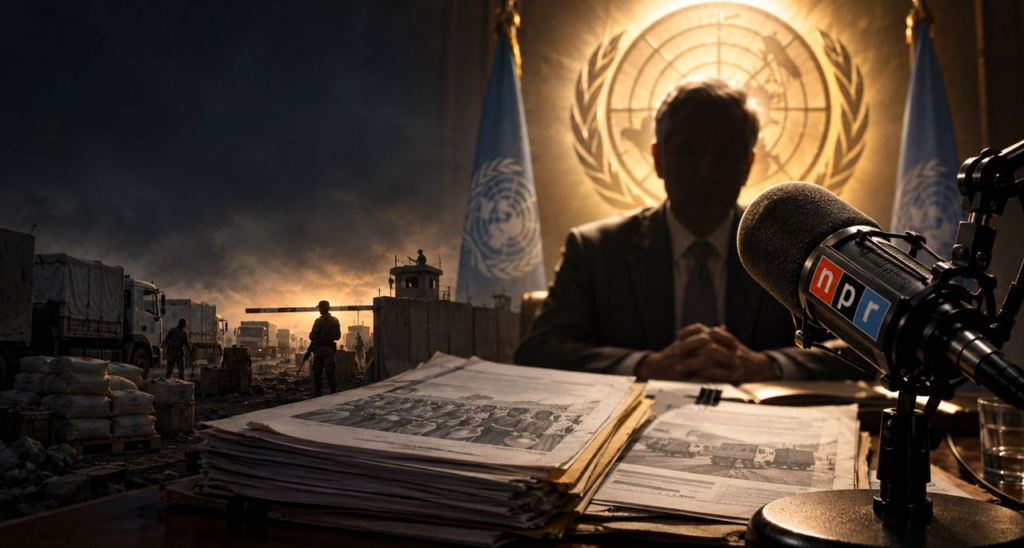
Major outlets like Reuters and AP covered the story, and the answers were softened, buried, or missing. The sharpest failure was NPR. Last Saturday night’s All Things Considered, host Joel Rose gave acting WFP head Carl Skau nearly six minutes of unchallenged airtime during which he asked the obvious questions, accepted the non-answers, and moved on. The result is a textbook halo effect: a UN official laundering causal facts, amplified by a public radio format that is supposed to interrogate them.
Let’s walk through the five things nobody said on that tape, and what each omission conceals.
Who Stopped Paying
Rose asks directly: “Why is the funding falling short of the need?” Skau’s answer, in full: “It’s a massive operation.” That is the entire answer on tape. Rose moves on.
In a nearly six-minute interview on a $450 million funding gap, the words United States, donor retreat, and contribution reduction never appear. The United States is WFP’s largest donor by a very wide margin. Per WFP’s own 2024 contribution ledger, the US gave $4.45 billion that year, out of a total of $9.76 billion. In 2025, that fell to roughly $2 billion. More than half of WFP’s largest single contribution, from its largest donor, gone in a year. The US announced an $800 million grant in June 2026, which is a partial restoration, not a return to the baseline.
The one time the US is named in the NPR piece is in Rose’s intro, as the broker of the Israel-Hamas ceasefire. Never as the donor whose withdrawal is the reason this interview exists.
What Israel Actually Did and Why
Skau refers to the suspension of commercial goods into Gaza as, in his exact words, “some disagreement around taxation for commercial goods.” Rose does not push on it.
Three days before the NPR interview aired, Israel’s COGAT publicly explained the suspension in specifics. Deputy spokesperson Lt. Daniel Kantorovich said that “The merchants don’t want to bring goods into Gaza.”
The reason, as COGAT laid out and multiple outlets reported on October 15 and 16, was that Hamas’s Ministry of Economy was demanding 10,000 shekels per truck, roughly $3,200. The head of Gaza’s own private truckers union, Nahed Sheheiber, confirmed the demand on the record. Hamas security personnel reportedly arrested a merchant’s son for refusing to pay.
That is not “some disagreement around taxation.” That is a US-designated terrorist organization levying extortionate tolls on humanitarian trucks, which is why Israel pulled the plug on the channel. Skau turns Hamas extortion into a vague procedural noun. Rose lets him.
Who Stole the Food
In a nearly six-minute interview with the head of the UN food agency, on a story about hunger in Gaza, nobody says the word Hamas in the context of aid theft.
The IDF has published documents it says prove Hamas has been confiscating humanitarian aid as a matter of policy. Reporting by the Jerusalem Post, the Times of Israel, and JNS has documented that Hamas has generated roughly $500 million from humanitarian aid, which it has used to pay operatives. Gazan residents, on record, have described the aid racket, the black markets, the taxed deliveries. Even the AP piece covering the story contains a single line in paragraph twelve noting the Hamas taxation issue. NPR has none of it.
Skau speaks about the fragile situation sliding back toward famine. That crisis, to the extent it existed, was manmade. The documented, named maker is Hamas. NPR’s six-minute interview does not say so. Not Rose asking, not Skau volunteering.
What Happened to the Famine Itself
Rose’s introduction describes the situation as “more than a year since famine was declared in parts of Gaza.” That is technically true. It is also the kind of “true” that produces a false impression.
The Integrated Food Security Phase Classification declared the Gaza famine in August 2025. The same IPC officially declared the famine over on December 19, 2025. The agency that made the declaration also unmade it four months later. In the ten months since, the IPC has not declared famine in Gaza again. The current status, per the IPC’s own reporting, is “critical” food insecurity, which is a serious condition but is not famine.
Rose does not mention any of this. The audience is left with the understanding of continuous famine with fragile improvement. What’s more, HonestReporting documented the disputed methodology at the time, including follow-up Global Nutrition Cluster data that measured malnutrition rates below the 15 percent famine threshold.
Further, as morbid as it sounds, one of the three pillars of a famine declaration is 2 starvation deaths per 10,000 people per day. Hamas’s own health ministry reported just over 460 malnutrition deaths over the course of the entire war. The IPC deliberately removed one of its own goal posts to score the declaration the media had been headlining for months. None of the four pieces last week engaged with that history.
Who Else is in Gaza
Skau talks about WFP as if the agency wass the only food operation in Gaza, and Rose lets him.
But other UN partners handle water, sanitation, and non-food logistics. Israeli-coordinated supply chains move hundreds of trucks a day when the system is working, and Israel’s COGAT has already mounted winterization operations ahead of the cold weather. A listener to the NPR interview walks away thinking WFP is all there is, and if WFP is cut, Gazans are abandoned. That is not the picture. It is a convenient framing for a WFP press pitch, which is what this interview functioned as.
The Halo
Add it up. On tape, in six minutes: no US cut, no Hamas tax named for what it is, no Hamas aid theft, no end-of-famine declaration, no non-WFP operations. The pattern is erasure. And it comes from the mouth of a UN official, bestowed the halo of a do-gooder honest broker. And while Israel is not accused in words, it is left as the implied cause by elimination of every other actor. The host does not interrupt. The guest does not volunteer. The audience fills in the blank.
And while the headline and focus is on Gaza, it leaves out a wider picture. Because Palestinians are only one victim of the “funding shortfall.” Sudan reveals what the framing left out. WFP’s own October 2025 report lists six operations in pipeline-break territory: Afghanistan, the Democratic Republic of the Congo, Haiti, Somalia, South Sudan, and Sudan. Sudan has confirmed famine right now, with 25 million people in acute hunger. The Gaza slice of the WFP crisis is less than ten percent of the hungry people being cut. It is close to 100 percent of the WFP-cut coverage this week in the outlets we reviewed, including Reuters, AP and Al Jazeera. On NPR alone, Gaza got six minutes. Sudan got zero.
A UN press call is not finished journalism. A nearly six-minute interview with the head of a UN agency is an opportunity to do the follow-up work that the press release does not. NPR, this past Saturday night, did not do the work. It handed Carl Skau the microphone and ran what he said, unchallenged and uninterrupted. And the pattern that produces: when the coverage can blame Israel, it says so. When it cannot, the cause goes passive, nameless, and incomplete. That is bias in a nutshell.
Liked this article? Follow HonestReporting on Twitter, Facebook, Instagram and TikTok to see even more posts and videos debunking news bias and smears, as well as other content explaining what’s really going on in Israel and the region. Get updates direct to your phone. Join our WhatsApp and Telegram channels!
© Divuach Ne’eman R”A, 2025