Key Takeaways:
- Joe Rogan used a recent podcast episode to portray Israel’s war as an example of “evil.”
- Rogan questioned the Jewish ancestry of Ashkenazi Jews and suggested that Palestinians are the “real Semites,” while advocating for a change in the term antisemitism.
- By invoking conspiracy theories and demonizing Israel in an otherwise casual conversation, Rogan subtly reinforces such antisemitic beliefs.
Joe Rogan is no stranger to hosting problematic guests on his podcast, The Joe Rogan Experience. Until now, his roster of guests has included Roger Waters and Ian Carroll, a commentator notorious for promoting deeply antisemitic tropes. As the most-listened-to podcast in the United States, the ability to influence millions of people and spread his rhetoric is not to be underestimated.
Related Reading: Joe Rogan’s Troubling Anti-Israel Podcast Episodes
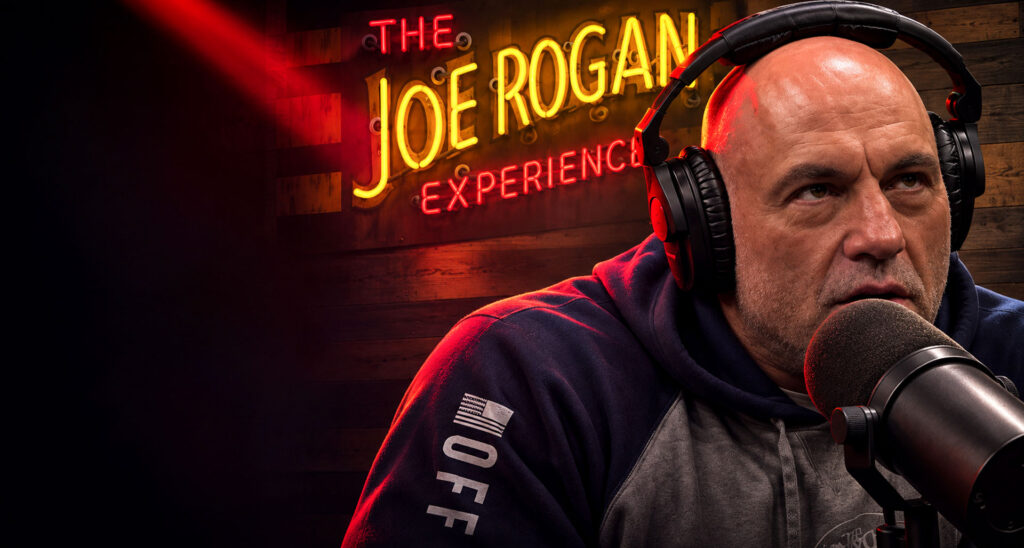
Yet it is not only who Rogan shares a stage with, but the topics he discusses on the podcast itself. In his most recent episode with comedian and author Sam Tallent, the two primarily discussed comedy, writing, and AI. But after two and a half hours of such light conversation, it was time for the conversation to turn to a subject that Rogan frequently discusses on his podcasts: Israel.
The discussion of AI’s capabilities in solving mathematical equations transitioned to discourse on how AI’s capabilities in general could lead to societal collapse, as it won’t value humans for their evil actions. Ultimately, this became the perfect opportunity for Rogan to insert how events in Gaza were the epitome of such evil, describing Israel as “launching missiles over the dirt line because these people are bad and you’re good,” meanwhile Tallent reinforced this characterization, claiming that while both sides “come from the same family tree,” they are “annihilating each other.”
Not only do the two single out Israel as an example of human depravity, but any context regarding the cause of the war, the purpose of the so-called “dirt line,” and Israel’s military objectives is left unspoken. Instead, the war is reduced to Israel “annihilating” a population, despite having some of the lowest civilian-to-combatant ratios in urban warfare as the IDF strategically targets terrorists and seeks to minimize civilian harm.
Yet the conversation does not end here. Instead, Rogan takes Tallent’s comment of shared ancestry between Jews and Muslims as an opportunity to claim that genetic testing in Israel is banned because the Jewish people living there are not the real Jews.
Rogan claims that the “reason why you can’t get genetic testing in Israel” is because “most of those people are not Semites.” What evidence does he offer to support this assertion? The existence of European Diaspora Jews.
While the largest ethnic Jewish group in Israel is Mizrahim – Jews whose Diaspora experience was in the Middle East – the places where Jews spent their time in exile do not negate the Jewish people’s historical and ancestral connection to the Levant region and the land of Israel in particular. Ashkenazi Jews, like other Jewish communities, maintained a distinct identity, religious tradition, and collective historical connection and memory to their ancestral homeland, despite generations spent living outside it.
In fact, genetic research has continuously demonstrated that Ashkenazi Jews share substantial ancestry with other Jewish communities, including Sephardi and Mizrahi Jews. A 2013 review of genetic research on Ashkenazi Jewish origins found that Ashkenazi Jews showed their greatest genetic similarity to Sephardi Jews, followed by North African Jewish populations. Another study in 2020 similarly identified shared genetic relationships among Ashkenazi, Sephardi, Mizrahi, and North African Jewish communities. In other words, Ashkenazi Jews’ European ancestry does not negate their shared Jewish ancestry or their historical connection to the Middle East or to the Jewish people.
Still, Rogan uses this age-old conspiracy about Ashkenazi Jewry to claim that “the real Semites are the Palestinians,” who he says were Jewish prior to converting to Islam. From this premise, he argues that the term antisemitism is misleading and should be better labeled as anti-Jewish to ensure it does not refer to the Jews who are “not necessarily Semites.”
Yet antisemitism was coined in nineteenth-century Europe specifically to describe hostility toward Jews, not those who are speakers of Semitic languages. Thus, the historical meaning of the term antisemitism is unrelated to whether Jews were forcibly converted, nor does such conversion make the rest of the Jewish population any less Jewish as Rogan’s premise suggests. By recasting a term for hatred of Jews as debate over who qualifies as Jewish, Rogan intentionally obscures the very prejudice it is meant to describe.
Rogan’s warping of the IDF’s war against terrorism alongside the insertion of historical antisemitism and conspiracy theories into an otherwise casual podcast conversation reveals the normalcy in which unrelated topics can be connected and redirected toward Israel and the Jews. For even when Rogan’s broader focus is not on Israel or the Jewish people, the re-introduction of these narratives in unrelated conversations displays how longstanding tropes can enter the mainstream under the guise of discussion, enabling the subtle reinforcement of the beliefs.
Liked this article? Follow HonestReporting on Twitter, Facebook, Instagram and TikTok to see even more posts and videos debunking news bias and smears, as well as other content explaining what’s really going on in Israel and the region. Get updates direct to your phone. Join our WhatsApp and Telegram channels!
© Divuach Ne’eman R”A, 2025