Key Takeaways:
- Hamas-run Gaza authorities were quick to blame Israel for the deadly sandbank collapse in Deir al-Balah.
- But their casualty accounts didn’t add up. Two people initially named among the dead were subsequently reported alive in hospital, raising questions about how the victims were identified.
- Media outlets, humanitarian organizations and UN agencies published conflicting death tolls, reinforcing longstanding concerns about the reliability of casualty information originating from Hamas-run authorities.
Four dead. Five dead. Six dead. Two women. One woman. Three children. Five children.
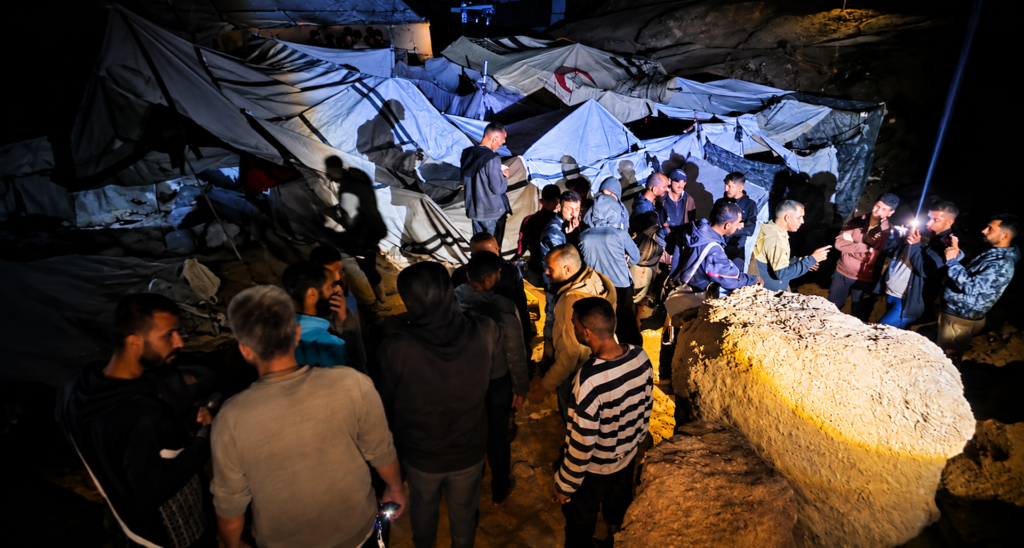
On Sunday, November 8, a sand embankment reportedly collapsed following heavy rain onto tents housing displaced Palestinians in Deir al-Balah, central Gaza, burying several people beneath sand and rubble.
Within hours, Gaza’s Hamas-run Civil Defense agency was reporting five fatalities, announcing on its official Telegram channel that its teams had recovered five “martyrs” and that rescue efforts were underway to locate “missing persons.”
A subsequent statement specified that the dead included “three children and two women,” adding that the incident came amid “catastrophic humanitarian conditions…with the onset of winter and the increased risks posed by rain and storms.”
Meanwhile, at 8:57 p.m. that evening, the Palestinian Authority’s official WAFA news agency published a casualty list naming five fatalities: Salah Nabhan, Mariam Nabhan, Reem al-Zein, Ibrahim al-Zein and Habiba al-Zein.
Tahrir Nabhan, the mother of Salah and Mariam, was identified as injured and suffering severe suffocation.
Four Hamas-Run Authorities. Four Different Accounts.
By the next morning, Gaza’s other Hamas-run ministries were seizing on the tragedy as another opportunity to blame Israel. But as their statements piled up, so did the contradictions.
On Monday, November 9, at 8:30 a.m., the Hamas-run Government Media Office issued a statement claiming four people had died, while two were missing, including women and children.
Just 11 minutes later, at 8:41 a.m., the Hamas-run Ministry of Social Development released another statement, putting the death toll back at five, with others still missing.
Then, at 11:13 a.m., Gaza’s Ministry of Education issued its own statement, identifying two of the dead as siblings Mariam Ahmad Nabhan, six, and Salah Ahmad Nabhan, eight. It repeated the death toll of five and reported additional injuries, including a female teacher and two students.
The same day, Arab News published interviews with relatives of the victims, whose account contradicted the names circulated by WAFA the previous evening.
Tahrir Nabhan was dead. Her sister Reem, previously named among the fatalities, was reportedly alive and receiving treatment at Nasser Hospital. Reem’s son Ibrahim, also listed among the dead, was being treated at at Al-Aqsa Martyrs Hospital.
The shifting death tolls issued by Hamas-run ministries, coupled with the speed at which Palestinian news agencies published conflicting accounts of the victims, offer a revealing snapshot of how casualty information emerges from Gaza: competing figures, changing identities and immediate allegations of responsibility, all circulating before even the basic facts have been established.
From Hamas Ministries’ Mouths to the Media
On November 9, Euronews reported five deaths: two women and three children.
Its source was Gaza Civil Defense spokesperson Mahmoud Basal, whom the IDF identified in June 2025 as an active Hamas operative, citing intelligence documents recovered in Gaza.
Reuters, however, reported four: a woman, her two children and another four-year-old child, and attributed the information to medics and interviewed witnesses and relatives.
UPI likewise reported four, identifying the deceased as Tahrir Nabhan, Salah Nabhan, Mariam Nabhan and Habiba al-Zein.
The Guardian’s November 9 article reported five deaths, and then separately published a video report titled “Four killed in sand embankment collapse in Gaza,” carrying Reuters’ account of one woman and three children.
The BBC’s coverage also changed, from an initial five-death account attributed to first responders to four deaths attributed to Gaza’s Hamas-run Health Ministry.
On November 9, Oxfam claimed six people had died in a press release: a mother, her two children and three other children from the same family.
The Independent repeated the figure, reporting one woman and five children dead, without identifying the additional three children.
UNICEF reported four deaths, while the UN’s humanitarian coordination office repeated five, citing the Gaza Civil Defense.
Oxfam: six. UNICEF: four. The UN humanitarian office: five.
The UK-based New Arab revised the death toll to six fatalities, naming both Reem and Ibrahim al-Zein among the dead, despite contemporaneous family accounts identifying them as critically injured.
Its description of four children, a pregnant woman and a man also contradicted its own list of names, which included two adult women.
One Tragedy. One Media Problem.
What makes this case particularly revealing is not simply the conflicting death tolls.
It is that this was an incident in which the basic facts were comparatively accessible: the collapse occurred at an identifiable location, affected two families and involved a relatively small number of victims.
Journalists interviewed surviving relatives and witnesses. Reuters photographed the aftermath and verified footage of the rescue operation.
Yet despite this, the published accounts offered four, five and six fatalities, different breakdowns of women and children, and contradictory information about whether specific people were dead or alive.
The available evidence points to four deaths: Tahrir Nabhan, her children Salah and Mariam, and her niece Habiba al-Zein. Their deaths were tragic, the apparent result of a sandbank collapse following heavy rain.
The Deir al-Balah collapse was relatively small in scale, but it perfectly illustrates a much wider problem: the international media’s reliance on casualty figures supplied by Hamas-run institutions without adequately scrutinizing their methodology or accuracy.
And if one documented tragedy involving four identifiable fatalities could produce so many conflicting accounts, what level of scrutiny is being applied to the vastly larger casualty figures routinely supplied by Gaza’s Hamas-run authorities?
The stakes become considerably greater when those figures concern hundreds or thousands of deaths, rather than a handful of victims whose names can be individually checked.
How often are names verified against medical records? How frequently are preliminary figures corrected? How quickly do media outlets update their reporting when contradictory evidence emerges?
And how readily does a claim from a Hamas-run authority become an established fact simply because it has been repeated by a Western newspaper, an international aid organization or a UN agency?
Liked this article? Follow HonestReporting on Twitter, Facebook, Instagram and TikTok to see even more posts and videos debunking news bias and smears, as well as other content explaining what’s really going on in Israel and the region. Get updates direct to your phone. Join our WhatsApp and Telegram channels!
© Divuach Ne’eman R”A, 2025