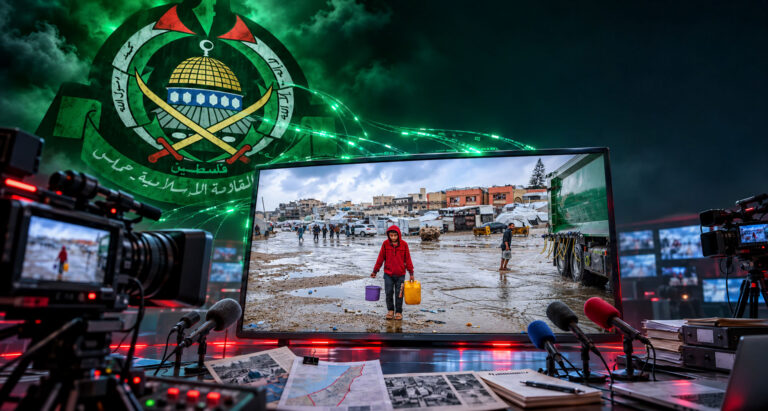
By the time you see the Palestinian woman holding her child in Al Jazeera’s video, you’ve already seen Mary holding Jesus. That order is rather important. Had Al Jazeera opened with Omar El Qattaa’s photograph from Gaza, would the Madonna have occurred to you? I’m not sure she would have occurred to me.
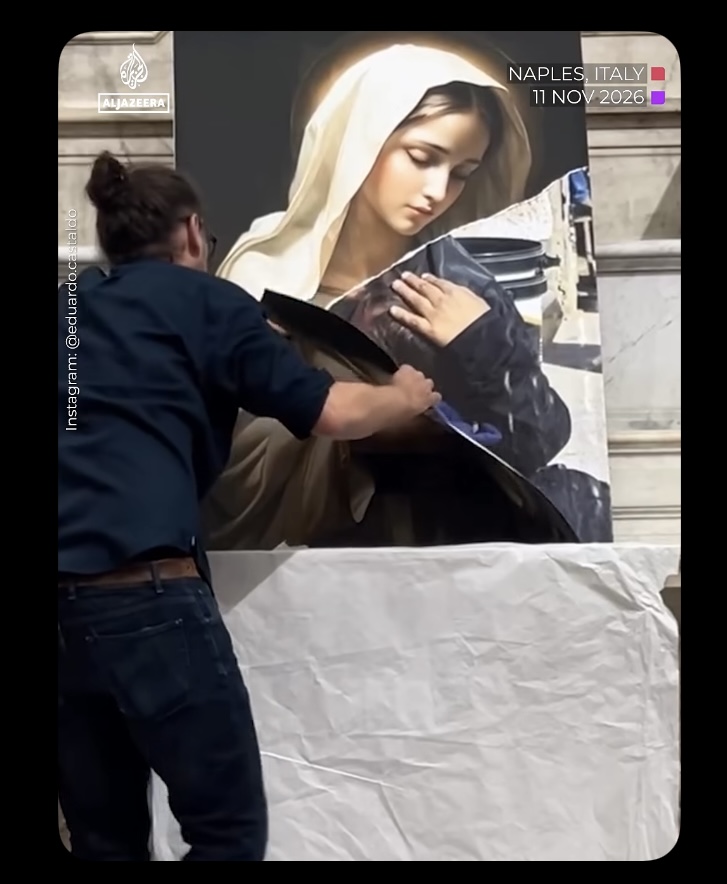
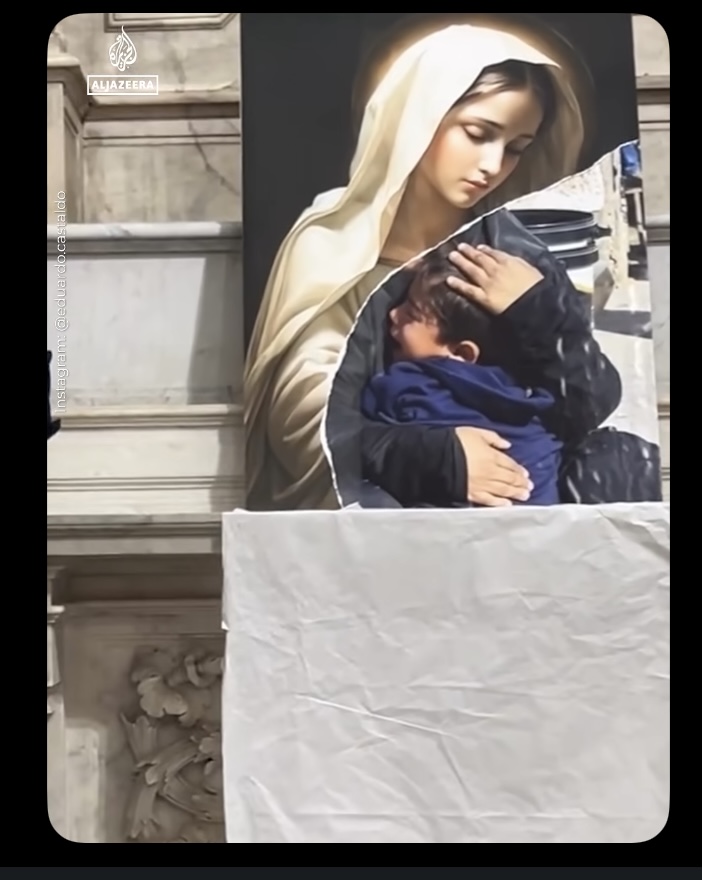
The reel was filmed in the Pappacoda Chapel in Naples, where Italian artist Eduardo Castaldo unveiled a work he calls Holy Mothers of Gaza. Castaldo takes hold of the outer picture and tears away enough of the painting to expose El Qattaa’s photograph underneath. Watch where he stops. There’s enough of the Madonna left for you to hold both mothers in view, and the camera stays there long enough for the comparison to register.
I can see why the photograph appealed to him. A mother holding her child is familiar to anyone who has ever picked up a son or daughter. It could be a woman in Gaza, in Israel, or just outside the chapel in Naples. What makes this particular mother Mary, or her child Jesus? Nothing I can see in the photograph. That association was made in Naples, and it depends on the viewer bringing to the picture a feeling for Mary and Jesus that was there long before anybody had heard of this woman or knew anything about her life.
It reminded me of the World Cup collage I wrote about in June. As the tournament got underway, digital artist Uğur Gallenkuş combined the trophy with a photograph of destruction in Gaza taken by Saher Alghorra the previous September. The photograph had no connection to the tournament until Gallenkuş put the trophy in it. Castaldo is a different artist, working with a different photographer, but I recognized the device. The soccer audience knew the trophy. A congregation in Naples scarcely needs an introduction to the Madonna.
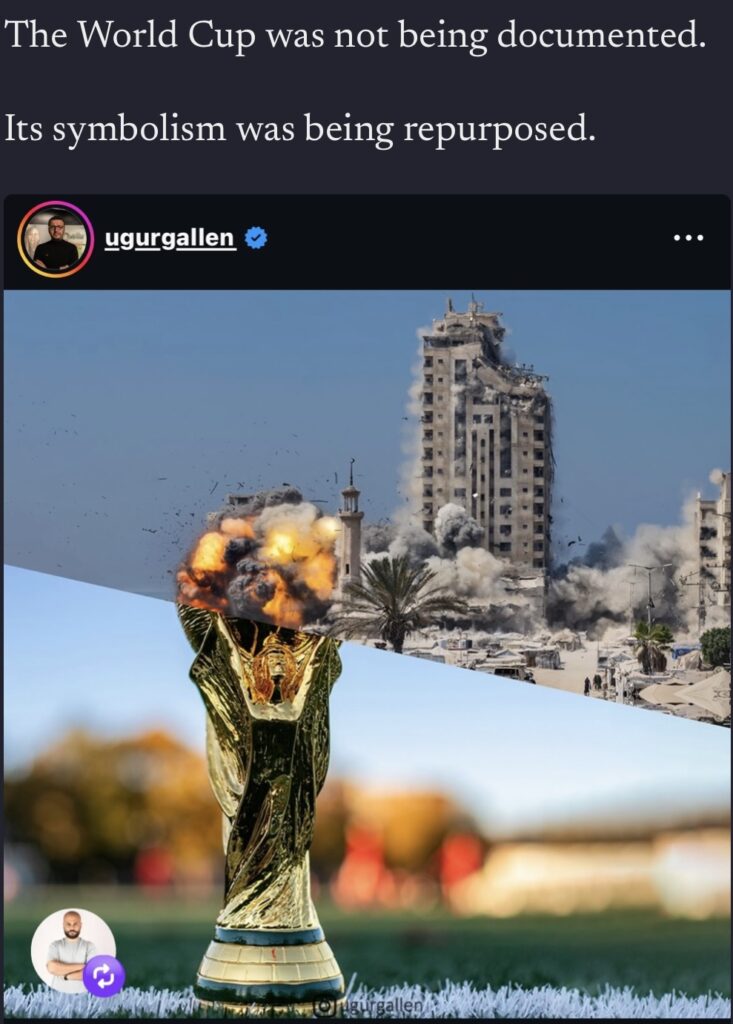
Castaldo is entitled to make that comparison. His name is on the work, and his title makes his sympathies plain. My objection is to the ease with which his interpretation passes into a news feed. Al Jazeera credits El Qattaa and identifies the installation as art. Yet I came away knowing the name of the chapel and the man who tore the paper. I still couldn’t tell you the woman’s name or what was happening to her child when El Qattaa took the picture.
That, to my eye, is what makes this such effective propaganda. The woman and child are real. So is the sympathy they command. Al Jazeera lets us watch an artist borrow the reverence people feel for Mary and Jesus and attach it to an image from Gaza. It has time to show us every inch of paper he tears away. What it never gives us is a moment with that mother and child before somebody else tells us who to see.
Liked this article? Follow HonestReporting on Twitter, Facebook, Instagram and TikTok to see even more posts and videos debunking news bias and smears, as well as other content explaining what’s really going on in Israel and the region. Get updates direct to your phone. Join our WhatsApp and Telegram channels!
© Divuach Ne’eman R”A, 2025